🧶 Yarn Calculator

Try

Visit our Etsy Shops

Pick a shop to browse. Each one opens on Etsy in a new tab.

Yarn & Materials

Crochet Hook Size Chart: US, UK & Metric Conversion

Crochet hook size chart: US letters, old UK numbers and millimeters side by side, plus steel hooks, hooks for each yarn weight and gauge fixes.

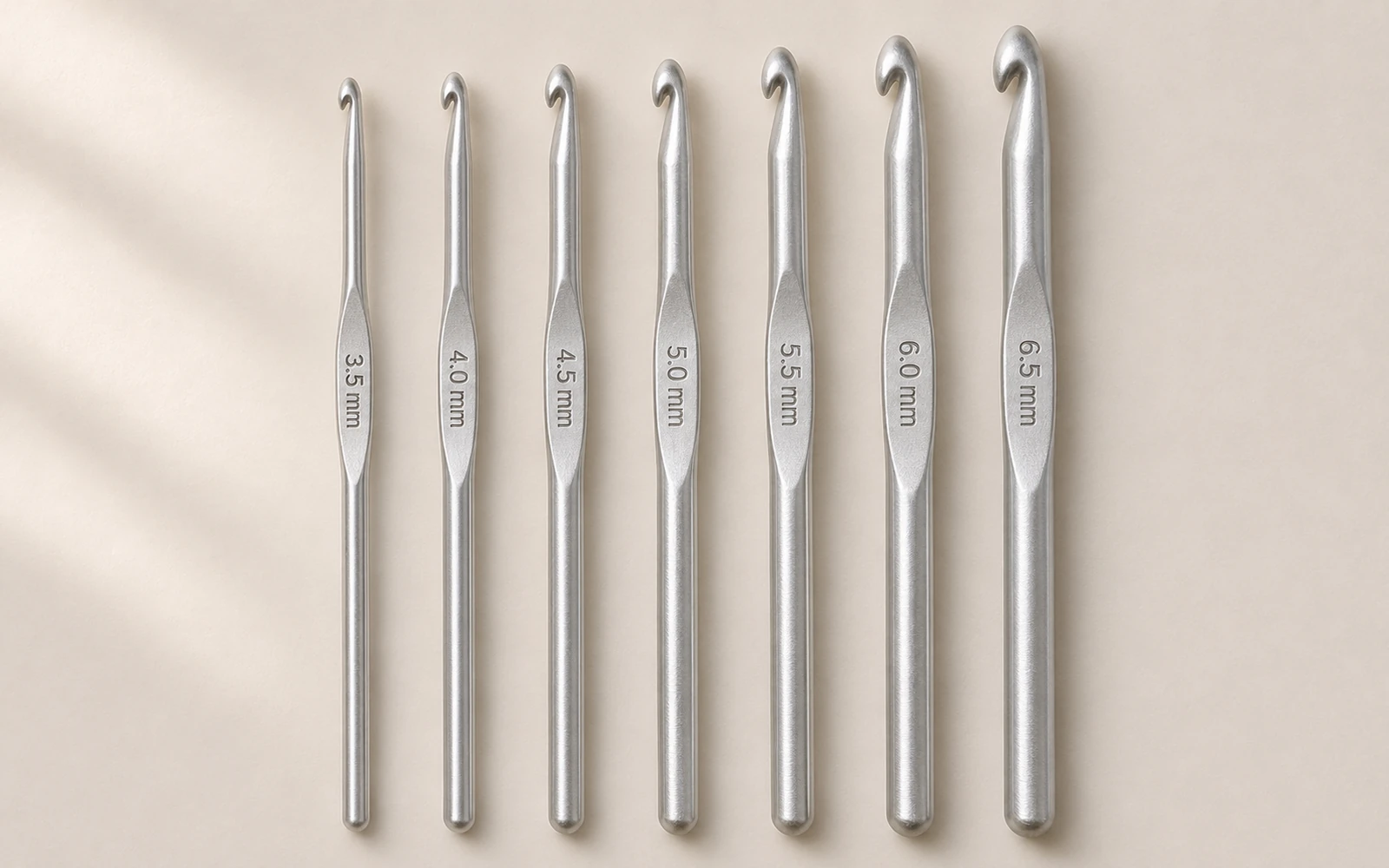
Seven aluminum crochet hooks from 3.5 to 6.5 mm in a row in size order with the size stamps readable, on a pale surface
Table of Contents
  1. How Hook Sizes Are Labeled
  2. Crochet Hook Size Chart: US, UK and Metric
  3. Steel Hooks for Thread and Lace
  4. Which Hook for Which Yarn Weight
  5. Adjust Your Hook to Match Gauge
  6. Hook Materials in Brief
  7. Key Takeaways
  8. Frequently Asked Questions

Quick answer: A crochet hook size chart matches millimeters, US letters and old UK numbers: a 5.0 mm hook is H/8 in the US and 6 in the old UK system. Millimeters measure the width of the hook’s shank, so they are the surest size to compare. Pick a starting hook by yarn weight, then adjust it by swatching.

The pattern asks for a 5 mm hook, the hook in your hand says H/8, and the old one from a relative says 6. Are those the same size, and does it matter if they are not? Every maker seems to label hooks differently.

This guide explains the three size systems, gives one chart that converts between them, covers steel hooks, pairs hooks with yarn weights, shows how to adjust a hook to match gauge, and says where charts disagree so you know when to trust the millimeters.

I go by the millimeters on the hook, not the letter. Letters and old UK numbers differ between makers, and the millimeter size is the one that tells me whether my hook matches what the pattern asked for.

How Hook Sizes Are Labeled

Crochet hook sizes come in three systems, millimeters, US letters and numbers, and old UK numbers, and all three describe the thickness of the hook. One hook can carry all three, so a pattern, a label and a handle may name the same size in different ways.

Millimeters: The Size to Trust

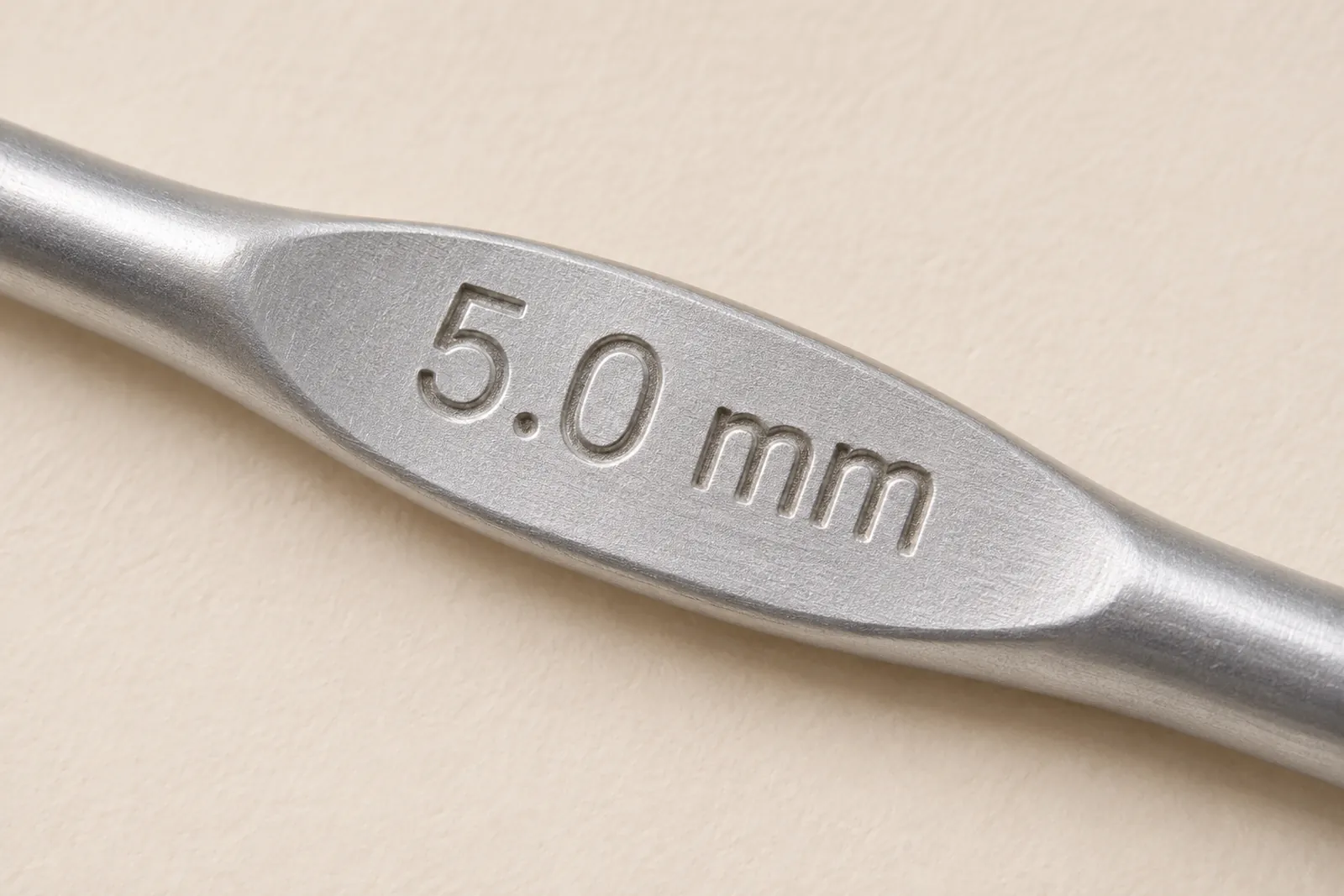
Hook size in millimeters is the width of the hook’s shank, and it sets the size of each stitch. The size is usually stamped on the flat thumb rest, as the photo below shows. Regular hooks run from about 2 mm up to 20 mm and larger, and some guides call 2.25 mm (B/1) to 9 mm (M/13) the most used range. If a pattern, a hook and a label disagree on letters, the millimeters settle it, because some guides call the metric size less ambiguous.

Crochet hook size chart basics: close-up of the thumb rest of a 5.0 mm aluminum crochet hook with the size stamped on it The size is stamped on the thumb rest: this hook is 5.0 mm.
US Letters and Old UK Numbers

US hook sizes use a letter and a number that rise with the size, while old UK hook numbers run the other way. The letters rise through the alphabet, so B is smaller than Q. A hook can show the letter and number together, such as H/8, or a number alone, such as 7 for 4.5 mm. Old UK sizes are numbers where a bigger number is a smaller hook: UK 8 is 4 mm and UK 4 is 6 mm. Letters and numbers can vary by brand and region, so go by the millimeters.

Crochet Hook Size Chart: US, UK and Metric

This crochet hook size chart converts millimeters to US letters and old UK numbers for regular hooks. The millimeter column is the one to match, and steel hooks have their own section below. Where the sources disagree, the chart shows a dash instead of a guess.

US, UK and Metric Conversion Chart

Metric (mm) US size Old UK size
2.0 mm – 14
2.25 mm B/1 –
2.5 mm – –
2.75 mm C/2 –
3.0 mm – –
3.25 mm D/3 –
3.5 mm E/4 –
3.75 mm F/5 –
4.0 mm G/6 8
4.5 mm 7 7
5.0 mm H/8 6
5.5 mm I/9 5
6.0 mm J/10 4
6.5 mm K/10½ 3
7.0 mm – 2
8.0 mm L/11 –
9.0 mm M/13 –
10.0 mm N/15 –

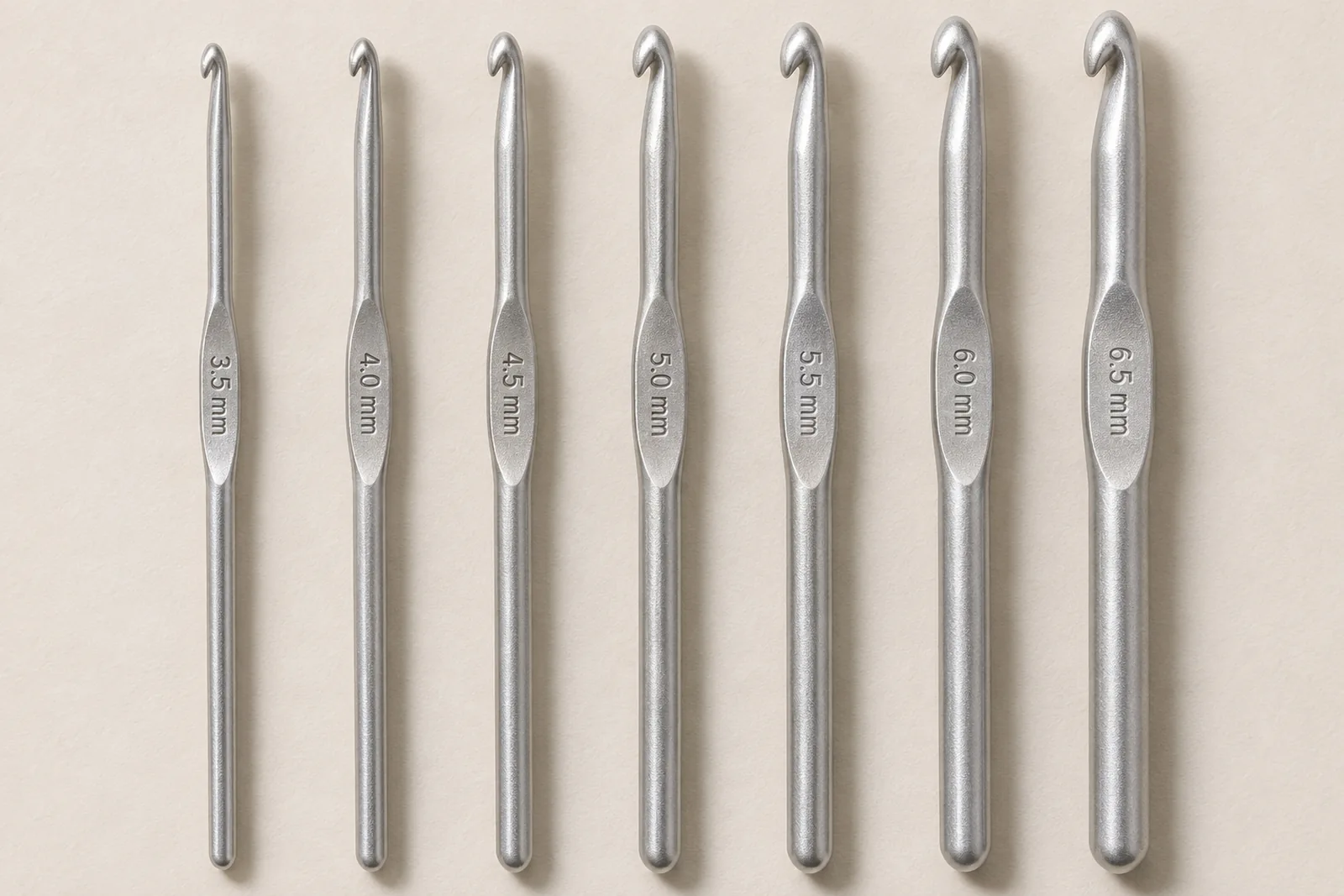
Read across a row to convert: find the millimeter size, then look to the right for the US letter and the old UK number. For example, 6.5 mm is K/10½ in the US and 3 in the old UK system. A dash means the sources do not agree or the system has no size at that point, so those cells are left empty rather than guessed. Where there is no exact match, charts give the nearest size. The 5.0 mm (H/8) hook is the one used in the photos on this page, and the photo below shows seven hooks from 3.5 mm (E/4) to 6.5 mm (K/10½) in size order. For which hook suits which yarn, see the crochet yarn weight guide.

Seven plain aluminum crochet hooks laid side by side in size order from 3.5 mm on the left to 6.5 mm on the right, each with its size stamp visible Seven hooks from 3.5 mm (E/4) to 6.5 mm (K/10½), smallest to largest.
Where Charts Disagree

Hook size charts do not always match, so go by the millimeters. Old UK numbers for small sizes differ: 3 mm is UK 10 in one chart and UK 11 in another, so the table shows only agreed numbers. Letters above 10 mm vary, with 15 mm given as P/Q or Q, so go by millimeters for jumbo hooks. A 4 mm G/6 is sometimes 4.25 mm, depending on the brand. A hook sizing gauge checks a hook against the chart. When in doubt, use the millimeters and swatch; if it is off, see how to substitute yarn.

Steel Hooks for Thread and Lace

Steel crochet hooks are the finest hooks, used with crochet thread and lace-weight yarn. They follow a numbering scale of their own, and the two sections below cover how the numbers work and when to choose one. For the wider map, see the crochet yarn and materials guide.

Steel Hook Numbers Run the Other Way

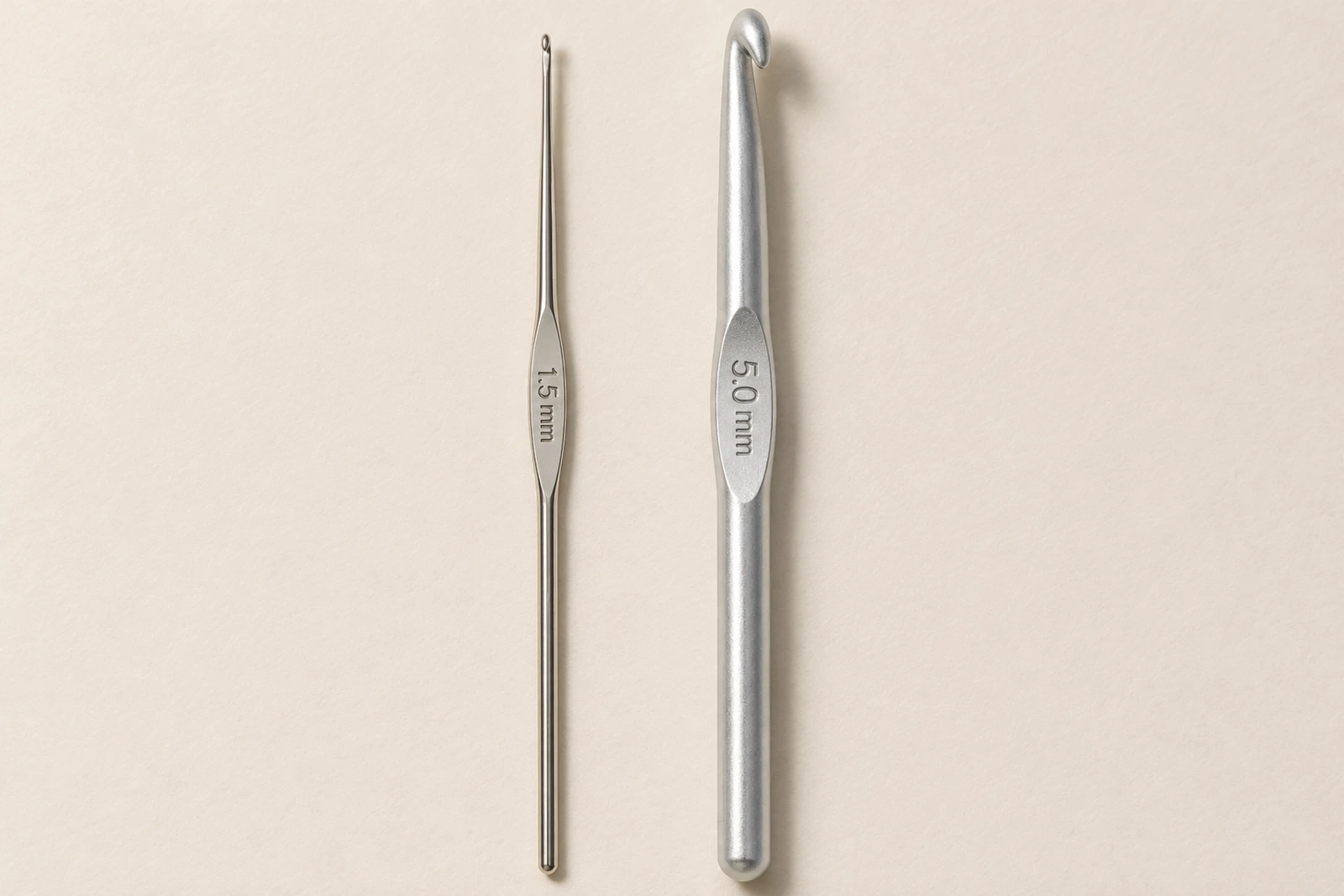
Steel crochet hook numbers run the opposite way to regular hooks: the higher the number, the finer the hook. In one guide, size 14 steel is 0.6 mm and size 5 steel is 1.75 mm. This is a separate scale from the old UK numbers in the chart above, so steel size 14 is not the UK 14 hook, which is 2.0 mm. Steel numbering varies between sources, so check the millimeters and swatch. Hooks under 2 mm are steel, and the photo below shows a steel hook beside a regular one.

A very thin steel crochet hook lying beside a thicker plain aluminum crochet hook, both with their size stamps visible A thin steel hook (left) beside a 5.0 mm aluminum hook (right).
When You Need a Steel Hook

A steel hook is the right tool for crochet thread and lace-weight yarn. Doilies and lace projects use steel hooks, and thread numbers run the other way too: a lower number is a thicker thread. The Craft Yarn Council gives 1.4 to 1.6 mm steel or a regular 2.25 mm for lace; one guide says 1.6 to 2.25 mm. See the crochet yarn weight guide for the full lace row. Some guides keep lace hooks in point protectors.

Which Hook for Which Yarn Weight

Yarn weight sets a starting hook, and thicker yarn takes a larger hook. The label and the pattern may ask for a different hook, and the pattern’s hook wins. For the full weight chart with stitch counts, see the crochet yarn weight guide.

Hook Range by Yarn Weight

Yarn weight Hook (mm) Hook (US)
0 Lace Steel 1.4–1.6 mm or regular 2.25 mm Steel 6 to 8 or B/1
1 Super fine 2.25–3.5 mm B/1 to E/4
2 Fine 3.5–4.5 mm E/4 to 7
3 Light 4.5–5.5 mm 7 to I/9
4 Medium 5.5–6.5 mm I/9 to K/10½
5 Bulky 6.5–9 mm K/10½ to M/13
6 Super bulky 9–15 mm M/13 and larger
7 Jumbo 15 mm and larger Letters vary by maker

These ranges are guidelines from the Craft Yarn Council, whose older printed charts stop at category 6. The hook on the yarn label is a starting point, and the pattern’s hook wins. For stitch counts and names, see the crochet yarn weight guide, and for the hook symbol on the band, how to read a yarn label. For the worsted hook, see worsted weight yarn. For the bigger picture of yarn, hooks and tools, see the crochet yarn and materials guide.

Choosing a Hook for a Project

A larger hook gives a more open, drapier fabric, and a smaller hook gives a tighter, firmer one. Softer items use the label’s hook or larger, and firm items use smaller. Toys and bags are often worked a size or two smaller; see how to make amigurumi. Too small a hook can split the yarn, and too large a one leaves gaps. For a first project, some guides suggest 4 mm (G/6) or 4.5 mm (7) with lightweight wool, one suggests 5 mm or larger with aran, and another 5.0 or 5.5 mm with worsted. See best yarn for beginners, crochet tools for beginners and beginner crochet patterns.

Adjust Your Hook to Match Gauge

Matching the pattern’s gauge matters more than matching its hook size, so change the hook until the swatch matches. Gauge is the number of stitches in 4 inches (10 cm), and the pattern’s hook is only a starting point. For the full swap method, see how to substitute yarn.

Swatch, Count, Change One Size

To match gauge, work a swatch, count the stitches in 4 inches, and change the hook by one size.

  1. Work a swatch in the pattern stitch with the hook the pattern names.
  2. Count the stitches and rows in 4 inches (10 cm) across the middle of the swatch.
  3. Compare the count with the pattern’s gauge. More stitches than the gauge means the fabric is too tight, so go up a hook size; fewer stitches means go down.
  4. Change the hook by one size and swatch again.

Put the other way, a swatch smaller than the pattern’s needs a larger hook. I change the hook by one size at a time and swatch again. See how to substitute yarn for the full method.

When the Hook Is Not the Fix

If the swatch will not match the gauge, check your tension and the yarn before you change the hook again. Relaxing or tightening your grip changes the stitch size, but the hook is easier to change than a habit. A yarn thicker or thinner than the pattern’s will not match, so check weight and yardage; see how to substitute yarn. Stitch count comes first and row count second, because raising or lowering the loop changes stitch height. Gauge matters for garments, but coasters and baskets need not be exact.

Hook Materials in Brief

Hook material changes how yarn glides and how the hook feels in your hand, not the hook’s size. The sections below cover each material and a quick way to check a hook’s size. For handles and ergonomic shapes, see ergonomic crochet hooks.

Aluminum, Plastic, Bamboo and Wood

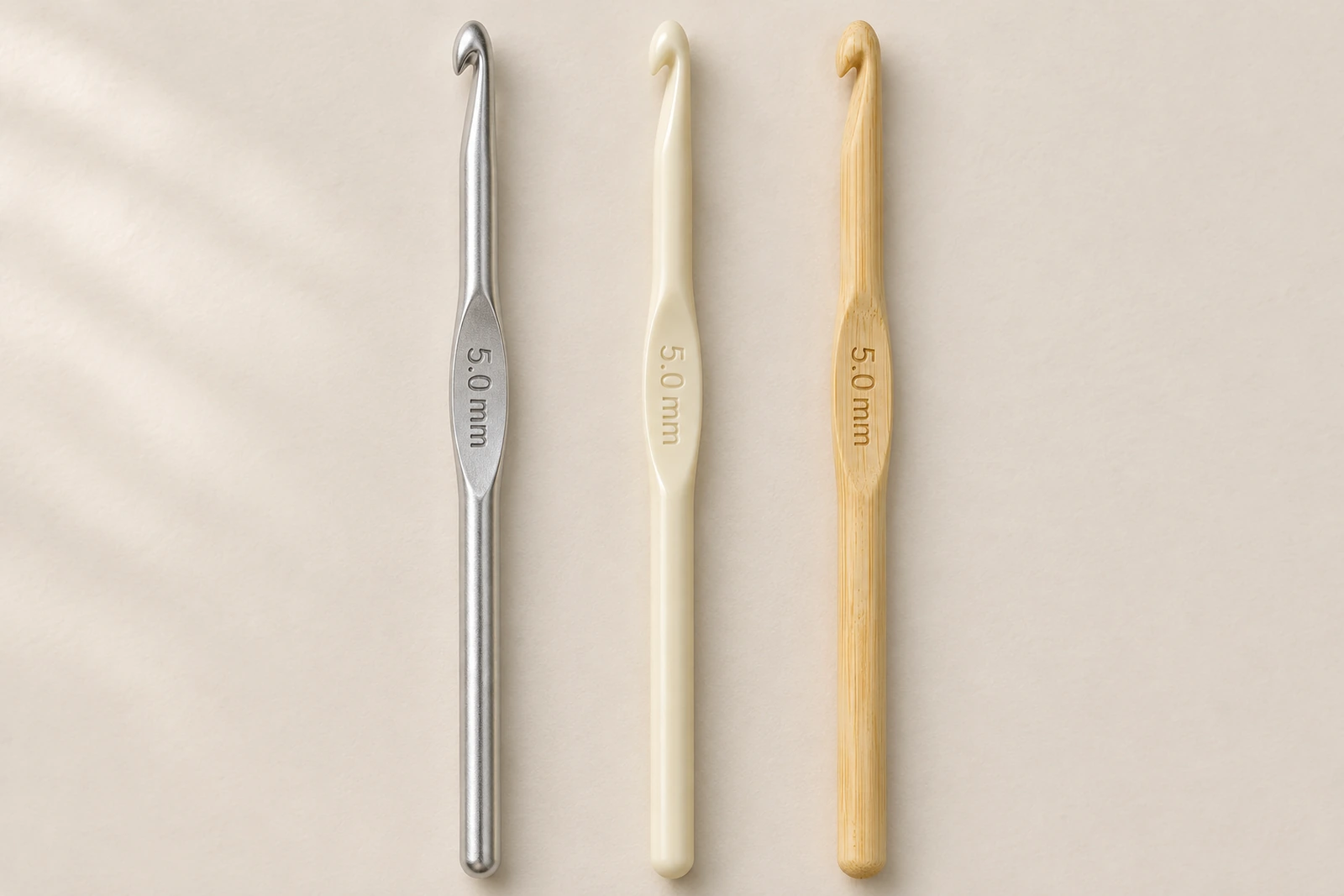
Aluminum hooks are smooth and strong, plastic hooks are cheap and bright, and bamboo and wood hooks grip the yarn. Aluminum is long-lasting, though a thin one may feel uncomfortable after long sessions, and a rubber grip helps. Some guides call plastic hooks less precisely made than metal and wooden hooks, and they can bend, snap or squeak against yarn; the largest hooks, about 10 mm and up, are usually plastic. Bamboo and wood hooks are lighter and grip better, which keeps slippery yarn from sliding. I use a smooth aluminum hook for most projects, and I try a wood or bamboo hook when a yarn feels slippery. The photo below shows three 5.0 mm hooks in three materials; see ergonomic crochet hooks for more.

Three crochet hooks of the same 5.0 mm size side by side, one aluminum, one plastic and one bamboo, each with its size marking visible Three 5.0 mm hooks in aluminum, plastic and bamboo: same size, different feel.
Check a Hook’s Real Size

A hook sizing gauge tells you the true size of a worn or unmarked hook. Hooks are stamped with their size, but stamps wear off, some hooks are unmarked, and two hooks stamped the same can differ slightly between makers. Match the label and the pattern by the millimeters, and swatch again if you switch to a different hook mid-project. See crochet tools for beginners for a starter hook.

Key Takeaways

  • Hook sizes come in millimeters, US letters and numbers, and old UK numbers, and the millimeter size, the width of the shank, is the surest one to compare.
  • A 5.0 mm hook is H/8 in the US and 6 in the old UK system; old UK numbers run backward, so a bigger number is a smaller hook.
  • Steel hook numbers also run the other way, so a higher number is a finer hook, and steel hooks are used for thread and lace.
  • Yarn weight gives a starting hook, but the pattern’s gauge decides: too many stitches in 4 inches means go up a hook size.
  • Charts and makers disagree on some sizes, so check a hook with a sizing gauge and go by the millimeters.

Frequently Asked Questions

What size is a 5 mm crochet hook?

A 5.0 mm crochet hook is a US H/8 and an old UK 6. It is a common size for worsted weight yarn, though the Craft Yarn Council range for worsted weight yarn starts at 5.5 mm (I/9). Check the millimeters on the thumb rest, because letters can differ by maker. The conversion chart above lists every size.

What is the difference between US and UK crochet hook sizes?

US sizes use letters and numbers that rise with the size (H/8 is 5.0 mm), while old UK sizes are numbers that run the other way (UK 6 is 5.0 mm and UK 3 is 6.5 mm). Most countries outside the US now give millimeters. Millimeters are the surest size to match, so use them when a pattern, a hook and a chart disagree. The sections above cover both systems.

What size crochet hook should I use for my yarn?

Match the hook to the yarn weight: a 2.25 to 3.5 mm hook for super fine, 3.5 to 4.5 mm for fine, 4.5 to 5.5 mm for light (DK), 5.5 to 6.5 mm for medium (worsted weight yarn) and 6.5 to 9 mm for bulky. Treat the label’s hook as a starting point and swatch to match the pattern’s gauge. The crochet yarn weight guide has the full chart.

What happens if I use a different hook than the pattern says?

The stitches, and so the finished piece, will come out a different size. A larger hook gives a more open, bigger fabric and a smaller hook a tighter, smaller one. If your swatch matches the pattern’s gauge, a different hook is fine; if not, change the hook by one size and swatch again. The gauge steps above show how, and how to substitute yarn covers the yarn.

Is a bigger hook number a bigger hook?

For US sizes, yes: K/10½ is bigger than H/8. For old UK numbers and steel hooks, no: UK 3 is bigger than UK 6, and a size 14 steel hook is finer than a size 5. Compare millimeters when the systems are mixed, since they are the surest size. The labeling and steel sections above explain each scale.

Portrait of Linda Davidsen

Written by

Linda Davidsen

Designer & founder

Linda has been crocheting for over 15 years and designs cozy, beginner-friendly patterns that anyone can finish in a weekend.

Keep reading

All posts