
đź§¶ Yarn Calculator

Try

Visit our Etsy Shops

Pick a shop to browse. Each one opens on Etsy in a new tab.

Yarn & Materials

How to Read a Yarn Label: Every Symbol Explained

How to read a yarn label: the weight symbol, fiber, yardage, crochet gauge square, care symbols, color number and dye lot, with a care symbol chart.

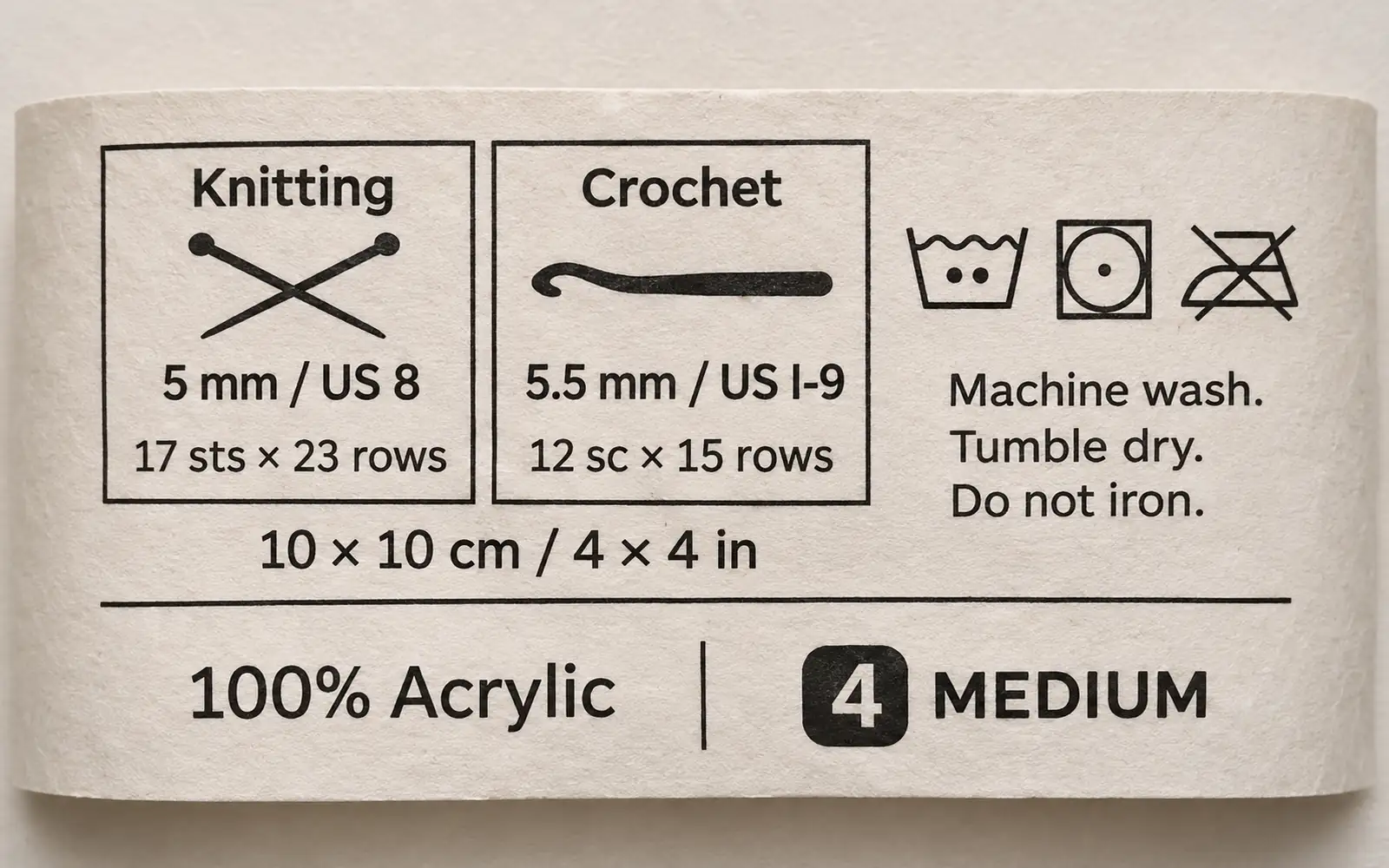
A close-up of a plain yarn band showing knitting and crochet gauge squares, three care symbols, the words 100% acrylic and a 4 Medium weight symbol
Table of Contents
  1. What a Yarn Label Shows
  2. Weight Symbol, Fiber and Ply
  3. Ball Weight, Yardage and Gauge
  4. Care Symbols: What Each One Means
  5. Color Number and Dye Lot
  6. Other Marks and a Shelf Check
  7. Key Takeaways
  8. Frequently Asked Questions

Quick answer: Learning how to read a yarn label comes down to six checks: the weight symbol, the fiber content, the yardage, the crochet gauge square with its hook, the care symbols, and the color and dye lot numbers. Together they show how thick the yarn is, how to work it and how to wash it.

The ball band is covered in numbers, tiny pictures and a wash tub with a cross through it, and the pattern only says to use worsted. Which number is the weight, which square is for crochet, and what does that crossed-out tub mean for the blanket you plan to wash?

This guide goes through the band one part at a time: the weight symbol, fiber content, ball weight and yardage, the gauge squares, the care symbols, and the color and dye lot numbers. A care symbol chart, a sample label and a six-step shelf check come with it.

I look for the crochet gauge square first, the one with the hook, and I ignore the knitting needle square. Labels often show both, and only the crochet square gives me a stitch count and a starting hook that apply to my work.

What a Yarn Label Shows

A yarn label, also called a ball band, shows the weight symbol, fiber content, ball weight and yardage, gauge, care symbols, color number and dye lot. It holds the facts a pattern assumes you know. See the crochet yarn and materials guide for the wider map.

The Eight Parts at a Glance

A yarn label has eight parts: the weight symbol, fiber content, ball weight and yardage, two gauge squares, care symbols, color and dye lot. The list uses the diagram’s numbers.

  1. Weight symbol: a skein icon and a number for thickness.
  2. Fiber content: what the yarn is made of.
  3. Ball weight and yardage: how heavy the ball is and how long the yarn is.
  4. Knitting gauge square: the needle square, which does not apply to crochet.
  5. Crochet gauge square and hook: the stitch count and starting hook.
  6. Care symbols: how to wash, dry and iron the piece.
  7. Color name or number: which shade the yarn is.
  8. Dye lot: which batch the yarn came from.

Ball weight and yardage are different things. The care symbols and dye lot carry over to the finished piece, and the sample label is made up.

4 Medium Color 123 Dye lot 456 100% acrylic 100 g (3.5 oz) / 200 yd (183 m) 18 sts and 24 rows = 4 in (10 cm) Needles 5 mm (US 8) 13 sts and 15 rows = 4 in (10 cm) Hook 5.5 mm (I/9) 1 7 8 2 3 4 5 6 1 Weight symbol 2 Fiber content 3 Ball weight and yardage 4 Knitting gauge square 5 Crochet gauge square and hook 6 Care symbols 7 Color number 8 Dye lot
A sample ball band with its eight parts numbered.

Labels Vary

Labels vary by maker, and handspun, vintage or imported yarn may lack some parts, such as the yardage, the hook or the care instructions. A hang tag can carry less than a wrap-around band, and the layout, wording and symbols change from one maker to the next. Do not guess at a missing part. When a band is missing the gauge or yardage, I swatch and go by my own numbers.

Weight Symbol, Fiber and Ply

The weight symbol and the fiber content tell you how thick a yarn is and what it is made of. Both are printed on the band, and each answers a question a pattern asks before you buy. Ply, often mixed up with weight, comes last.

The Weight Symbol

The weight symbol is a skein icon with a number from 0, lace, to 7, jumbo. In the Craft Yarn Council system, 0 is the finest, 7 is the thickest and 4 is medium, also called worsted. Many bands add a name such as worsted or DK, and those names change by country. Match the number when the pattern uses the same system. The ranges are guidelines, so two yarns with the same number can work up a little differently. Handspun and hand-dyed yarns may carry no symbol. See the crochet yarn weight guide for the full chart.

Fiber Content

The fiber content line lists each fiber as a percentage, usually from the largest share to the smallest, and a label may show one fiber or a blend. The fiber decides how the yarn feels, drapes and is cared for. Superwash means a wool treated so it can be machine washed, while machine washable is a care statement. Compare the fiber line with the care symbols, because a blend usually follows its most delicate fiber. See cotton vs acrylic yarn for how fibers wash.

Ply Is Not Thickness

Ply is the number of strands twisted together, and it does not tell you how thick a yarn is. A four-ply yarn can be thick or thin, depending on the thickness of each strand. Ply describes how the yarn is built, while the weight number describes how thick it is, so use the weight number.

Ball Weight, Yardage and Gauge

A band shows ball weight in grams and ounces, yardage in yards and meters, and a gauge square with a suggested hook. A pattern’s materials list uses the same numbers, so read the two together. See how to read a crochet pattern for the materials list.

Ball Weight and Yardage

Ball weight tells you how heavy a ball is, and yardage tells you how long the yarn is, so compare yardage. A ball may weigh 50 g or 100 g, but patterns count length. Two balls of the same weight can hold different lengths, because fibers differ, so a heavier ball is not always a longer one. A pattern’s yardage is approximate, because stitch type, hook size and tension change how much you use. Treat the total as a guide, and check which unit the pattern uses, yards or meters. Check yardage before you buy, because it is the number that shows if you have enough. For the sum, see how to substitute yarn.

Knitting and Crochet Gauge Squares

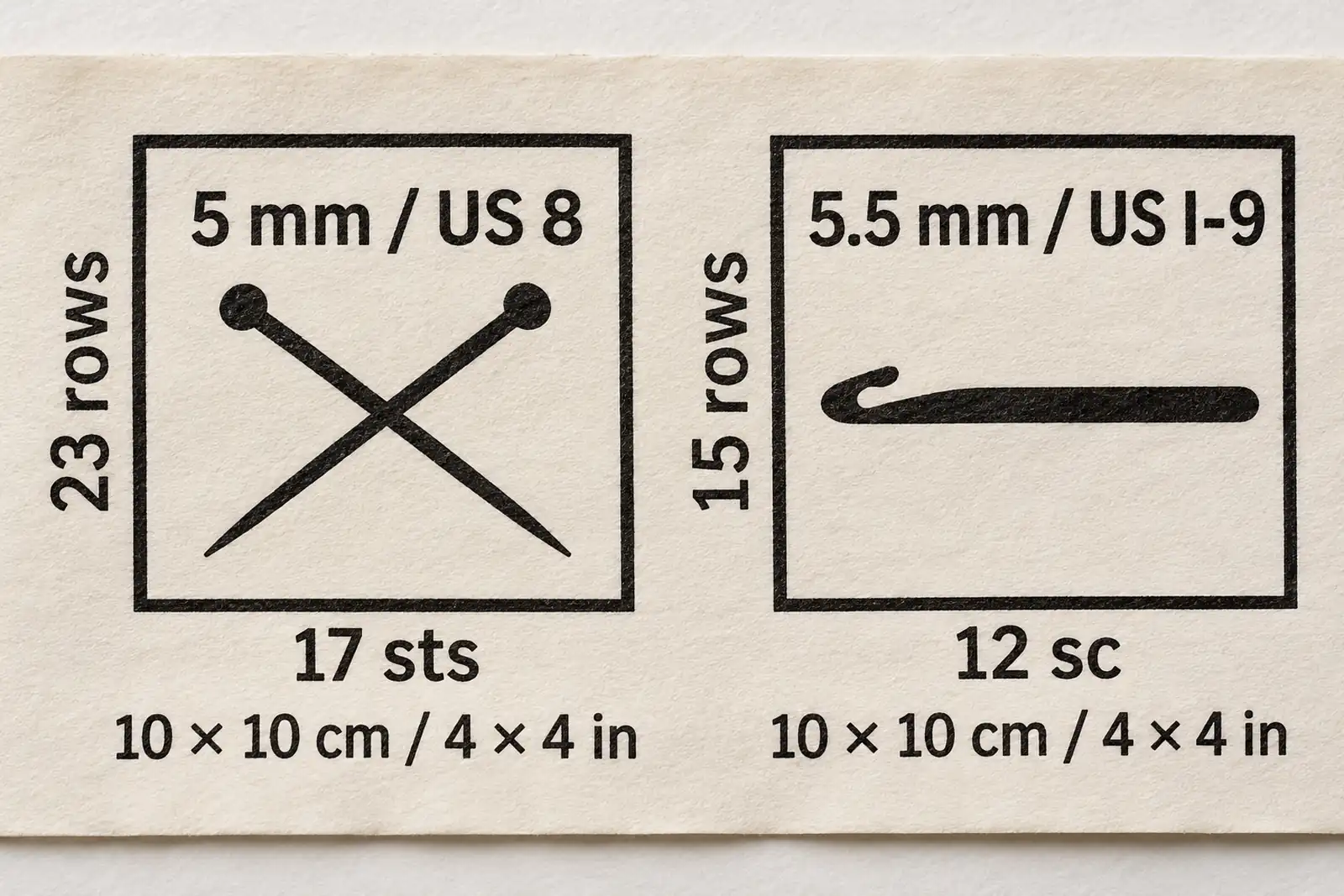
Of the two gauge squares on many yarn labels, the crochet one is the square with the hook icon. A gauge square is a 4 by 4 in (10 by 10 cm) swatch, with the stitch count across and the row count down. Many labels print two: one with a knitting needle and a stitch count for knitting, and one with a hook for crochet. On some labels the crochet count is marked sc instead. The knitting count does not apply to crochet, so skip it. Check the icon before the numbers, because a crochet count and a knitting count can sit side by side. Some labels write the gauge in words instead of a square. The photo below shows both squares on one real band.

How to read a yarn label: a close-up of the knitting and crochet gauge squares on a ball band, with the crochet square showing a hook icon and a hook size The two gauge squares on one real band: the crochet square shows a hook.
The Suggested Hook

The hook in the crochet square is the size expected to give that gauge. It is a starting point, not a rule. A larger hook gives a more open fabric and a smaller one a tighter fabric. Make a swatch, count the stitches in 4 in (10 cm), and move up or down one size: more stitches than the gauge means go up, and fewer means go down. See the crochet hook size chart for sizes.

Care Symbols: What Each One Means

Yarn care symbols are five shapes, a tub, a triangle, a square, an iron and a circle, with marks that change what each one means. Read them before you buy, because the finished piece is washed the way the band says.

The Five Shapes and Their Marks

Yarn care symbols use five shapes: a tub for washing, a triangle for bleach, a square for drying, an iron and a circle for professional cleaning. Dots or a number show the highest temperature, and more dots means warmer. A number is degrees Celsius, and North American yarn lists both Celsius and Fahrenheit, says the Craft Yarn Council. A hand in the tub means hand wash, bars under a symbol mean a gentler cycle, and a big cross means do not. International symbols closely match the US ones.

Washing 40 degrees C hand wash gentler cycle Bleaching oxygen bleach only Drying low heat Ironing medium heat Professional cleaning P ask the cleaner a cross means do not
The five care symbol shapes and the marks that change them.

Care Symbol Chart

Use this chart for what each symbol means; the label always wins.

Symbol Name What it means
Washtub Washing is allowed; dots or a number show the highest water temperature, and more dots or a higher number means warmer
Washtub with a hand Hand wash only; do not use a washing machine
Washtub with a cross Do not wash, by hand or in a machine
Triangle Bleach is allowed; two slanted lines mean oxygen bleach only
Triangle with a cross Do not bleach
Square with a circle Tumble drying is allowed; one dot is low heat, two medium and three high
Square with a circle and a cross Do not tumble dry; choose another way to dry the piece
Square with a horizontal line Dry flat; lay the piece on a flat surface to dry
Square with a curved line Line dry; for heavy crochet, dry flat instead, because a wet piece stretches when hung
Iron with dots Ironing is allowed; one dot is low heat, two medium and three high
Iron with a cross Do not iron the piece
Circle Professional cleaning; a letter inside tells the cleaner which solvents to use
Circle with a cross Do not dry clean

Care Words and Blends

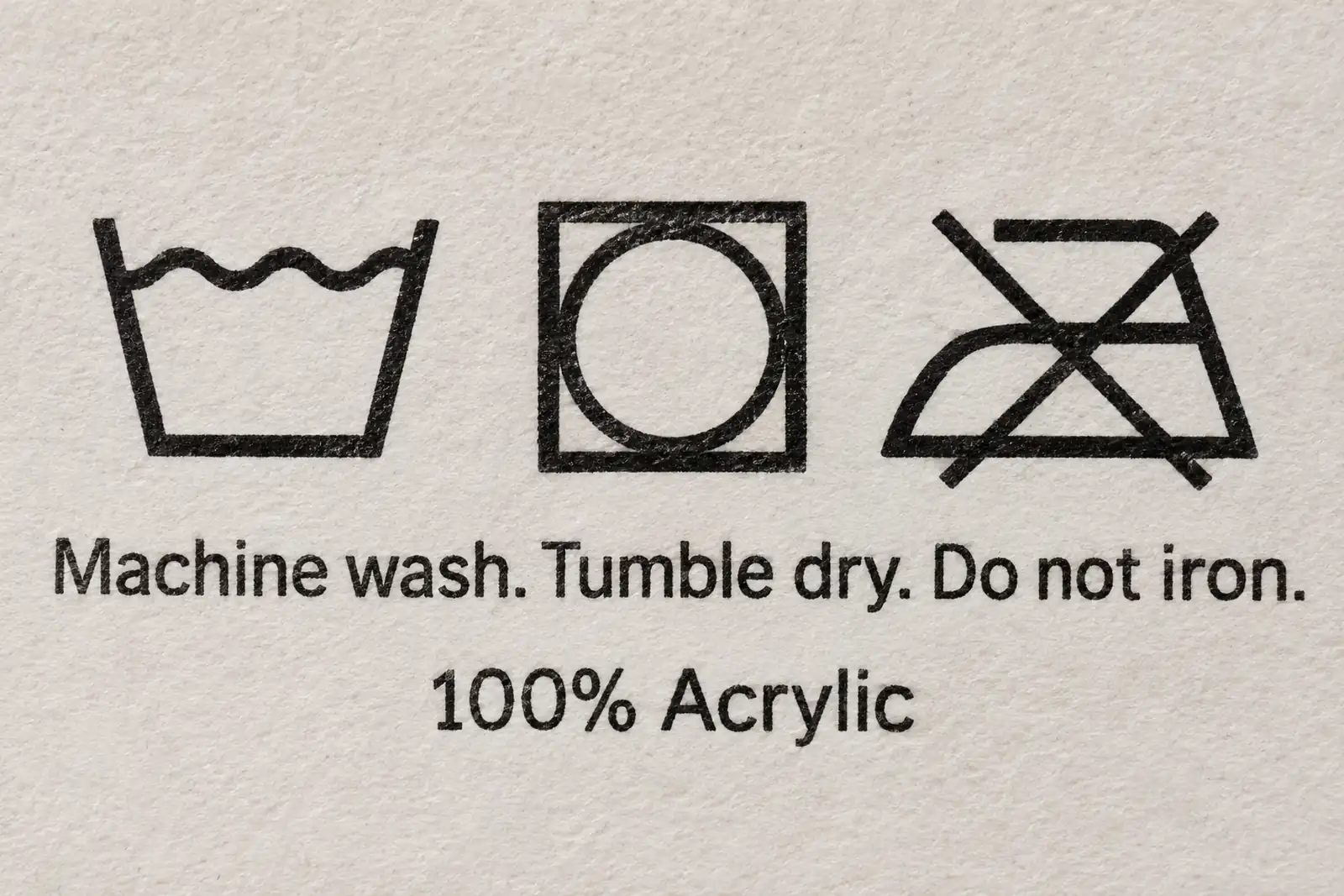
Care words such as machine washable, hand wash and superwash add detail to the symbols, and the label always wins. Superwash or machine washable yarn can be washed on a gentle cycle in cool water, and many recommend hand washing. If you combine yarns, choose ones with similar washing instructions. Wash a swatch the way you will wash the piece. I take a photo of every band before I start, so the care symbols are always on my phone. For washing, see cotton vs acrylic yarn. The photo below shows care symbols and words on a real band.

Close-up of the care symbols printed on a ball band: a row of small washing, bleaching, drying and ironing symbols with a few care words beside them Care symbols and care words as printed on one real band.
Color Number and Dye Lot

The color name and number pick the shade, and the dye lot number records the batch, which matters once a project needs more than one ball. A dye lot is one batch of yarn dyed together, and shades can vary slightly between lots.

Color Name and Number

The color name and number tell you which shade a yarn is, but not which batch it came from. The number picks the color, but the same color number from two dye lots can differ slightly. Some bands also show an article number, the maker’s product code, and not every band does. Note the color number, and keep the band or a photo of it, so you can reorder the same shade later.

Dye Lot

Buy all the yarn for a project at the same time, from one dye lot, because shades can vary slightly between lots. The difference shows in the finished item. Note the lot number on each band, and make sure new yarn matches the lot number of the original purchase. Keep the bands, because they identify the yarn if you run short. Two patterns to try are the Boho Rainbow Baby Blanket and the Heart Sweater, or browse beginner crochet patterns and free blanket patterns.

Other Marks and a Shelf Check

Once you know the main parts of a yarn label, you can check one in about a minute. A few other marks may appear on a band, and six steps cover the rest. See best yarn for beginners for a first purchase.

Other Marks You May See

Besides the main parts, a band may show a skill level bar, a tested-label mark such as OEKO-TEX, and the maker’s website. The Craft Yarn Council skill level symbol is a bar of four sections: one shaded means beginner and all four mean experienced. A tested-label mark says the yarn was tested for harmful substances, so look for a test number and the testing institute. Words such as hypoallergenic or baby on a band are not standards. The maker’s name, website, country of origin and barcode do not change how you crochet.

Six Steps at the Shelf

Use these six steps at the shelf, in this order.

  1. Find the weight symbol and match its number to the weight the pattern asks for.
  2. Read the fiber content and note each percentage, so you know the feel and the care.
  3. Compare the yardage, not the ball weight, with the pattern’s total.
  4. Find the crochet gauge square, the one with the hook icon, and note the suggested hook.
  5. Check the care symbols against how you will wash the finished piece.
  6. Check the color number and dye lot on every ball, buy them all at once, and keep the band or a photo of it.

Key Takeaways

  • A yarn label shows the weight symbol, fiber content, ball weight and yardage, gauge squares, care symbols, color number and dye lot.
  • The number from 0 to 7 is the weight category, and neither ply nor ball weight tells you how thick a yarn is.
  • Compare yardage, not ball weight, with the pattern’s total, and use the crochet gauge square with the hook icon for the stitch count and the starting hook.
  • Care symbols use five shapes, a tub, a triangle, a square, an iron and a circle; dots or a number show temperature, a hand means hand wash and a cross means do not.
  • Buy every ball from one dye lot and keep the band, or a photo of it, until the project is done.

Frequently Asked Questions

What does the number on a yarn label mean?

The number inside the skein icon is the yarn weight category, from 0, lace, to 7, jumbo, and most worsted bands show 4. It shows how thick the yarn is, not how heavy the ball is or how long the yarn is, so check the yardage separately. The Weight Symbol, Fiber and Ply section above has the details.

Which gauge square on a yarn label is for crochet?

The square with the hook icon, and on some labels sc beside the count. The numbers give the stitches across and the rows down in a 4 in (10 cm) square. The square with the knitting needle gives a knitting count that does not apply to crochet, so skip it. The Ball Weight, Yardage and Gauge section above shows both squares on one real band.

Is the hook size on a yarn label the one I should use?

Not always. It is a starting point for the gauge on the label. Make a swatch, count the stitches in 4 in (10 cm), and move up or down one hook size to match the pattern’s gauge. A larger hook gives a more open fabric. See the crochet hook size chart for sizes, and the Ball Weight, Yardage and Gauge section above for the swatch.

What do the care symbols on yarn mean?

They use five shapes: a tub for washing, a triangle for bleach, a square for drying, an iron and a circle for professional cleaning. Dots or a number show the highest temperature, a hand means hand wash and a cross means do not. Check the label before you wash. The Care Symbols: What Each One Means section above has a chart of every mark.

Do I need to match the dye lot number on yarn?

Yes, for any piece that needs more than one ball. A dye lot is one batch, and shades can vary slightly between lots, which shows in the finished piece. Buy all the yarn at once, check the lot number on each band and keep the bands. The Color Number and Dye Lot section above has the details.

Portrait of Linda Davidsen

Written by

Linda Davidsen

Designer & founder

Linda has been crocheting for over 15 years and designs cozy, beginner-friendly patterns that anyone can finish in a weekend.

Keep reading

All posts