Common Crochet Mistakes and How to Fix Them
Twisted chains, wavy edges, wrong stitch counts: the common crochet mistakes beginners make, how to spot each one and how to fix it.
Read More: Common Crochet Mistakes and How to Fix Them 🧶 Yarn Calculator
Beginner Guides
Not sure what yarn to buy for your first crochet project? Here is the weight, fiber and color that work best, plus what to skip.
 By Linda Davidsen · · 13 min read
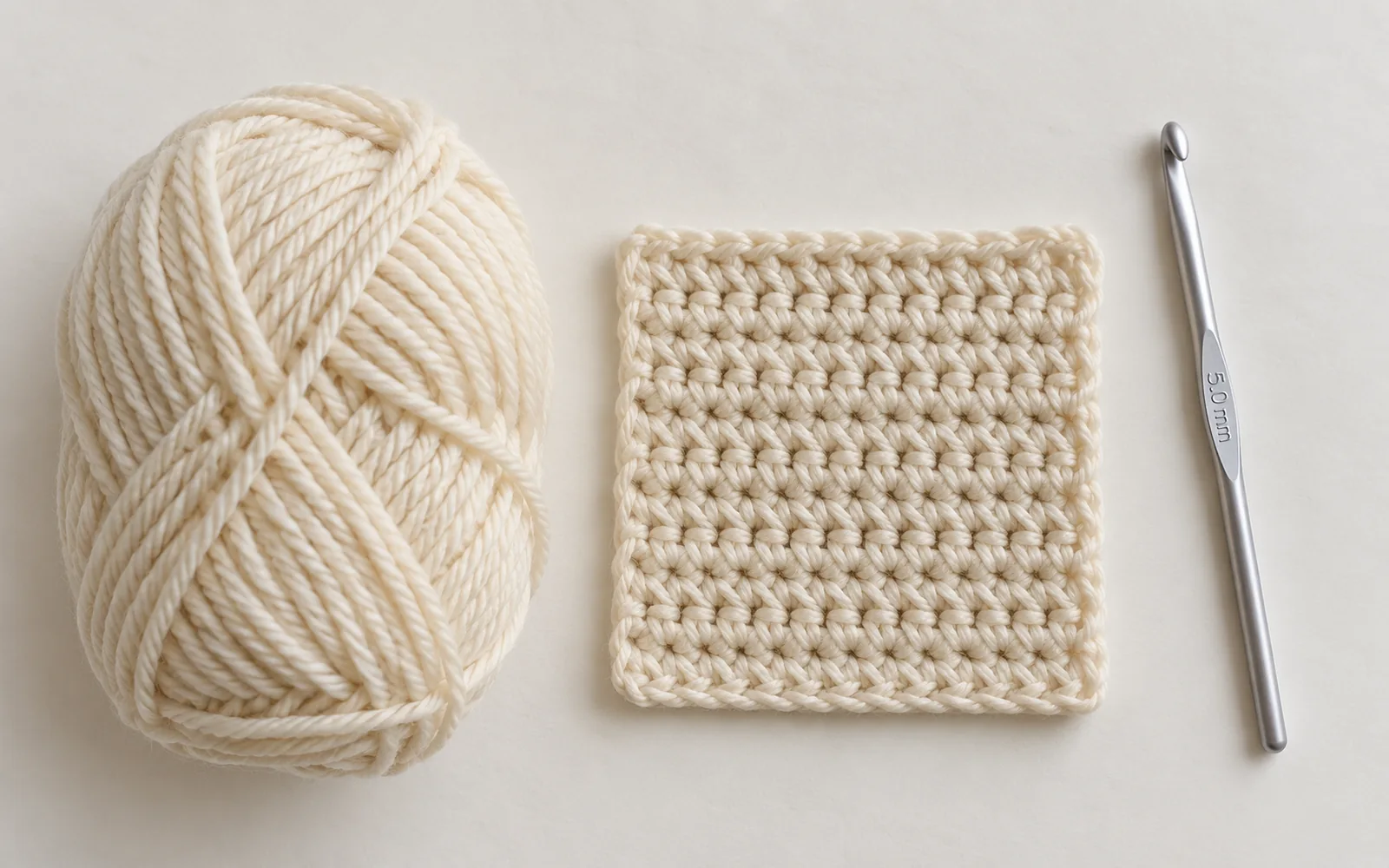
The best yarn for beginners crochet projects is a smooth, light-colored, solid worsted weight (category 4) yarn in acrylic or an acrylic blend. You can see every stitch, pull it out cleanly when you make a mistake, and a hook of 5.0–5.5 mm (H/8 to I/9) works well.
You are standing in the yarn aisle, looking at a wall of colors, weights and fibers, and every label says something different. You only need one ball for a first project, but picking the wrong one can make even a simple stitch feel impossible, which is where some people give up.
This guide gives you one clear answer, then shows what to skip, three widely available yarns with their stated specs, five things to check on the label, and how to work out how much to buy and what it will cost you.
My test for a first yarn is simple: can I see every stitch, and can I pull it out cleanly? If the answer to both is yes, it’s the right yarn, whatever the brand.
Choose a smooth, light-colored, solid worsted (category 4) yarn in acrylic or an acrylic blend. Four traits make it easy to learn on: weight, fiber, color and texture. The Beginner’s Complete Guide to Crochet shows the bigger picture, and our crochet yarn and materials hub goes deeper.
Worsted weight is category 4 in the Craft Yarn Council system, also labeled medium. A starter hook is 5.0–5.5 mm (H/8 to I/9), while worsted labels often print 5.5–6.5 mm, so start with the starter size and let the pattern’s hook win. Thin yarns make small stitches that are hard to see, and very thick yarns change the hook you need. The crochet yarn weight guide has the full chart, there is more on worsted weight yarn, and the crochet hook size chart covers sizes.
Acrylic is inexpensive, durable and easy to wash, which makes it forgiving for practice. It resists moths, sits on almost every shelf, and can feel slightly rougher than some other fibers. Blends add structure, strength and washability. Cotton is absorbent and good for dishcloths and coasters, but it is a second step for most beginners, and wool can wait (check the care label first). This is a starting choice, not a ranking of fibers; see cotton vs acrylic yarn for the full comparison.
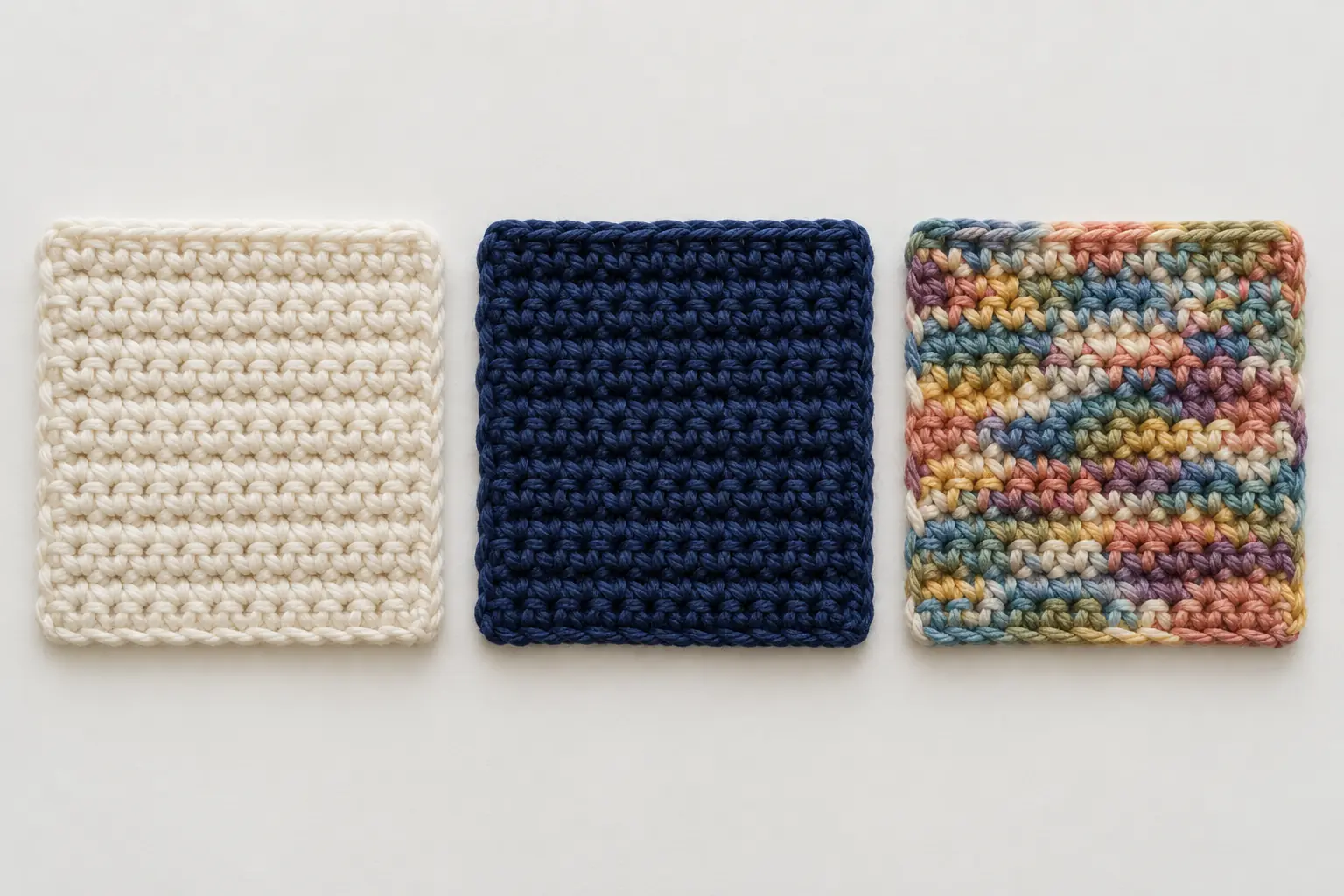
A solid yarn is one color throughout, and a variegated yarn changes color along its length. Light or medium solids, such as cream, soft white, pastels and light gray, show every stitch. Dark colors and strongly variegated or multicolored yarns hide the stitches, which makes counting and finding the right place harder. Stitches are easier to count in a solid, and the photo shows the same swatch in a light solid, a dark solid and a variegated yarn.
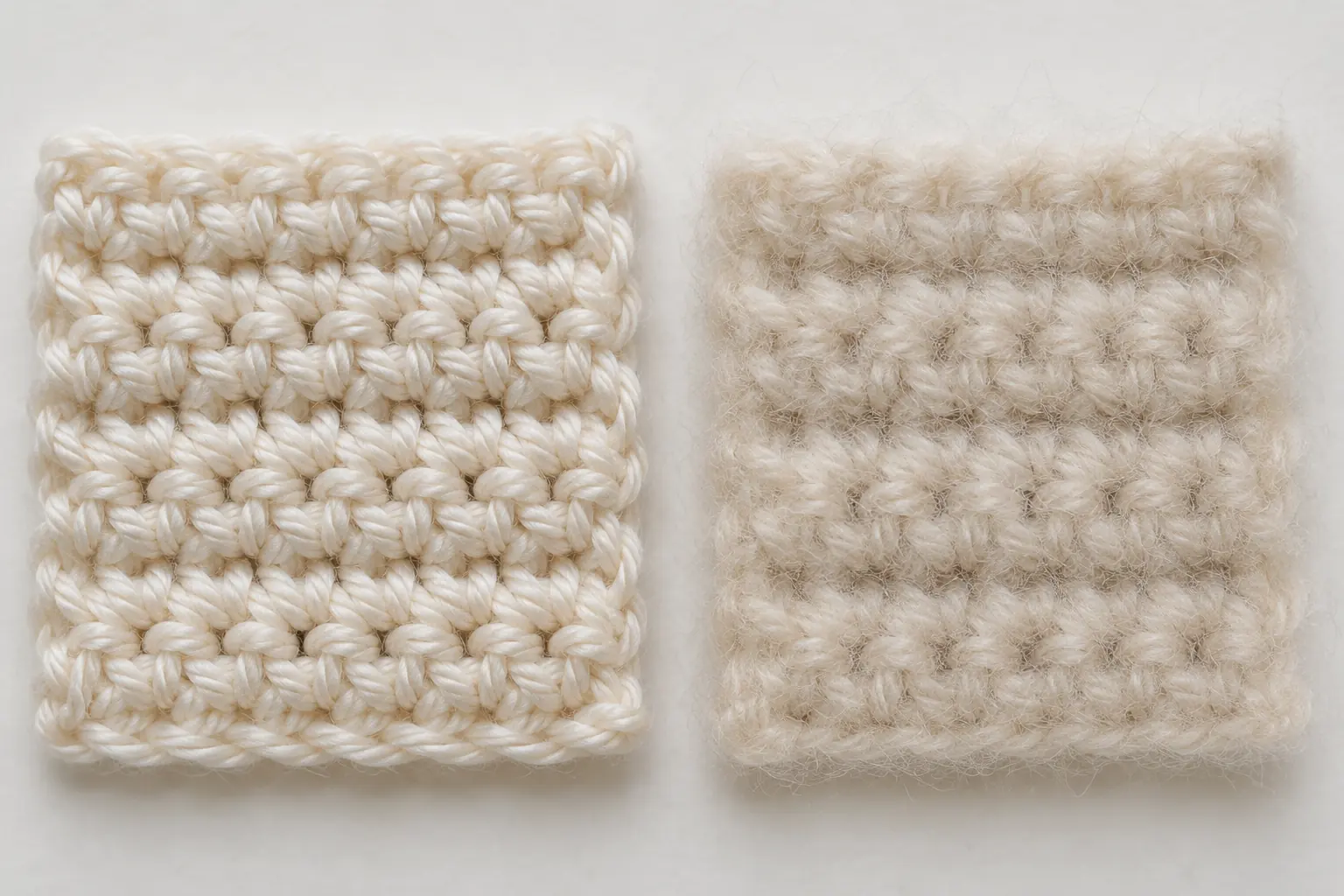
Ply is the number of strands twisted together to make a yarn. Look for a smooth surface with clearly visible plies, because fuzzy, hairy or novelty yarns hide the stitches and are hard to unravel. Ply is not an indication of thickness, so check the weight number on the label rather than counting plies. The photo shows a smooth plied yarn next to a fuzzy yarn in the same stitch.
These yarns are not bad, only harder to learn on. Save them for after your first few projects, and notice that each row of the table points to an easier swap.
| Yarn type | Why it is harder | What to try instead |
|---|---|---|
| Dark colors (black, navy, charcoal) | Stitches are hard to see and count | A light or medium solid of the same weight |
| Variegated or multicolor yarn | Color changes hide stitch shapes | A solid color |
| Fuzzy, hairy or novelty yarn (eyelash, boucle, mohair) | Hides the stitches and is hard to unravel | A smooth plied acrylic |
| Single-ply yarn | The strand can split and come apart | A yarn with at least two plies |
| Very thin yarn (lace, fingering, sport) | Tiny stitches, small hook, slow progress | Worsted (category 4) |
Yarns to save for later.
DK weight is category 3, one step lighter than worsted. It works well in a solid color, and many of the small toy and baby patterns in the library use it. It needs a smaller hook, and the stitches come out smaller than in worsted. Start in worsted, then move to DK once counting feels easy. Our guide to DK weight yarn covers the switch.
Bulky yarn is easy to see but needs a larger hook than worsted. The stitches are big and clear, but the finished piece is heavy, so bulky suits chunky scarves and blankets better than small first projects. Sources disagree on whether bulky makes a good first yarn, and this page recommends worsted first because most beginner patterns on this site use worsted or DK. The crochet yarn weight guide lays out every weight.
This is a what’s-on-the-shelf list, not a ranking and not a test. The three yarns below were chosen because they are widely stocked and meet the checklist above. Prices change, so treat the price column as a rough guide and check the label in the store.
| Yarn | Fiber | Weight | Per skein | Hook on label | Price band |
|---|---|---|---|---|---|
| Red Heart Super Saver | 100% acrylic (solids) | #4 worsted (medium) | 7 oz / 198 g, 364 yd in solids; 5 oz / 141 g, 236 yd in prints and variegated | 5.5 mm (US I/9) | $ |
| Caron Simply Soft | 100% acrylic | #4 worsted (medium) | 6 oz / 170 g, 315 yd | 5.0 mm (US H/8) | $ |
| Lion Brand Vanna’s Choice | 100% acrylic | #4 medium | 3.5 oz / 100 g, 171 yd | I–J (5.5–6.0 mm) | $ |
Three worsted acrylics and what their makers state. Prices checked in October 2026: $ means about $3–$7 per skein and varies by store and sale.
These three are widely stocked, not tested or ranked. They are stocked across the US, they show up in beginner guides, and they meet the checklist in the first section. That is the whole method, so read the list as a sample of what the shelf offers, not as a pick of one maker over another. Availability differs by country and by store, so your local shelf may look different.
Check any yarn against these four points:
A store-brand or local-shop yarn that ticks all four does the same job, so pick a color you like, because a yarn you enjoy is one you will finish. If a pattern names a different yarn, read how to substitute yarn.
A yarn label, also called a ball band, lists the weight, fiber content, length, dye lot and care instructions. Five of those details matter most for a first skein, and the diagram shows where each one sits.
The label may also suggest a hook and show a gauge, which helps when you are matching a pattern. For every symbol, see how to read a yarn label.
A dye lot is one batch of yarn colored at the same time. Different lots can vary slightly in shade, and the difference shows in the finished piece. Buy all the yarn for a project at the same time. Keep the label and a scrap of yarn until the project is done, so you can identify the yarn if you run short. Never put an iron on synthetic yarn, and follow the care symbols instead.
Use the pattern’s yardage, not a guess. Two quick sums, one for quantity and one for cost, stop you from overbuying or running short, and you only need a calculator.
Patterns list the yardage or weight of yarn needed. Divide the pattern’s yardage by the yardage in one skein and round up. For example, if a pattern needs 600 yards and a skein has 364 yards, you need 2 skeins (600 ÷ 364 = 1.65, rounded up). Small projects such as keychains and coasters often use only part of a skein. If you swap in a different yarn, check its weight and yardage first, and see how to read a crochet pattern and how to substitute yarn.
The price on the shelf is not the cost. Price divided by yards gives the cost per yard, which lets you compare skeins of different sizes. For example, a $5.99 skein of 364 yards (Red Heart Super Saver in solids, as listed in October 2026) costs about $0.016 per yard. Prints and variegated colors often come in smaller skeins, so the same brand can cost more per yard.
For a first project, one skein of the right yarn and one hook is enough to start, so buy more only after the first project works. A keychain or coaster fits comfortably in a single skein. Linda’s tip: “I buy one skein for a first project, and a second only after the first one is finished.” The full starter kit is in our guide to crochet tools for beginners, and if the hook is what bothers you, read about ergonomic crochet hooks.
The right yarn depends on the project, and three beginner patterns show how:
Find them as the Citrus Slice Coaster, the Modern Diamond Beanie and the Heart Keychain, and always follow the yarn listed on the pattern page. More ideas are in our guide to free crochet patterns for beginners and in our beginner crochet patterns. The Beginner’s Complete Guide to Crochet shows what to learn next.
A smooth, light-colored, solid worsted weight (category 4) yarn in acrylic or an acrylic blend, paired with a 5.0–5.5 mm (H/8 to I/9) hook. You can see every stitch, and you can pull the yarn out cleanly when you need to redo a row. The first section above explains each trait, and the label check confirms you picked the right skein.
Acrylic, for a first project: it is inexpensive, durable and easy to wash, so mistakes cost little. Cotton is a good second yarn, especially for dishcloths and coasters, because it is absorbent. Cotton is also less forgiving to work, so save it until single crochet feels easy. The full comparison is in cotton vs acrylic yarn.
Yes, as long as the weight matches the one the pattern is written for. If you use a different yarn, match the weight and check the gauge, or the finished size will differ from the pattern. Read the materials list first with how to read a crochet pattern, and see how to substitute yarn for the checks.
Because dark and variegated yarn hide the stitch shapes, so counting stitches and finding the next stitch is harder. A light solid shows each stitch clearly, which makes it easier to spot a mistake while it is still one row deep. Dark and variegated yarn are fine later, once you can read your stitches by feel.
Try three fixes in order. First, slow down, since splitting happens when the hook tip catches between the plies. Second, insert the hook under the whole stitch, not into the strand. Third, switch to a smoother, firmly plied yarn. A different hook head can also change how the yarn feels, and our guide to ergonomic crochet hooks covers the options.
Divide the pattern’s yardage by the yards in one skein and round up. Small projects such as keychains and coasters often use only part of a skein. If a project needs more than one skein, buy them all at once so they come from the same dye lot. The sums above show a worked example for yardage and for cost.
Ad-free, printable, and ready for your project bag. We'll also send you one new free pattern every week.
No spam. Unsubscribe anytime.
Written by
Designer & founder
Linda has been crocheting for over 15 years and designs cozy, beginner-friendly patterns that anyone can finish in a weekend.
Keep reading
Twisted chains, wavy edges, wrong stitch counts: the common crochet mistakes beginners make, how to spot each one and how to fix it.
Read More: Common Crochet Mistakes and How to Fix ThemCrochet tools for beginners, simplified: the six you need, the extras that can wait, and a starter kit that avoids wasted money.
Read More: Crochet Tools for Beginners: Need vs. Nice to HaveAre ergonomic crochet hooks worth the price? An honest look at handle shapes, popular brands, who benefits and how to try one cheaply.
Read More: Ergonomic Crochet Hooks: Are They Worth It?