30 Crochet Stitches Every Maker Should Know
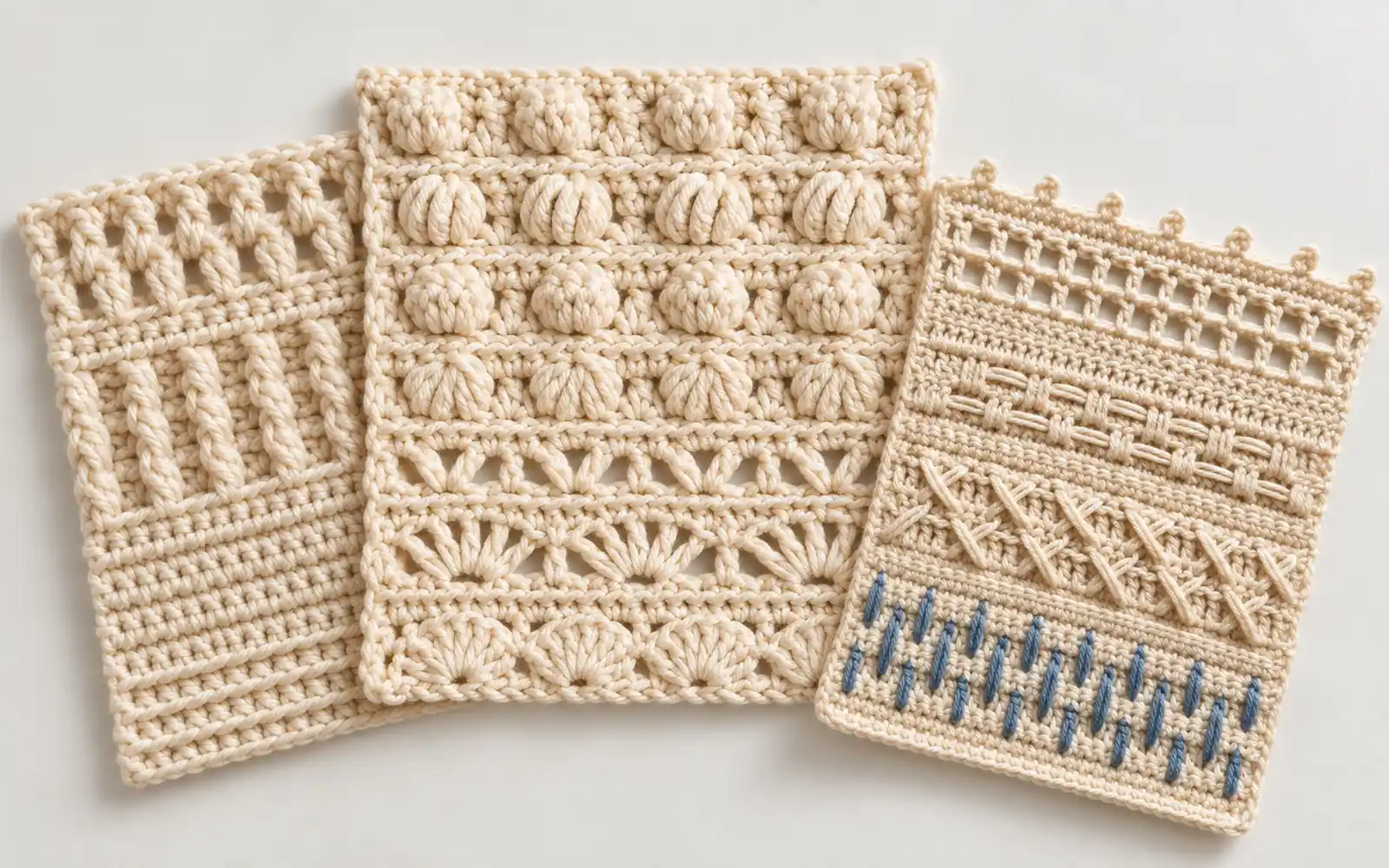
Crochet stitches to know, 30 in all: basics, shaping, loop and post stitches, shells, bobbles, spikes and edges, each with its abbreviation and use.
Read More: 30 Crochet Stitches Every Maker Should Know 🧶 Yarn Calculator
Stitches & Techniques
Learn the bobble stitch step by step: five unfinished double crochets, six loops, one pull through. Pick the right side, space bobbles and fix flat ones.
 By Linda Davidsen · · 12 min read
Quick answer: Bobble stitch crochet is a raised bump made by working five incomplete double crochets into one stitch, leaving 6 loops on the hook, then pulling through all 6 in one move. Close it with a single crochet in the next stitch, and work bobbles on a wrong-side row so they face you on the right side.
You worked every leg of the bobble, pulled through, and the result is a flat patch. Or one bobble is fat, the next is thin, and half of them sank to the back of the work. The stitch is easy to make, but its shape depends on small things.
This page builds one bobble leg by leg with a loop count at each step, then covers closing it, the side to work it on, spacing, a 15-stitch swatch with 6 bobbles, and fixes for flat or uneven bobbles. A short note separates bobbles from clusters, puffs and popcorns.
I count the loops on the hook after every leg of a bobble: 2, 3, 4, 5, 6. If the number is wrong, I undo that leg right away. It is quicker than fixing the bobble after it closes.
A bobble is a group of unfinished double crochets worked into one stitch and closed together at the top, which pushes the group out of the fabric as a raised bump. It uses only stitches you know; learn how to double crochet first. See crochet stitches and techniques for more.
Use smooth, light-colored worsted yarn and a 5.0 mm (H/8) hook to practice; a smooth yarn shows the bobble’s shape best. Choose a hook that leaves room for the final pull-through, which takes the most space. See worsted weight yarn, the crochet hook size chart and crochet tools for beginners. Photos are right-handed; left-handed crocheters mirror each step, starting the first row from the left.
A bobble is incomplete double crochets worked into one stitch and closed together. A cluster spreads incomplete stitches over several stitches, a puff uses half double crochet, and a popcorn folds complete stitches closed. A pattern’s stitch note wins; UK patterns call the legs trebles. See crochet stitches to know and crochet abbreviations.
To make a bobble, work an unfinished double crochet, repeat it four more times in the same stitch, pull through all six loops, then close with a single crochet. The legs use the moves from how to double crochet, stopped before the last pull-through.
Work a double crochet up to the last yarn over, and stop with 2 loops on the hook. Yarn over, insert the hook, yarn over and pull up a loop, then yarn over and pull through the first two loops only. The two loops are the one already on the hook and this stitch’s last loop.
Each leg adds one loop to the hook. Work four more unfinished double crochets into the same stitch, under the same two loops, so the hook holds 3, 4, 5 and then 6 loops. Pull each leg up to row height so the legs match. Counting the loops after every leg is the surest check.
Yarn over and pull through all 6 loops in one move. A slightly firmer pull helps the bobble stand up, but a very tight one is hard to draw through. One loop remains and the bobble is formed. Bulky bobbles are often closed with an extra chain; follow the pattern’s note.
Work a single crochet into the next stitch to lock the bobble. The shorter stitch draws the fabric in, and many tutorials say it helps the bobble round out and pop. Then carry on; this single crochet is the first of the stitches between bobbles. See how to single crochet.
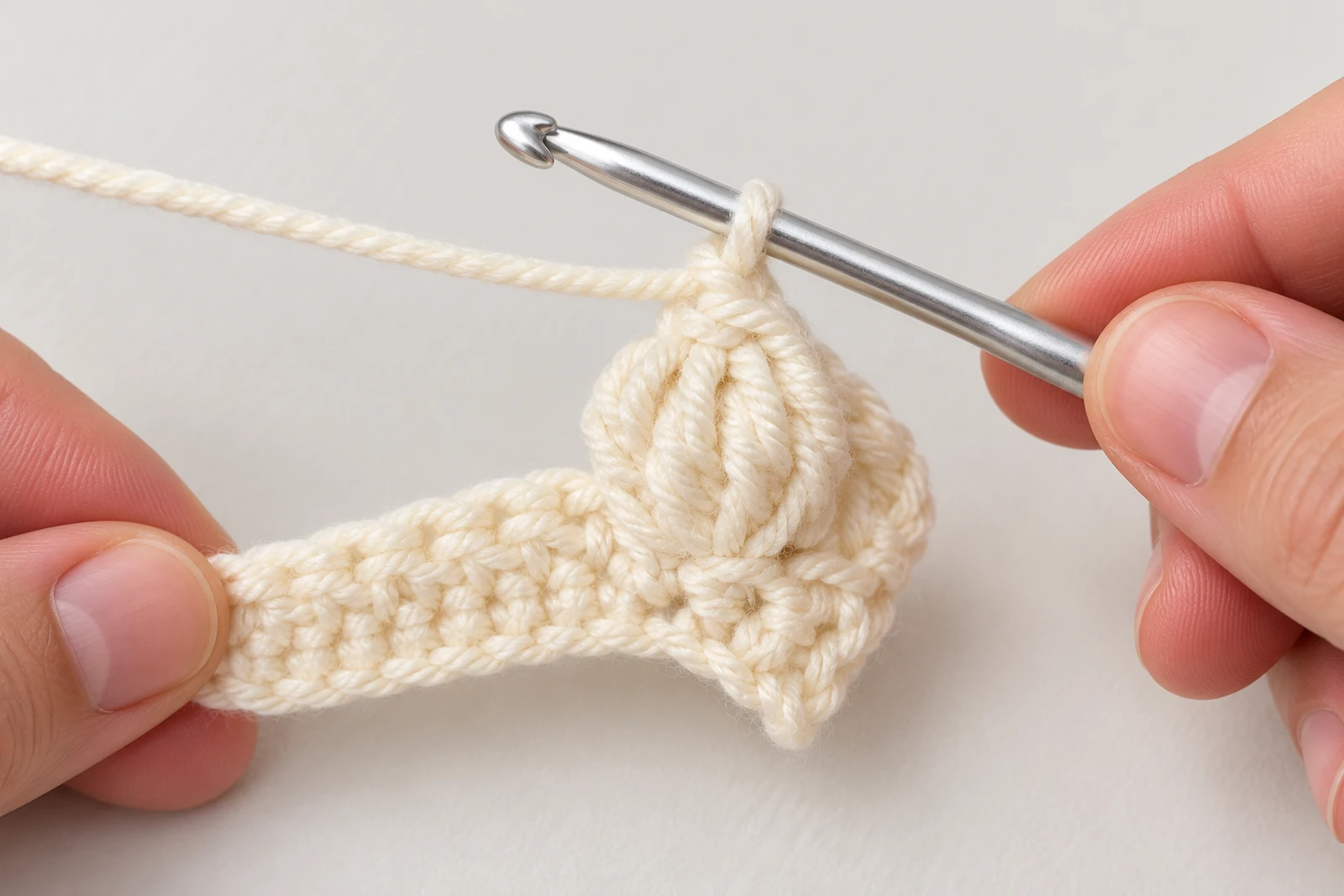 A single crochet in the next stitch locks the bobble.
A 5-double-crochet bobble has 2, 3, 4, 5 and then 6 loops on the hook before the final pull.
| Move | What you do | Loops on the hook afterward |
|---|---|---|
| Start | Working loop only | 1 |
| Leg 1 | Unfinished double crochet | 2 |
| Leg 2 | Unfinished double crochet | 3 |
| Leg 3 | Unfinished double crochet | 4 |
| Leg 4 | Unfinished double crochet | 5 |
| Leg 5 | Unfinished double crochet | 6 |
| Pull through all | Yarn over, pull through every loop | 1, bobble formed |
If the count differs, undo the last leg.
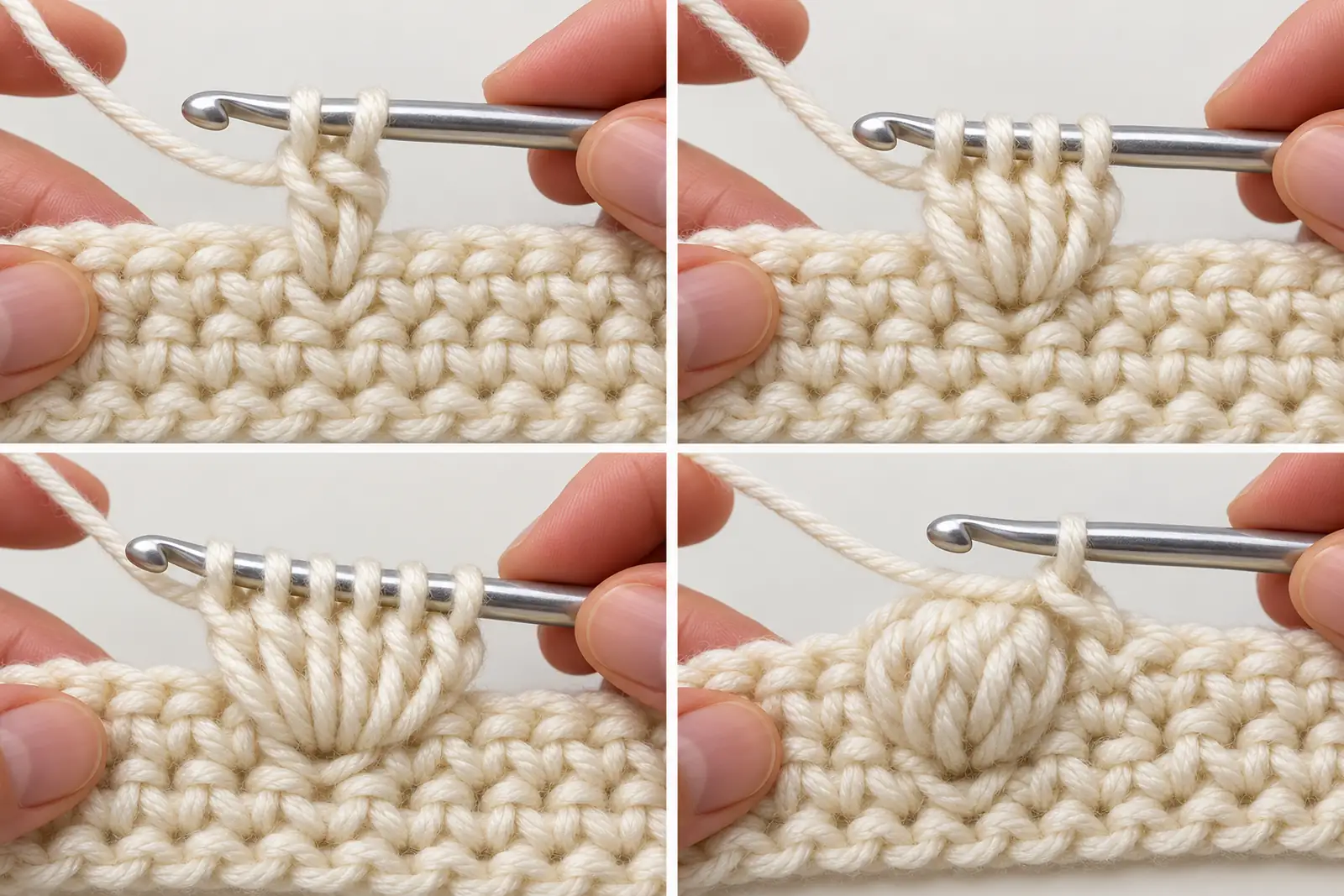 One bobble in four frames: 2 loops, 4 loops, 6 loops, then closed.
A bobble bulges toward the side facing away from you, so the row you work it on decides which side shows it. The fabric is not reversible, with the bobbles on one side and a flatter back on the other, so plan which side is the front.
Work the bobble on a wrong-side row to have it face you on the right side. Many tutorials say the same, but some patterns label the bobble row a right-side row. Follow a pattern’s own side labels, and test on a swatch if it is not clear. This page’s swatch works its bobble rows as wrong-side rows. A swatch tells you the answer faster than any rule.
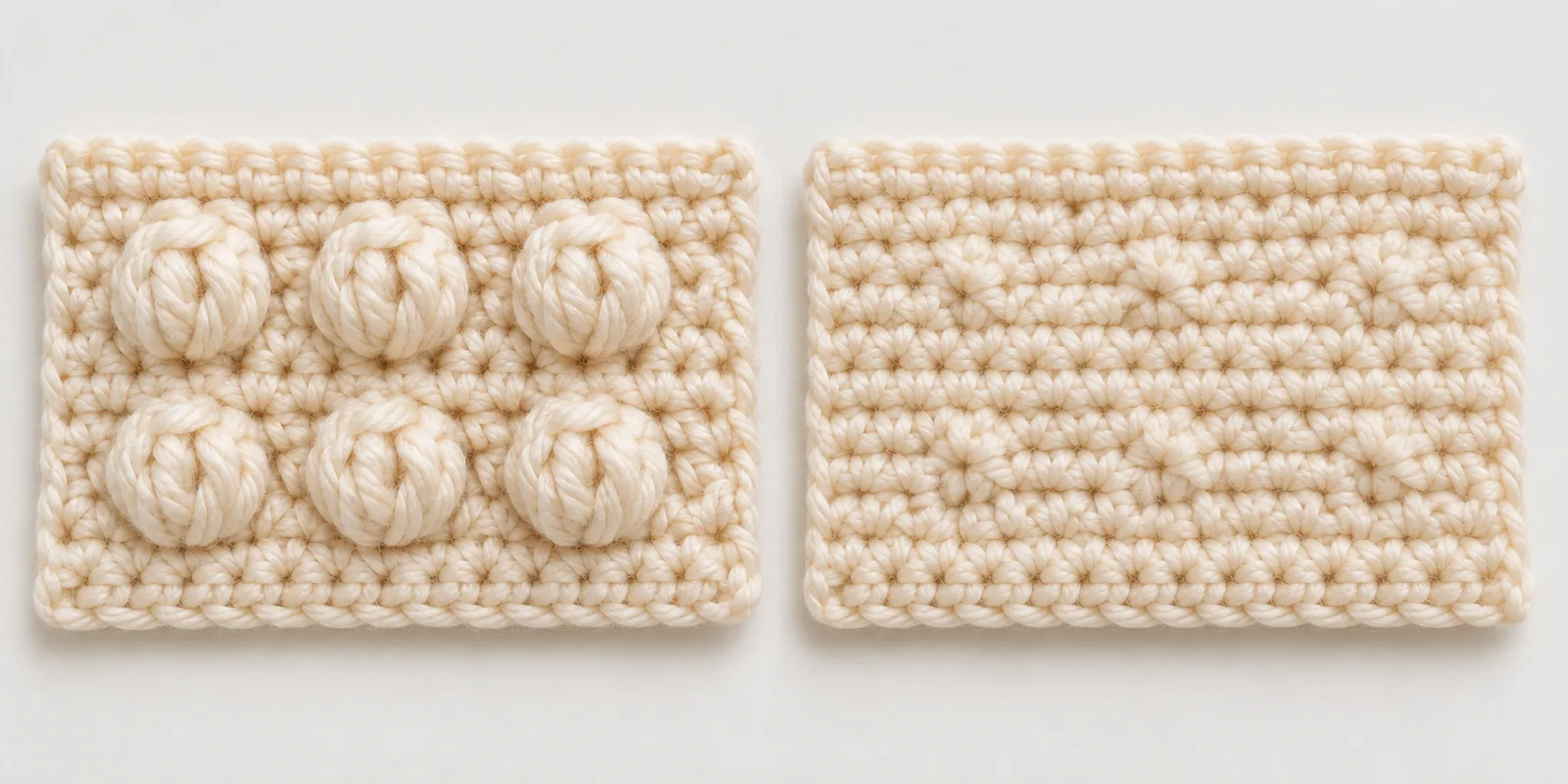 Made on purpose: bobbles worked on a wrong-side row (left) and on a right-side row (right), seen from the same side.
Work plain single crochet rows between bobble rows. Turn and chain 1 for each one, as in how to single crochet. Keep every plain row at the same stitch count. One tutorial uses taller rows of half double crochet to space the bobble rows further apart.
A bobble row has the same number of stitches as the row before it; each bobble counts as one stitch. Bobbles need room to stand out, so spacing and counting are the two habits that matter. For other counting mistakes, see common crochet mistakes.
Leave three single crochets between bobbles. Bobbles worked close together can lose their raised look. Three stitches between means a repeat of 4 stitches, one bobble plus three single crochets; this swatch has 3 plain stitches, then 3 repeats, so it starts with chain 16. Chain multiples vary between patterns, so use the chain count a pattern states.
A bobble counts as one stitch, and the single crochet that closes it counts as the next stitch. In the next row, work a single crochet into the top of each bobble, where the legs close. Count the tops of the stitches and compare with your starting number. A swatch bobble row has 3 bobbles and 12 single crochets, 15 stitches in all.
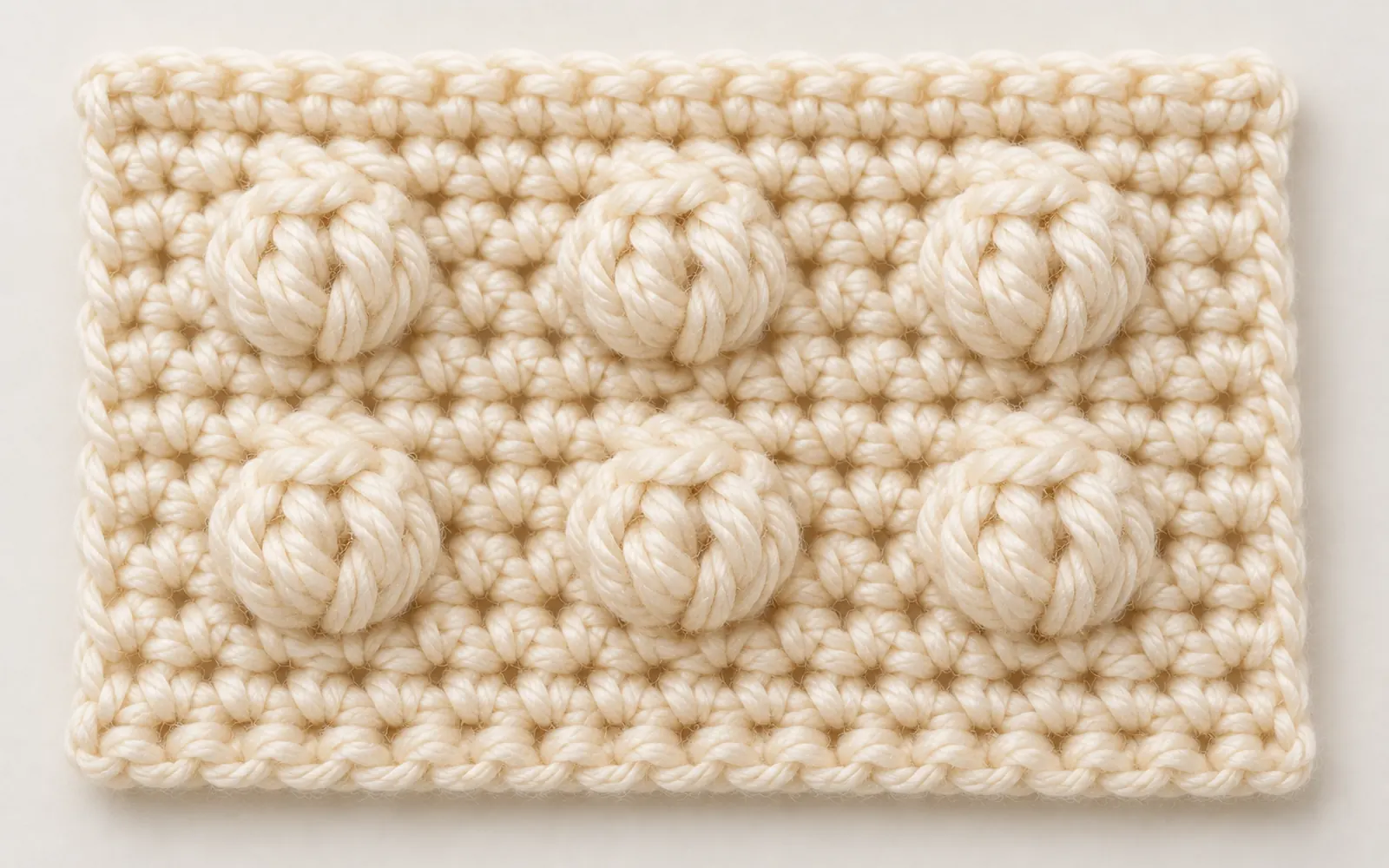
A 15-stitch, 9-row swatch with 2 rows of 3 bobbles is small enough to finish in one sitting and large enough to see the spacing. Abbreviations such as ch, sc and bo are in crochet abbreviations. See crochet stitches and techniques for more.
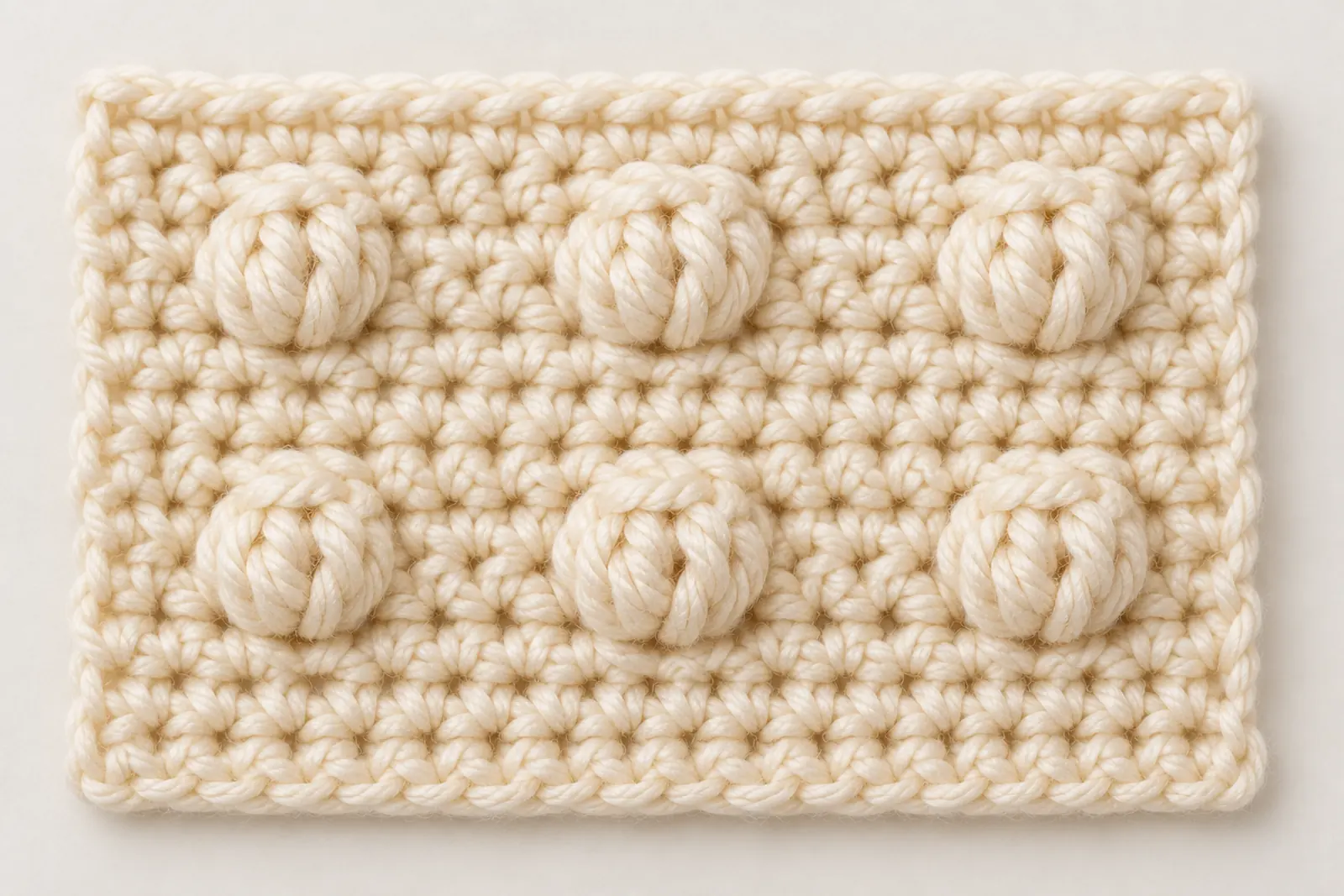 A finished swatch: 15 stitches wide, 9 rows tall, 6 bobbles.
Bobbles usually have 3, 4 or 5 double crochet. Taller legs, such as treble crochet, make a taller bobble. More or fewer legs change the look but not the row’s stitch count, so follow the pattern’s note.
| Legs | Loops on the hook before the final pull | The look |
|---|---|---|
| 3 double crochet | 4 | A small, tidy bump |
| 4 double crochet | 5 | A medium bump |
| 5 double crochet | 6 | The classic full bump (this page) |
Most bobble problems come from the wrong row, the wrong loop count or loose tension. Check those three first, and count the loops after every leg to catch a missed one. For mistakes that apply to any project, see common crochet mistakes.
Flat bobbles usually mean a loose final pull or no closing stitch. Another cause is legs pulled up to different heights. Uneven bobbles usually mean a missed or extra leg, so the loop count was 5 or 7 instead of 6, or a leg went into a different stitch. Keep tension steady, because both loose and tight stitches spoil the look. A loose swatch has soft bobbles with visible gaps.
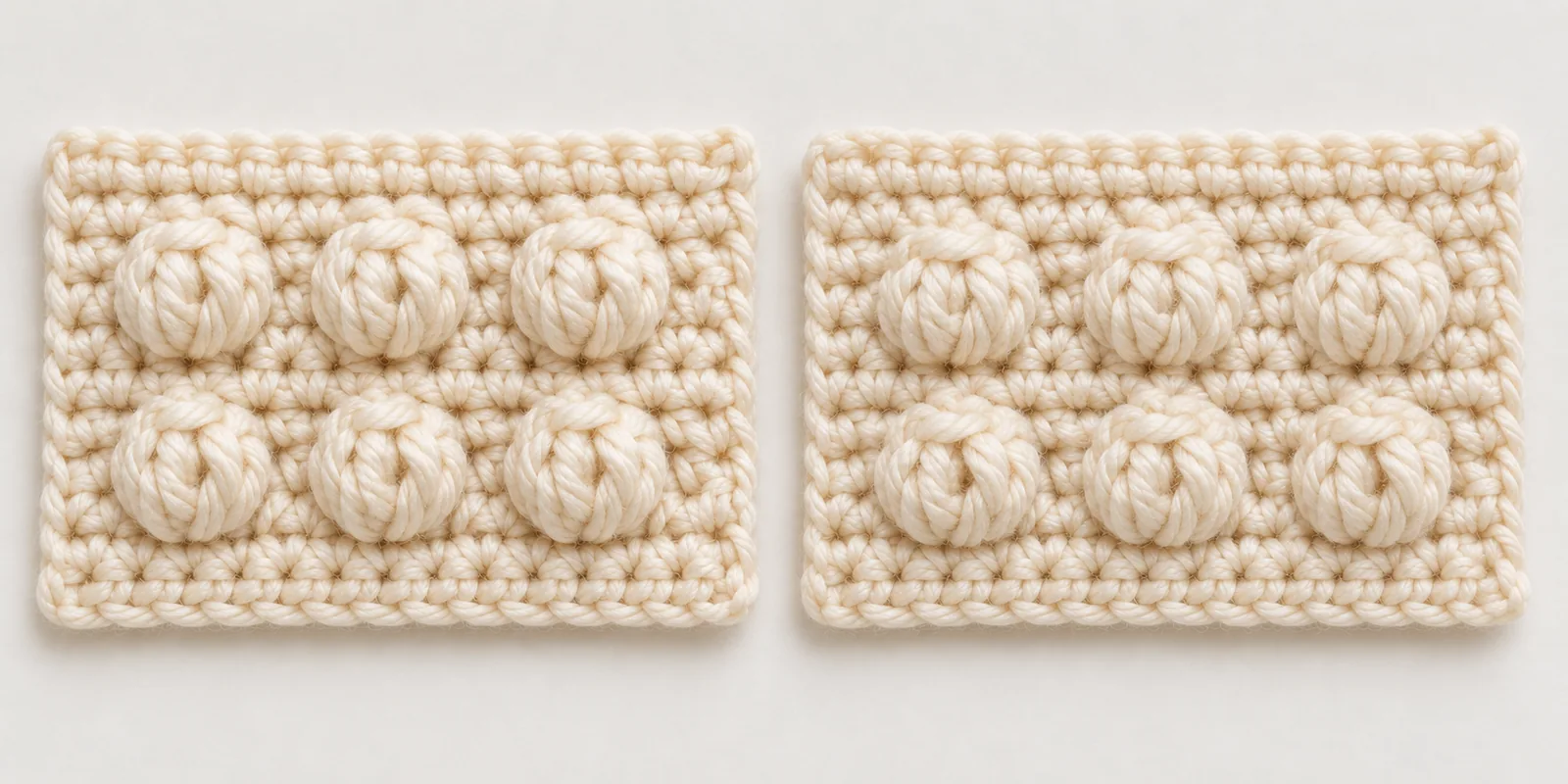 Made on purpose: firm bobbles (left) and loose, soft bobbles (right).
| Problem | Likely cause | Fix |
|---|---|---|
| Bobbles are flat | Loose final pull or no closing stitch | Pull the last step firmer and close with a single crochet |
| Bobbles are uneven in size | Legs at different heights or a wrong loop count | Pull each leg to row height and count 2 to 6 loops |
| Bobbles sink to the back | Worked on the wrong row | Use the other row type, or turn the swatch over |
| Hard to pull through | Tight grip or too many legs | Relax your grip, try 4 legs or a larger hook |
| Gaps beside the bobbles | Loose single crochets next to the bobble | Keep those stitches snug |
| Stitch count changes | A bobble counted twice, or the closing stitch skipped | Count the tops of the stitches and redo the row |
Bobble stitch makes a thick, textured fabric with one right side. The fabric is not reversible, so choose projects where the back will not show. Below are projects that suit it and a note on how much extra yarn to plan for.
Bobble stitch suits blankets, bags and hats, and it works as dots, flowers or a bobble border. Because the fabric has a back, use it where the back will not show, such as a lined blanket, a lined bag or a hat. See the crochet baby blanket guide and how to crochet a bag, or browse free blanket patterns. The Textured Afghan Blanket is a larger project to try once the swatch is even. For other textures, try shell stitch crochet and spike stitch crochet.
Bobbles use more yarn than plain rows, because each one packs several stitches into one. Buy extra, check the pattern’s yardage, and work a swatch with the exact yarn first. See worsted weight yarn for help choosing a yarn for the swatch.
A pattern defines its bobble in a stitch note, and that note is the one to follow. Patterns write the bobble two ways: as a short code in the row and as a full note near the start. See how to read a crochet pattern for the parts.
A pattern’s bobble note lists the legs and the loops. The abbreviation is bo (see crochet abbreviations), and a note may read: 5 unfinished dc in same st, yo and draw through all 6 loops. At the start of a round, chain 3 counts as the first leg, so a beginning bobble is chain 3 plus four unfinished double crochets, then one pull through all 5 loops. The chain stands in for the first leg, so there are five loops before the final pull, not six. In UK patterns the legs are trebles. If a note adds an extra chain, do it. See how to read a crochet pattern for the note.
Five double crochets make the classic bobble, with 6 loops on the hook before the final pull. Three or four give a smaller bobble with 4 or 5 loops, and taller stitches give a taller one. Always follow the pattern’s stitch note, because it states the number of legs. The bigger or smaller bobbles table above shows each count.
The side facing away from you as you work. To have bobbles face you on the right side, work the bobble row on a wrong-side row. Some patterns label the bobble row a right-side row, so follow the pattern’s own labels and test on a swatch. The side section above and its photo show both cases.
Usually the final pull-through was loose, the legs were pulled to different heights, or the closing single crochet was skipped. Pull the last step firmer, bring each leg up to row height, and always close with a single crochet in the next stitch. Count 2 to 6 loops to catch a missed leg. The problems table above covers other causes.
Three single crochets is a good start, giving a repeat of 4 stitches (one bobble plus three single crochets). Bobbles worked closer together can lose their raised look, and bobbles further apart give a sparser texture. Use the stitch count a pattern states, since patterns vary. The swatch uses chain 16 for 3 plain stitches plus 3 repeats. The spacing section above explains the repeat.
No, though the names overlap in patterns. A bobble is incomplete double crochets worked into one stitch and closed together. A cluster spreads its stitches over several stitches, a puff uses half double crochet and a popcorn uses complete stitches that are folded closed. The pattern’s stitch note defines the name. See crochet stitches to know for the full comparison.
Ad-free, printable, and ready for your project bag. We'll also send you one new free pattern every week.
No spam. Unsubscribe anytime.
Written by
Designer & founder
Linda has been crocheting for over 15 years and designs cozy, beginner-friendly patterns that anyone can finish in a weekend.
Keep reading
Crochet stitches to know, 30 in all: basics, shaping, loop and post stitches, shells, bobbles, spikes and edges, each with its abbreviation and use.
Read More: 30 Crochet Stitches Every Maker Should KnowLearn how to crochet granny squares round by round, with corners, color changes, fixes, joining methods and advanced shapes like the solid square.
Read More: How to Crochet Granny Squares: Beginner to AdvancedLearn how to double crochet step by step: yarn over, insert, pull through twice, start a row, work the turning chain and keep edges even.
Read More: How to Double Crochet: Complete Step-by-Step Tutorial