đź§¶ Yarn Calculator

Try

Visit our Etsy Shops

Pick a shop to browse. Each one opens on Etsy in a new tab.

Stitches & Techniques

30 Crochet Stitches Every Maker Should Know

Crochet stitches to know, 30 in all: basics, shaping, loop and post stitches, shells, bobbles, spikes and edges, each with its abbreviation and use.

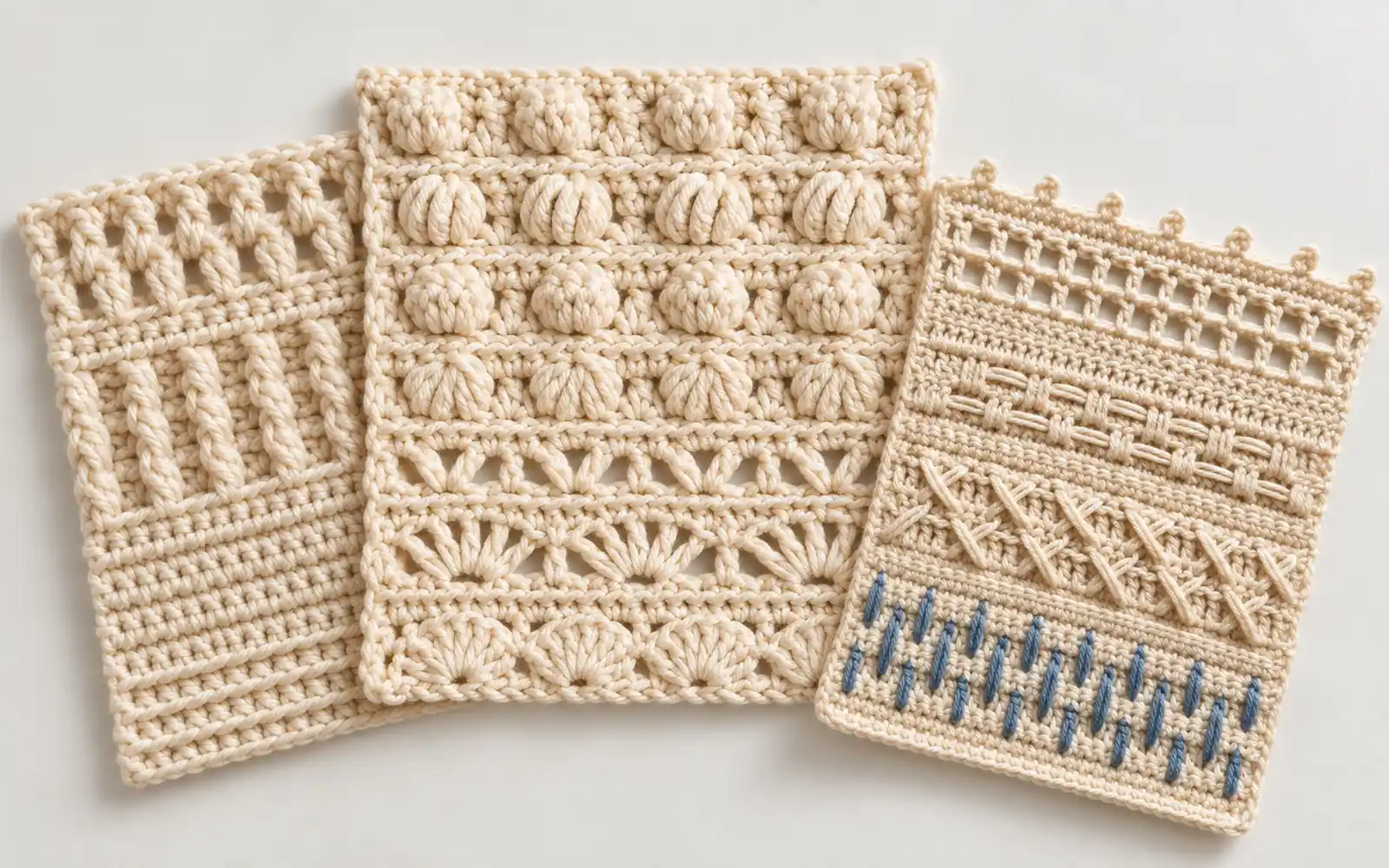
Three crochet stitch sampler swatches on a light linen surface fanned out to show loop and post textures, grouped stitches and spike and mesh stitches in cream yarn
Table of Contents
  1. The Seven Basic Crochet Stitches
  2. Starting and Shaping: Foundations, Rings, Increases and Decreases
  3. Loop and Post Stitches: Same Stitch, New Hook Placement
  4. Grouped Stitches: Shells, Fans, V Stitches, Clusters, Bobbles, Puffs and Popcorns
  5. Spikes, Crosses, Links, Edges and Mesh
  6. Key Takeaways
  7. Frequently Asked Questions

Quick answer: Crochet stitches to know fall into five families: the seven basic stitches, four starting and shaping moves, six loop and post stitches, seven grouped stitches such as shells and bobbles, and six long, crossed, linked or edging stitches. Start with single and double crochet; most others are built from them.

You open a pattern and meet puff, spike, linked and FPdc in one row. Every list online seems to give a different set of names, and none says which ones you will use next week, or what they are made from.

This page names 30 stitches and starting moves in five families. Each entry gives the abbreviation, the stitch it is built from, how it looks, and what to use it for. Full tutorials are linked, so nothing here is a long lesson. It also says which stitches to learn first.

If I could keep only five, I would keep chain, single crochet, double crochet, slip stitch and the invisible decrease. Shells and bobbles are just double crochet in a new place.

The Seven Basic Crochet Stitches

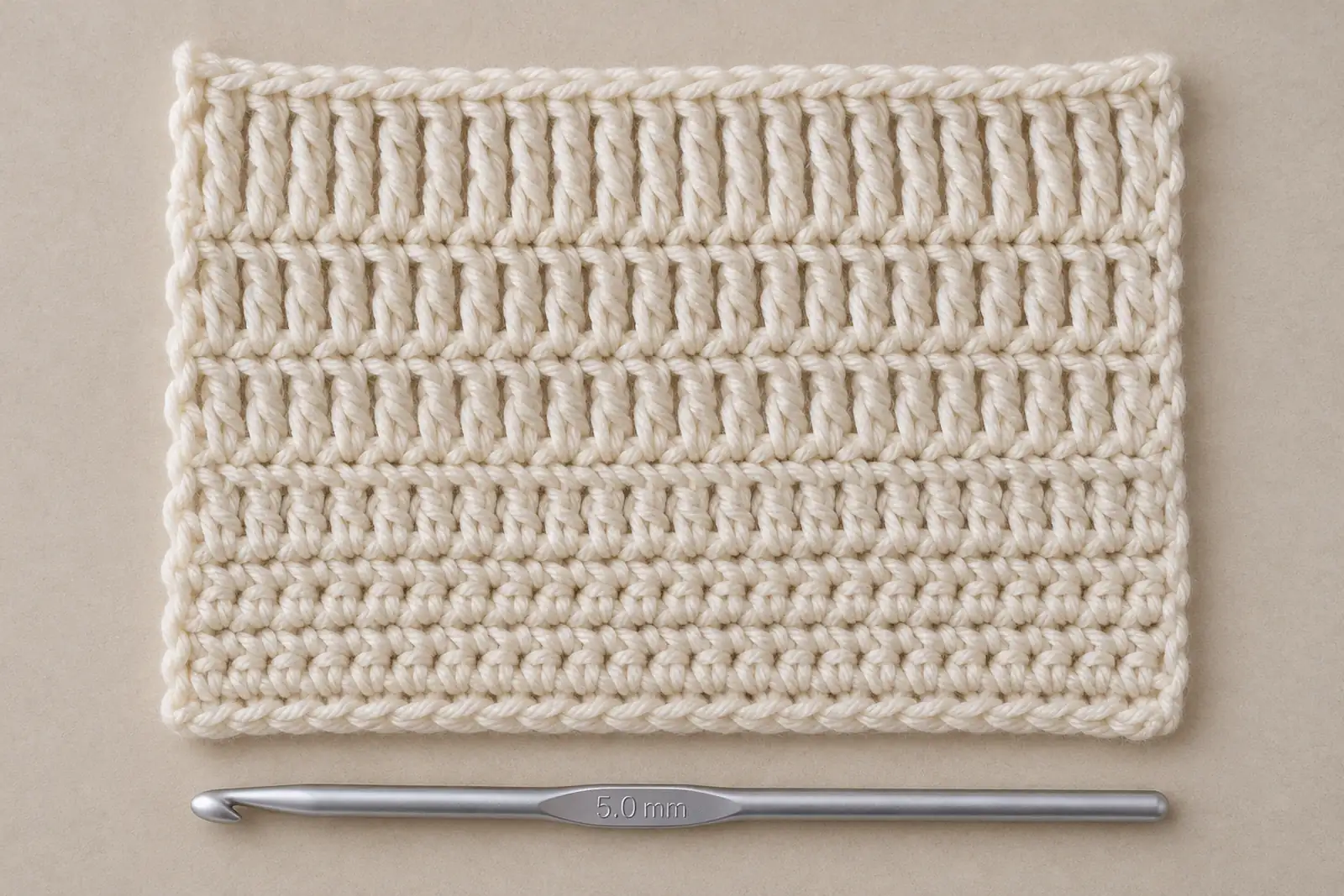
These seven stitches use US names, and they differ mainly in height. Every other stitch in this list is a combination of them, so they come first, from shortest to tallest. UK names appear only in the FAQ. The photo shows the heights side by side.

Crochet stitches to know: one swatch with two rows each of single, half double, double and treble crochet, rows getting taller from bottom to top

From the bottom: single crochet, half double, double and treble crochet, two rows each.

Slip Stitch (sl st)

A slip stitch is the shortest crochet stitch, pulled through the stitch and the loop on the hook in one step. It adds almost no height. Use it to join a round, to travel across stitches without adding height, to seam pieces and to make neat edges.

Chain (ch)

A chain is the base of almost every pattern: yarn over and pull through the loop on the hook. Chains make the starting row, the turning chain and the spaces in lace stitches. The loop on the hook is not counted as a stitch. See crochet abbreviations.

Single Crochet (sc)

Single crochet is the usual stitch for shapes that must keep their form: pull up a loop (two loops on the hook), then yarn over and pull through both. The fabric is short, dense and firm. Use it for amigurumi, coasters and edges; see how to single crochet.

Half Double Crochet (hdc)

Half double crochet takes a yarn over before the hook goes in, then finishes with one pull through all three loops. That finish matters for color changes. Between single and double in height, it works up soft and quick, for hats and blankets.

Double Crochet (dc)

Double crochet is the workhorse of blankets and granny squares: yarn over, insert the hook, pull up a loop (three loops on the hook), then yarn over and pull through two loops twice. Tall, drapey and quick. See how to double crochet and single crochet vs double crochet.

Treble Crochet (tr)

Treble crochet, also called triple crochet, takes two yarn overs before the hook goes in; after pulling up a loop, yarn over and pull through two loops three times. It is tall and open, which suits lace, tall shells and light fabrics. Its turning chain is taller.

Double Treble Crochet (dtr)

Double treble crochet takes three yarn overs before the hook goes in; after pulling up a loop, yarn over and pull through two loops four times. It is very tall, appears in lace and long shells, and is rarely used for whole garments.

Starting and Shaping: Foundations, Rings, Increases and Decreases

These four moves start a piece or change its width, and all use stitches already covered; the magic ring is a technique that patterns write like a stitch, so it is counted here. For projects, see the free amigurumi patterns, the Heart Keychain and the Minimal Frog Amigurumi.

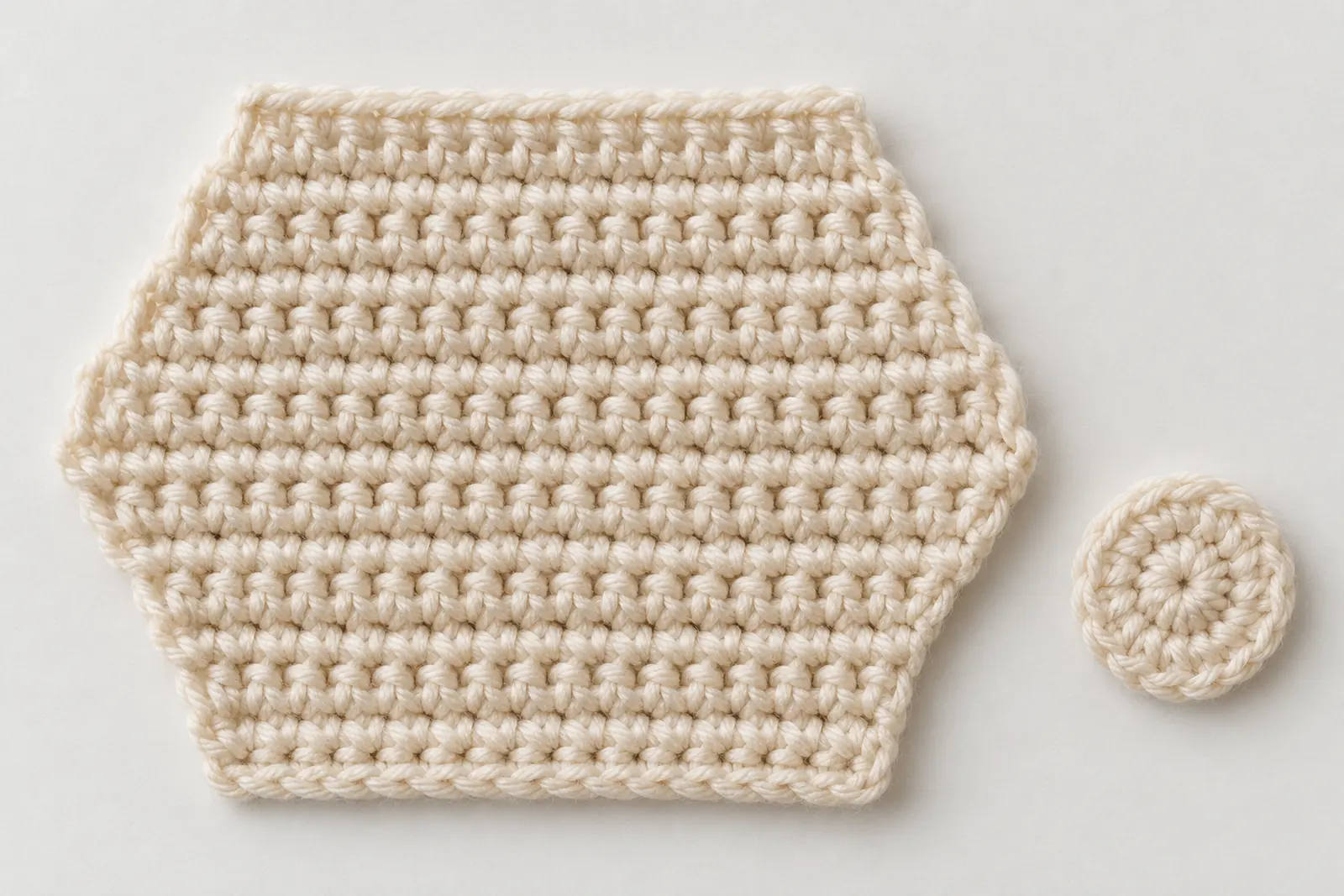
A crochet swatch started with foundation single crochet that widens with increases and narrows with decreases, beside a small closed magic ring circle

Foundation single crochet (bottom), increases and decreases at the edges, and a magic ring circle (right).

Foundation Single Crochet (fsc)

Foundation single crochet (fsc) makes the starting chain and the first row in one pass: chain two, then work each stitch into the base of the last. It gives a stretchy first row that avoids a tight chain (see common crochet mistakes), though it takes longer.

Magic Ring (MR)

A magic ring is a loop of yarn that the first round’s stitches are worked into, then pulled tight by the tail to close the center with no hole. It suits amigurumi, hats and flat circles. See the magic ring crochet tutorial and how to make amigurumi.

Increase (inc)

An increase is two stitches in one stitch, which adds one stitch to the count. It widens a flat piece and makes a circle or sphere grow. Space increases out so they do not stack, as crochet in the round explains.

Decrease (dec, sc2tog)

A decrease works two stitches together as one, which reduces the count by one. The standard form, sc2tog, can leave a small bump, and many makers use the invisible decrease for amigurumi. It shapes hat tops and toy ends; see the invisible decrease tutorial.

Loop and Post Stitches: Same Stitch, New Hook Placement

Unless a pattern says otherwise, the hook goes under both loops of the stitch. These six entries change only the hook placement, so they are techniques counted as stitches; how to read a crochet pattern shows the wording. For projects, see the free wearable patterns and the Modern Diamond Beanie.

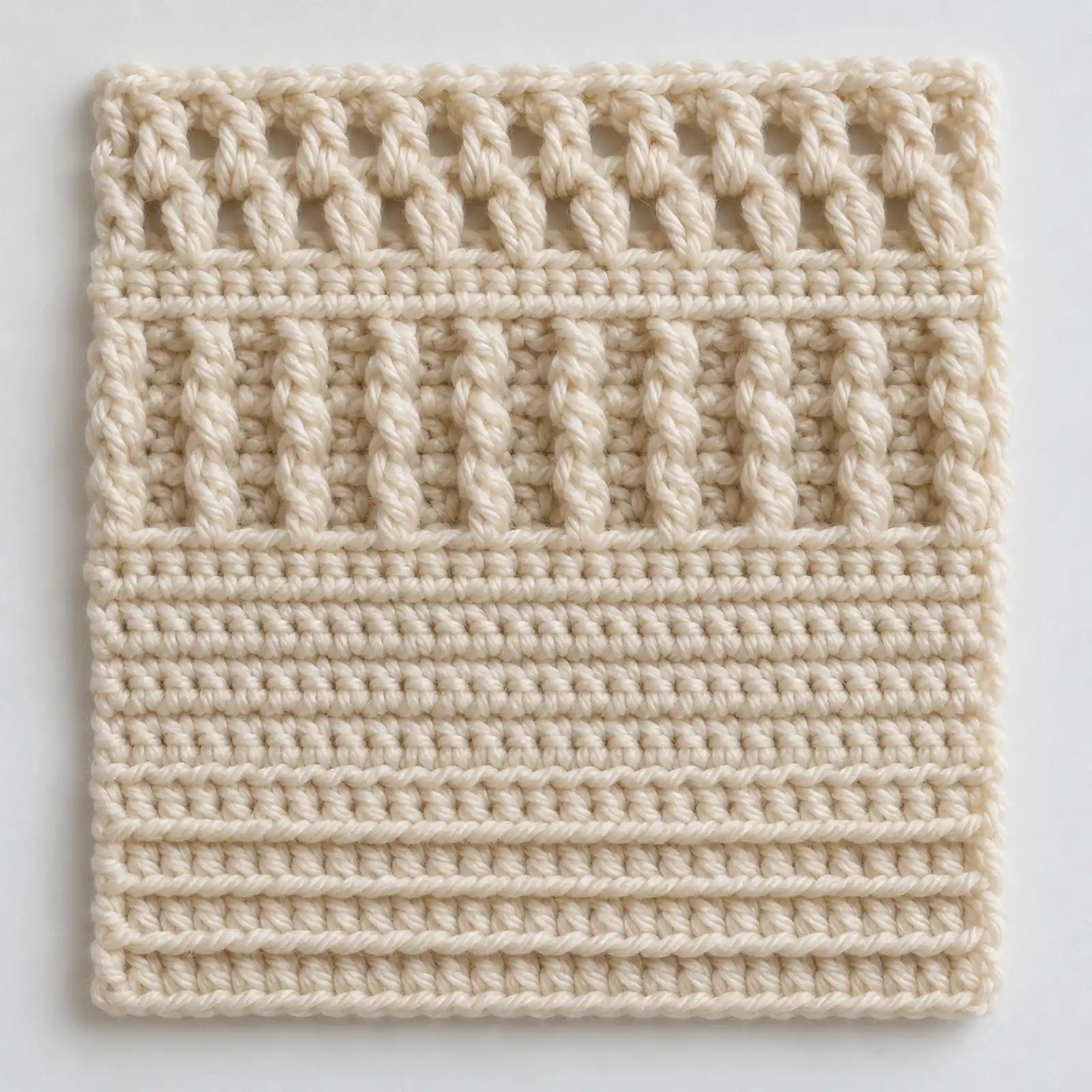
A crochet sampler swatch in four bands showing back loop only ridges, front loop only rows, a post stitch rib and stitches worked between stitches

From the bottom: back loop only, front loop only, post stitch rib, and double crochet worked between stitches.

Front Loop Only (FLO)

Front loop only means the hook goes under only the front loop of the stitch, the one closest to you. Worked on every row, it gives a less pronounced texture than back loop only, so it suits subtle ridges and folds. Also written TFL.

Back Loop Only (BLO)

Back loop only leaves the front loop unworked, which creates a ridge. The hook goes under only the loop farthest from you. Worked on every row of single crochet, it gives a deep ridged effect, which suits scarves, brims, cuffs and slip stitch ribbing. Also written TBL.

Front Post Double Crochet (FPdc)

The post is the upright stem of the stitch. To work one, yarn over and insert the hook from front to back to front around the post below, then finish as a double crochet. It pushes the stitch toward you in raised lines, for ribbing and cables.

Back Post Double Crochet (BPdc)

A back post double crochet is worked the same way, but the hook goes behind the post, so the stitch sits toward the back of the fabric. Front and back posts are used together: worked side by side, they make ribbing.

Post Rib Stitch

A post rib stitch alternates one front post and one back post double crochet across the row: front post, back post, repeat. It gives a stretchy fabric that imitates knitted ribbing, and it is used for cuffs, brims and hat borders.

Between the Stitches (spaces)

Working between the stitches means placing the hook in the gap between two stitches of the row below, not in the top. It gives a looser surface with a subtly different texture. Patterns ask for it as in space or between stitches; it is not a chain space.

Grouped Stitches: Shells, Fans, V Stitches, Clusters, Bobbles, Puffs and Popcorns

If a pattern defines a stitch, the pattern’s definition wins, because the same name can mean different stitches in different patterns. These stitches put several stitches in one place or join several at one top. For blankets, see the crochet baby blanket guide, free blanket patterns and Textured Afghan Blanket.

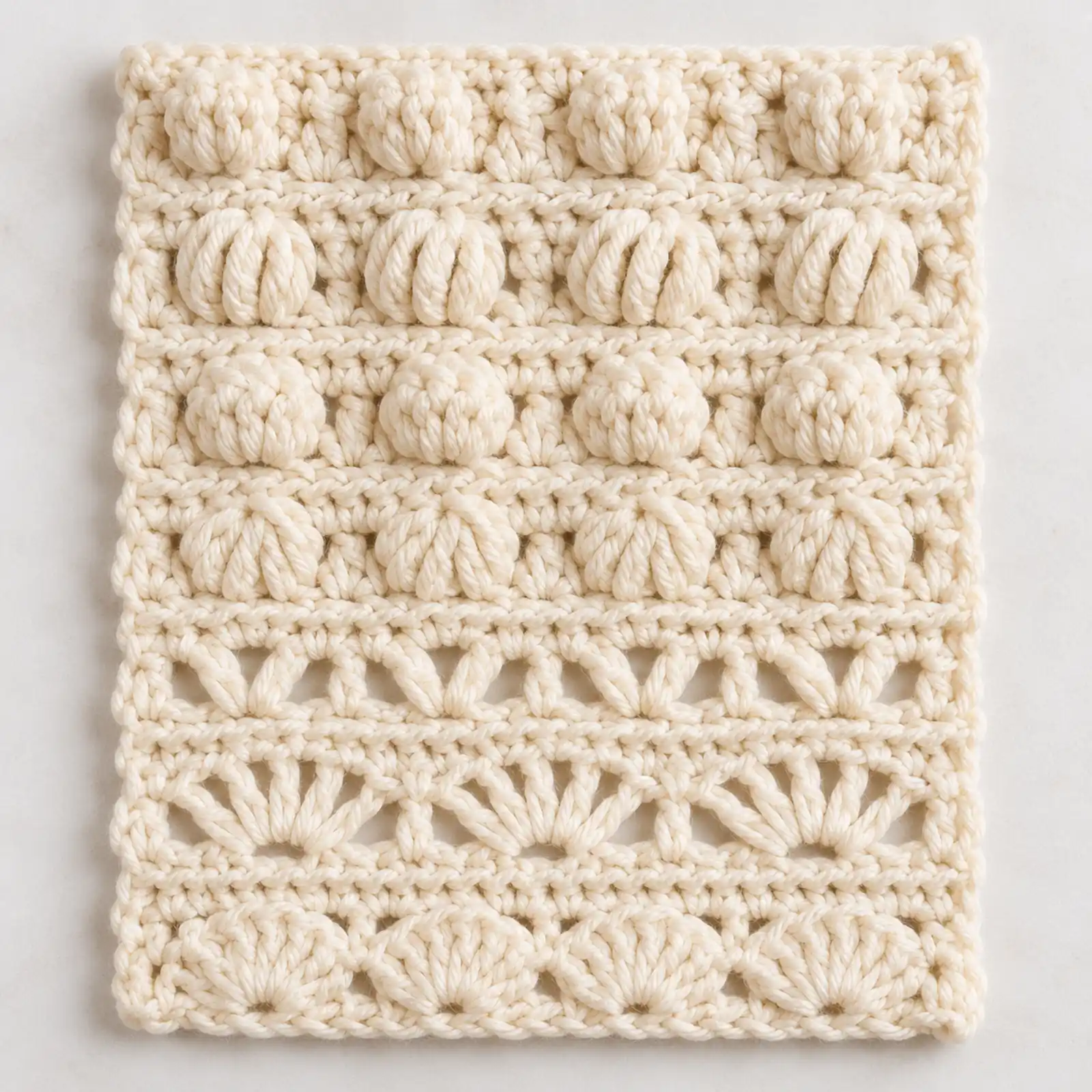
A crochet sampler swatch in seven bands showing shell, fan, V stitch, cluster, bobble, puff and popcorn stitches side by side

From the bottom: shell, fan, V stitch, cluster, bobble, puff and popcorn.

Shell Stitch

A shell is a group of stitches, usually 4 or 5 double crochet, worked into one stitch or space so they fan out and the row scallops. It suits blankets and edgings. Granny squares use shell-like groups that patterns often call clusters; see granny squares and shell stitch crochet.

Fan Stitch

A fan is a shell with a gap: the same fan of stitches, but with a chain space between them, which looks lighter and lacier than a solid shell. Fans suit scarves and wraps. Some patterns use shell and fan for the same thing, so follow the pattern.

V Stitch

A V stitch is double crochet, chain 1, double crochet in the same stitch or space, which makes a V. It uses fewer stitches than a shell and is the smallest form of the fan idea. Use it for open, quick blankets and scarves.

Cluster (cl)

A cluster joins stitches worked over several different stitches at the top. It is made of incomplete stitches, such as three double crochet, closed together in one pull-through, so it looks like an upside-down shell and reduces the count at the top. Use it for scallops and lace.

Bobble Stitch

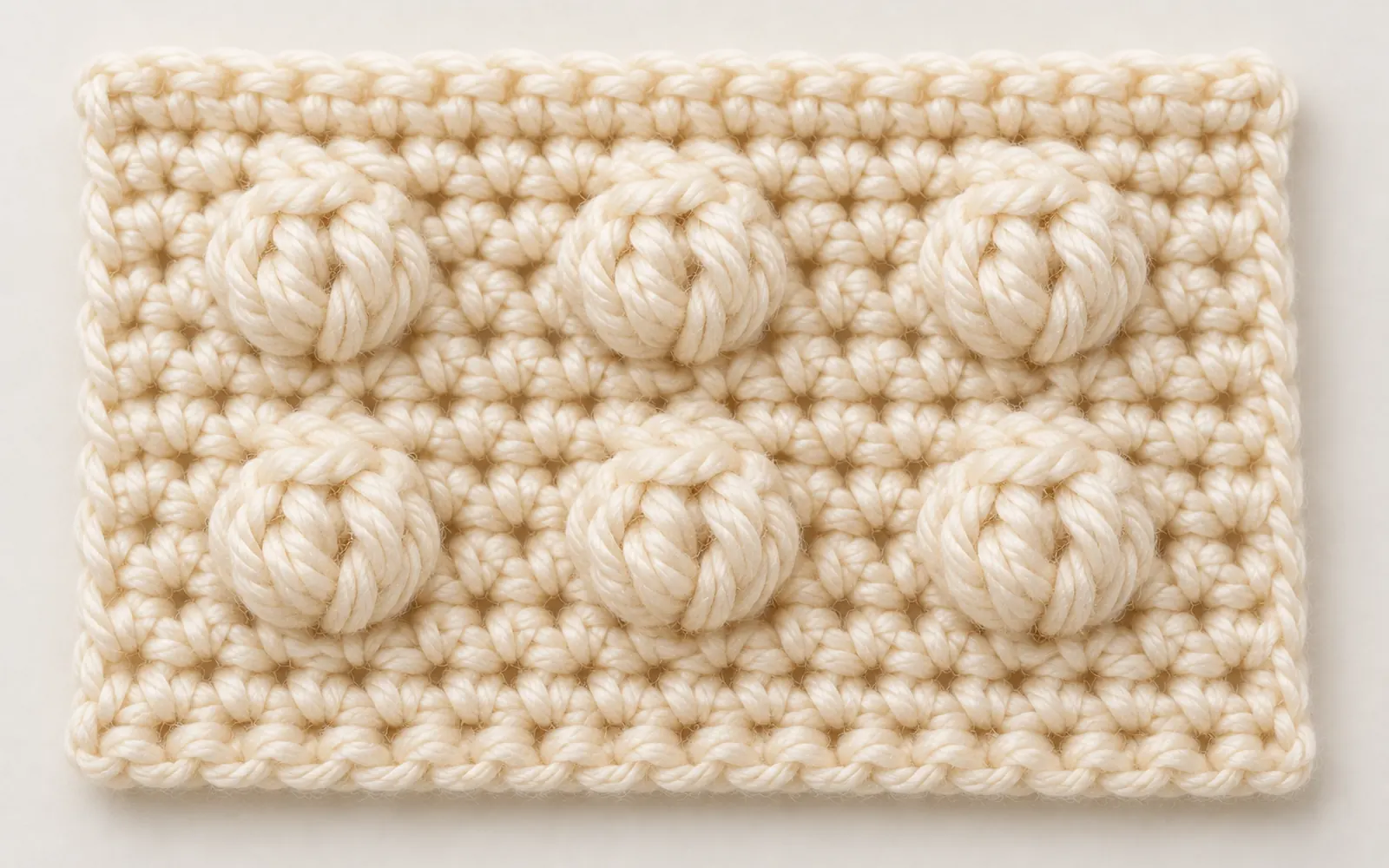
A bobble (bo) is five double crochet, each left incomplete, worked into one stitch, which leaves six loops on the hook; one yarn over is then pulled through all six. It pushes out as a raised bump. Use it for dots, flowers and textured blankets; see bobble stitch crochet.

Puff Stitch

A puff (ps) is a bobble made from half double crochet: work half double crochet into one stitch, leaving all the loops on the hook, then close them in one pull-through. Three half doubles leave seven loops. It is softer and rounder than a bobble, with a plush texture.

Popcorn Stitch

A popcorn (pc) is complete stitches, usually five double crochet, worked into one stitch and folded closed: take out the hook, insert it into the top of the first stitch and pull the last loop through. Unlike a bobble, the top protrudes forward. Use it for bold, raised dots.

Cluster, Bobble, Puff or Popcorn? A Quick Comparison

Stitch Made from Worked into Closed how
Cluster Incomplete stitches Several different stitches Joined at the top
Bobble Incomplete double crochet One stitch Joined at the top
Puff Half double crochet One stitch All loops pulled through together
Popcorn Complete stitches One stitch Folded and closed

Cluster, bobble, puff and popcorn compared.

Cluster and bobble both use incomplete stitches closed at the top; the cluster spreads over several stitches and the bobble stays in one. Puff and popcorn both sit in one stitch, but the puff closes all its loops in one pull-through while the popcorn is finished with a fold. Designers define these four slightly differently, so the pattern’s own stitch notes win; see how to read a crochet pattern and crochet abbreviations.

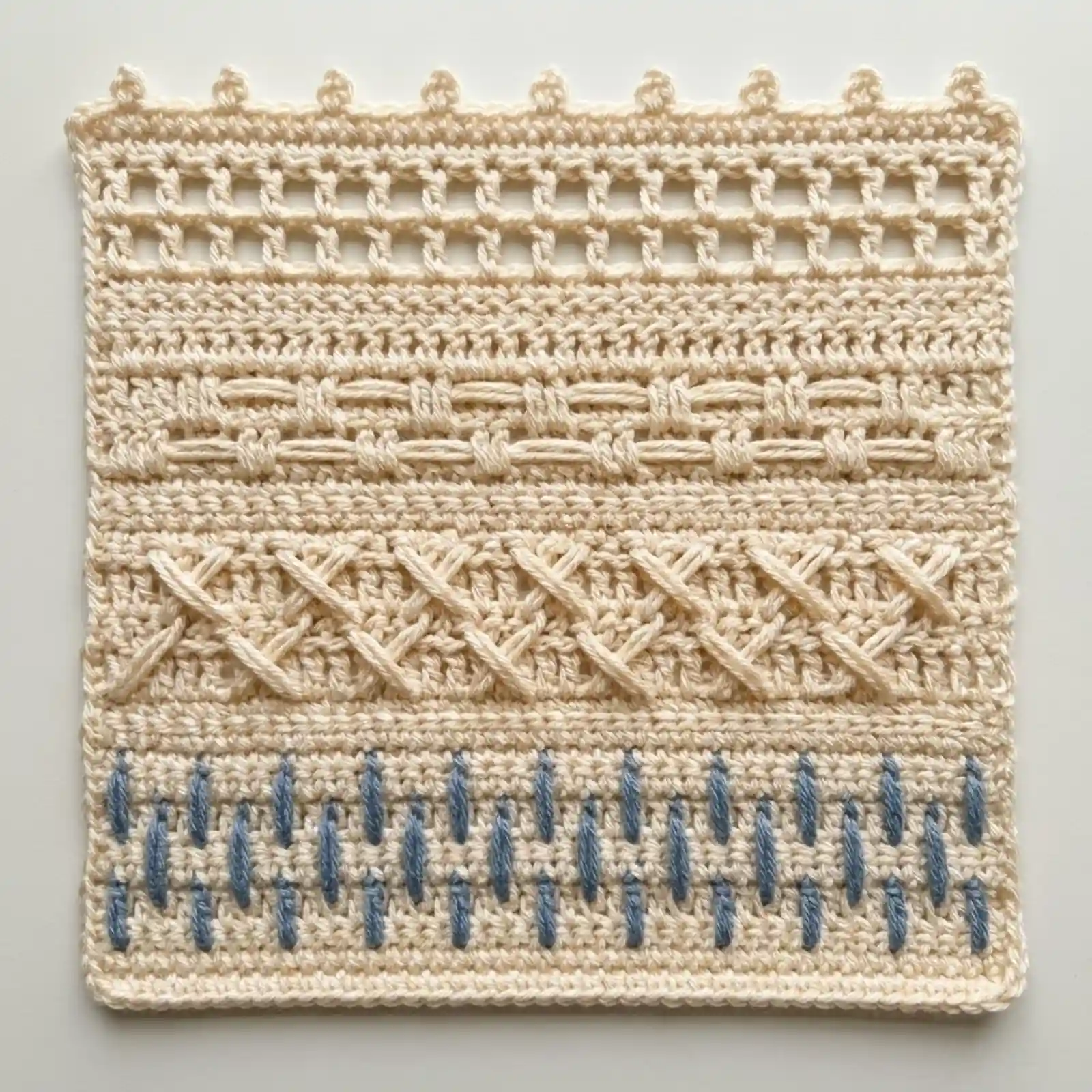
Spike, crossed, linked, reverse single crochet, picot and mesh stitches reach to another row, cross, link, run backward or leave spaces. They are the finishing touches and the openwork of the list. For projects, see the free home patterns and the Citrus Slice Coaster.

A crochet sampler swatch with a reverse single crochet edge, spike stitches, a crossed band, linked double crochet, open mesh and a picot edge

From the bottom: reverse single crochet edge, spike, crossed, linked, mesh and a picot edge.

Spike Stitch

A spike stitch is worked into the stitch below, not the one beside it, so its long loop sits over the rows between. Insert the hook into the top of a stitch one row below. Use it for color streaks and texture; see spike stitch crochet.

Crossed Double Crochet

Crossed double crochet crosses two stitches because one is worked back into a skipped stitch: skip a stitch, double crochet into the next stitch, then work a long double crochet back into the skipped stitch. It gives a woven look and suits textured scarves and blankets.

Linked Double Crochet

Linked stitches close the gaps between tall stitches. In linked double crochet, a loop drawn through the horizontal bar of the previous stitch replaces the first yarn overs, which links neighbors. The fabric comes out solid. Designers abbreviate linked stitches differently, so check the pattern’s key.

Reverse Single Crochet (Crab Stitch)

Reverse single crochet, or crab stitch, is single crochet worked backward: you work from left to right if you are right-handed, without turning at the end of the row. The stitches twist into a small rope-like border. Use it to finish the edges of blankets and garments.

Picot

A picot is a small decorative loop: chain a few stitches, usually three, then slip stitch back into the first chain or the stitch below. Three-chain picots decorate edgings, lace and doilies, and they are the common size.

Mesh Stitch

Mesh stitch is a grid of stitches and chain spaces, such as double crochet, chain 1, skip a stitch, repeated across the row. It gives an open, light fabric, so it suits market bags, shawls and curtains. Filet crochet builds designs from the same mesh.

Key Takeaways

  • Crochet stitches to know fall into five families with 30 entries: 7 basic, 4 starting and shaping, 6 loop and post, 7 grouped and 6 long, crossed, linked or edging.
  • Learn chain, slip stitch, single crochet and double crochet first; every other stitch on the list is built from them.
  • Loop and post stitches change only the hook placement; unless a pattern says otherwise, put the hook under both loops.
  • Cluster, bobble, puff and popcorn group the same basic stitches in different ways, and names vary, so follow the pattern’s stitch notes.
  • Shell, fan and V stitch differ by gap: a shell is solid, a fan adds a chain space, and a V stitch is two stitches with one chain between.

For the full learning path, read crochet stitches and techniques.

Frequently Asked Questions

How many crochet stitches are there?

There is no fixed number. Most stitches are combinations of a few basics, so a count depends on how a list groups them. This page names 30, grouped in five families: 7 basic, 4 starting and shaping, 6 loop and post, 7 grouped and 6 long, crossed, linked or edging. The first section above covers the basics.

Which crochet stitches should a beginner learn first?

Chain, slip stitch, single crochet and double crochet, then half double crochet. These cover most patterns, and the other stitches are built from them. After that, learn the increase and decrease for shapes, and leave shells, bobbles and spikes for later. The first two sections above cover each stitch, and the beginner’s guide to crochet gives a full starting path.

Are bobble, puff and popcorn stitches the same thing?

No, though patterns sometimes mix the names. A bobble is incomplete double crochet closed together in one stitch, a puff does the same with half double crochet, and a popcorn uses complete stitches that are folded closed. A cluster is worked over several stitches. The comparison table above sets them side by side; follow the pattern’s own notes.

Are UK and US crochet stitch names the same?

No. UK patterns use different names for the same stitches, so a UK double crochet is a US single crochet, a UK treble is a US double crochet and a UK half treble is a US half double crochet. This page uses US terms. Check the pattern’s header for its terms; crochet abbreviations and how to read a crochet pattern explain how to tell.

What is the difference between a shell, a fan and a V stitch?

The difference is the gap. A shell is a solid run of stitches in one place, a fan adds a chain space between stitches, and a V stitch is two stitches separated by one chain in the same stitch. Patterns sometimes use shell and fan for the same thing, so follow the pattern. The grouped stitches section above shows each one.

What is the easiest textured crochet stitch to learn?

Back loop only is the easiest, since it is single crochet with one changed hook placement and no new motion. A reasonable next step is front post double crochet, followed by shells and V stitch, and then bobbles. Each one adds a single new move to stitches you already know. The loop and post section and the grouped stitches section above cover them.

Portrait of Linda Davidsen

Written by

Linda Davidsen

Designer & founder

Linda has been crocheting for over 15 years and designs cozy, beginner-friendly patterns that anyone can finish in a weekend.

Keep reading

All posts