Common Crochet Mistakes and How to Fix Them
Twisted chains, wavy edges, wrong stitch counts: the common crochet mistakes beginners make, how to spot each one and how to fix it.
Read More: Common Crochet Mistakes and How to Fix Them 🧶 Yarn Calculator
Beginner Guides
Every crochet abbreviation explained: sc, dc, hdc, tr, MR, BLO and more, plus US and UK differences and chart symbols.
 By Linda Davidsen · · 15 min read
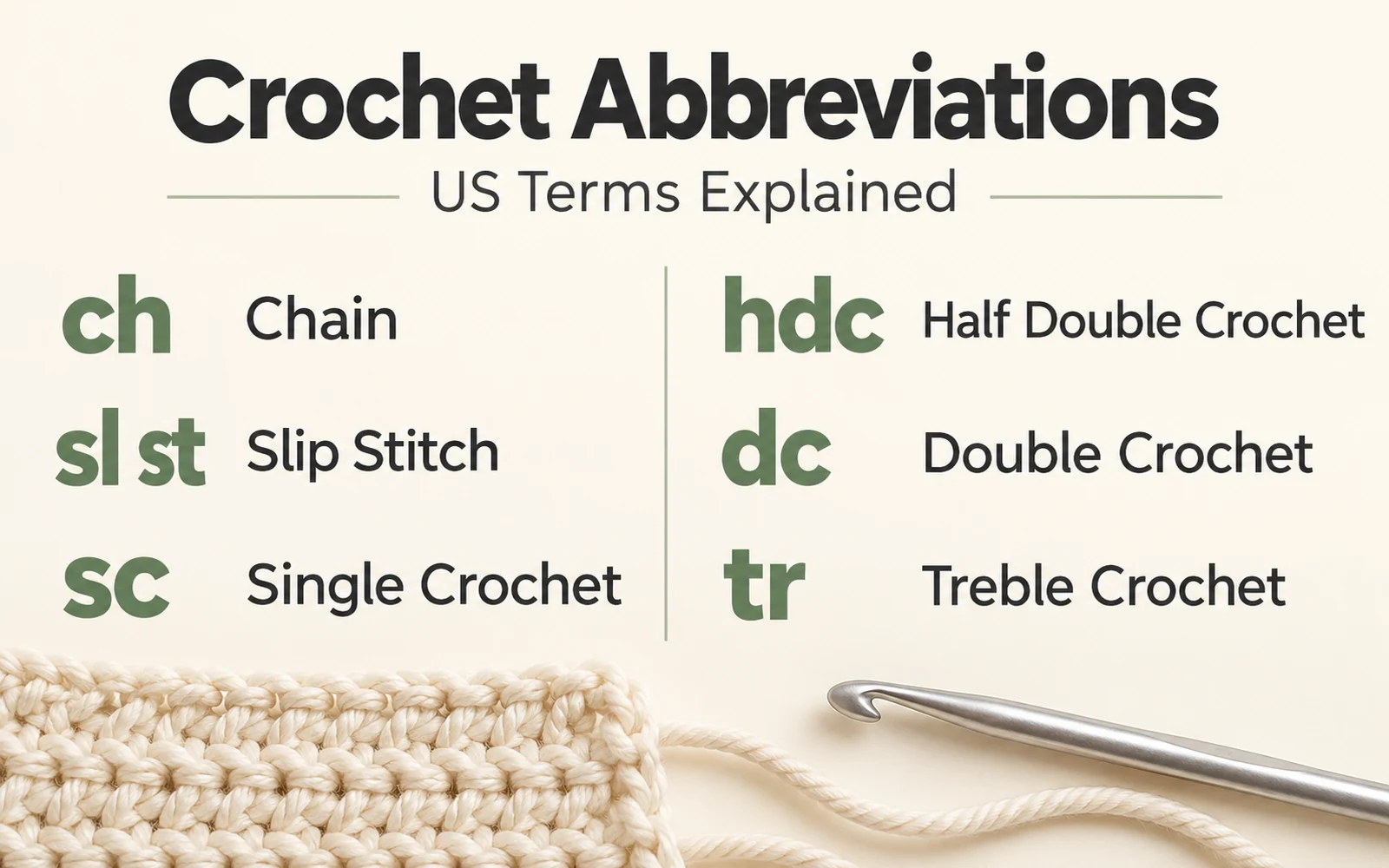
Crochet abbreviations are short codes for stitches and instructions, such as ch for chain, sc for single crochet and dc for double crochet. Most US patterns follow the Craft Yarn Council list, but a pattern’s own abbreviation key always wins, and UK patterns use the same names for different stitches.
You open a free pattern and the first line reads Rnd 1: MR, 6 sc in ring. Every word after the colon looks like a code, and nobody gave you the key. You do not need the whole alphabet of shorthand to get started. About a dozen terms cover most beginner patterns.
This page lists the abbreviations you are likely to meet, grouped by what they do. It also covers the US and UK differences, the shorthand amigurumi designers add, the symbols used in charts, and what to do when a pattern uses a term you cannot find.
Before the first row, I read the pattern’s abbreviation key, every time. A designer’s own key beats any list I can give you, and two minutes there saves an hour of ripping out.
Twelve terms cover most beginner patterns: six stitch names and six bits of everyday shorthand. This page uses US terms until the UK section further down. The Beginner’s Complete Guide to Crochet sets the scene, and the crochet stitches and techniques hub shows how each stitch is made.
Nearly every beginner pattern is built from these six.
| Abbreviation | Full term | What it is | Relative height |
|---|---|---|---|
| ch | chain | The base of most projects, and the loops that start many rows. | Base |
| sl st | slip stitch | Joins or moves the yarn without adding height, and is usually not counted as a stitch. | No added height |
| sc | single crochet | The shortest of the main stitches. | Shortest |
| hdc | half double crochet | A stitch that sits between sc and dc in height. | Between sc and dc |
| dc | double crochet | Taller than hdc, with a looser, more open fabric. | Taller than hdc |
| tr | treble (also called triple) | Taller than dc, with two yarn overs before the hook goes in. | Taller than dc |
From shortest to tallest, the main stitches are sc, hdc, dc and tr.
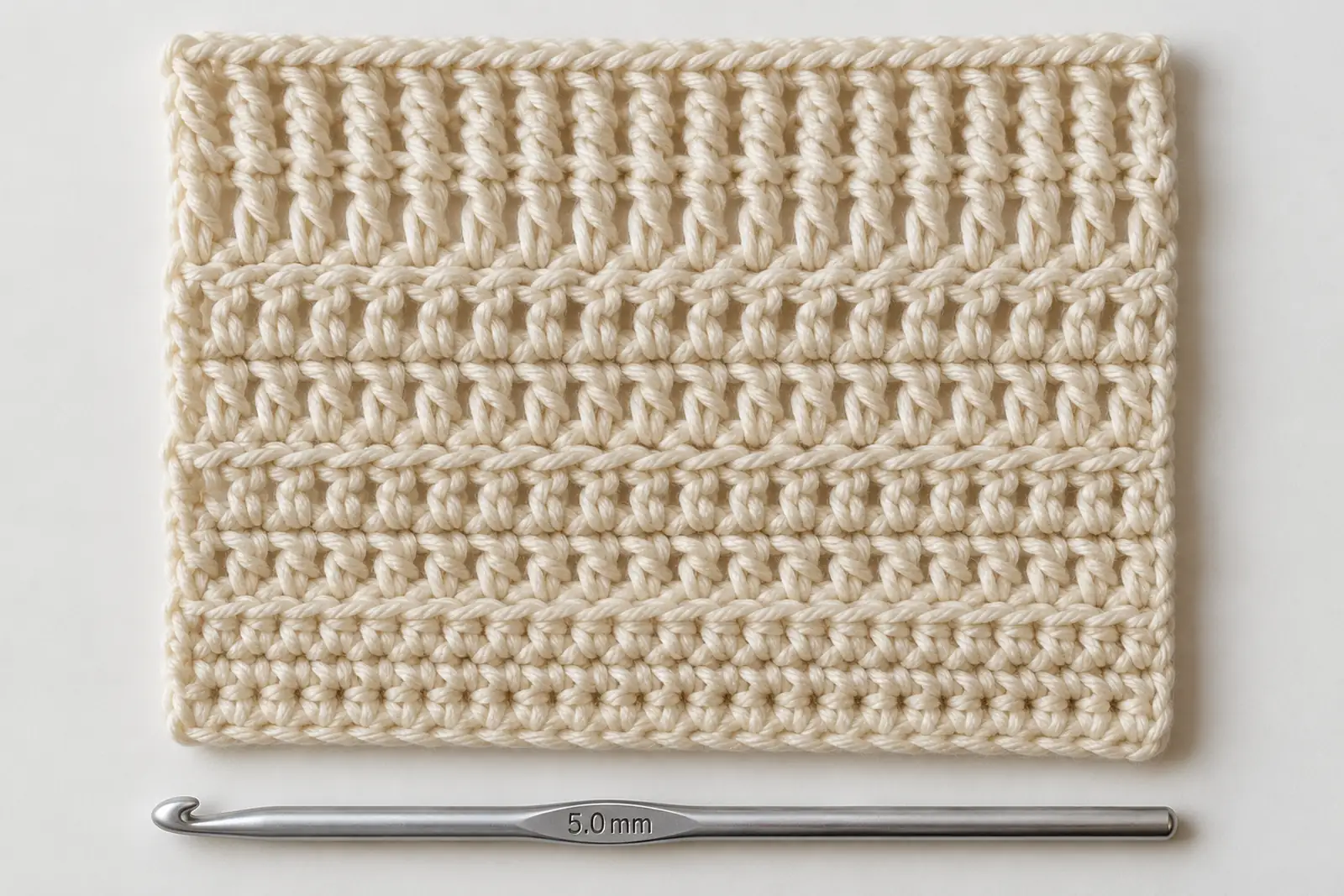
To learn to make them, start with how to single crochet and how to double crochet. If you are not sure which one a project needs, single crochet vs double crochet puts them side by side.
Yarn over (yo) means wrapping the yarn over the hook from back to front. The other five are just as short.
| Abbreviation | Full term | What it means |
|---|---|---|
| st | stitch | Any stitch, whatever its type. |
| sk | skip | Pass over a stitch or space without working into it. |
| yo | yarn over | Wrap the yarn over the hook. |
| rep | repeat | Do the steps again as many times as directed. |
| rnd | round | One trip around the work, in a spiral or a joined circle. |
| tog | together | Work stitches together, as in “2 sc tog” for a decrease. |
Everyday shorthand.
Note that st stands for stitch in general. It is not a single crochet loop, an error that does appear in some printed charts. The best way to make these stick is to read them in a real pattern line, and the Heart Keychain is a small project to try that on. More ideas are in free crochet patterns for beginners and our beginner crochet patterns collection.
These abbreviations change or add to the basic stitches instead of naming them. A pattern usually explains the unusual ones in its own special stitches notes, so use this section to recognize a term, not to learn the technique.
Increase (inc) usually means working two stitches into one stitch, which adds a stitch. Decrease (dec) usually means working two stitches together into one, which removes a stitch. A pattern may define either word differently, so check its key.
A written decrease is often sc2tog or dc2tog, meaning single or double crochet two stitches together. The “2tog” part means “two together” and works with any stitch, as in hdc2tog or tr2tog. Some amigurumi patterns ask for an invisible decrease instead and say so. The amigurumi invisible decrease tutorial covers that one.
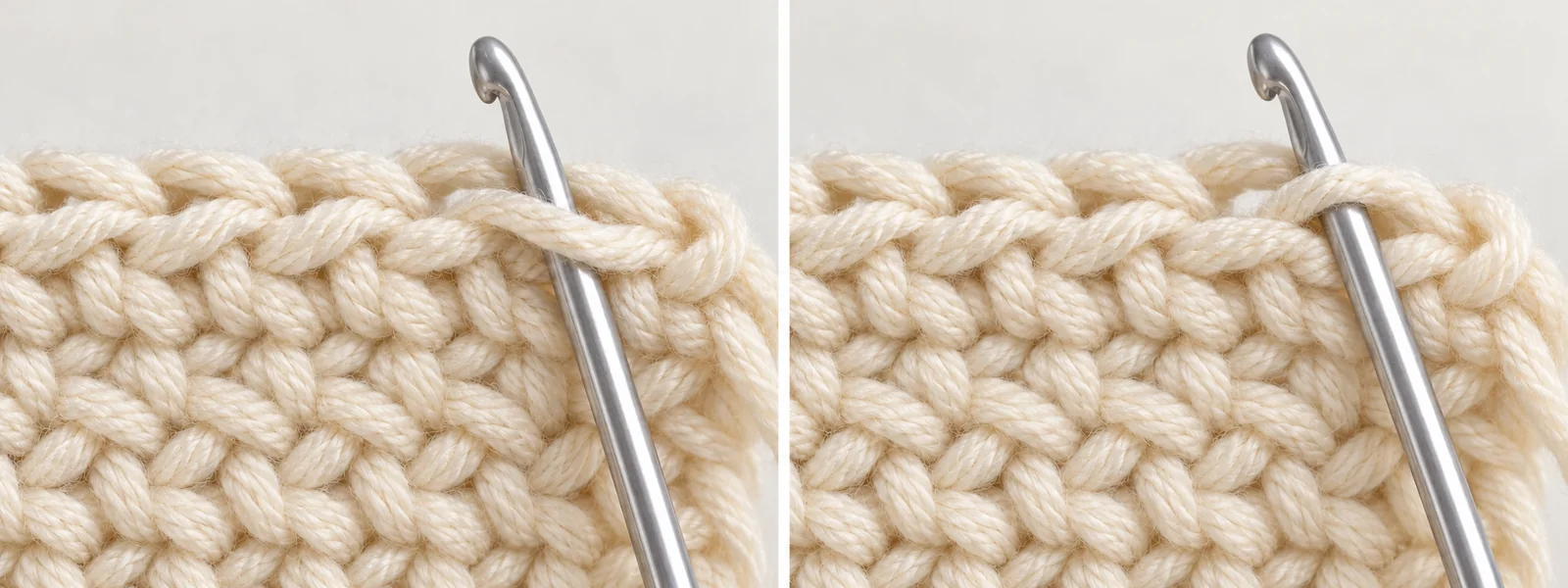
Front loop only (FLO) and back loop only (BLO) tell you to put the hook under just one of the two loops at the top of the stitch. Back loop only (BLO) means working into the loop of the stitch that is farther from you, and front loop only is the loop nearer to you. Worked row after row, BLO leaves a ridge. The abbreviation tbl, through back loop, usually points to the same loop, and some lists treat BL and BLO as the same.
Front post (FP) and back post (BP) mean working around the stem, or post, of a stitch in the row below instead of into its top. The stitch type is added, so FPdc is a front post double crochet and BPdc is a back post double crochet. Bobble (bo), cluster (CL), popcorn (pc) and puff (ps) are textured stitches. The exact steps for a bobble, cluster, popcorn or puff vary by pattern, so check the pattern’s notes. These are intermediate terms, and a beginner can skim them.
These terms tell you where to work, which side faces you and which yarn to use. They are the glue of a pattern, so they are grouped here by purpose.
| Abbreviation | Full term | What it means |
|---|---|---|
| beg | begin or beginning | The start of a row or round. |
| bet | between | In the gap between two stitches. |
| sp | space | A gap you can work into. |
| ch-sp | chain space | A gap made by one or more chains. |
| tch | turning chain | Chains made at the start of a row to reach the next stitch’s height; the pattern says whether they count as a stitch. |
| RS | right side | The side meant to show. |
| WS | wrong side | The side meant to stay hidden. |
Where to work.
CC means contrasting color and MC means main color, while CA, CB and so on name color A, color B and the rest. Some patterns use MC for magic circle instead, which the next section untangles. The abbreviation pm means place marker, and sm means slip marker, usually moving the marker along so it keeps marking the same spot. Fasten off (FO) means cutting the yarn and pulling the end through the last loop.
These marks tell you to do something more than once. A single * usually marks where a repeat starts, and a pair of ** marks a repeat between them. Brackets [ ] repeat the group the number of times given, and parentheses ( ) group stitches worked into the same place or repeated as directed. Designers differ on the details. Brackets, parentheses and asterisks all mark a repeat or a group, and each pattern’s key says exactly how. Working a repeat is covered in how to read a crochet pattern.
These terms are common shorthand, not part of a universal standard, and the pattern defines them. A toy pattern such as the Minimal Frog Amigurumi, which uses a magic ring and decreases, shows where they turn up.
MR usually means magic ring, a common way to start the first round of an amigurumi piece. Its appeal is that the center can be pulled closed, so a toy has no hole in the middle. Some designers write magic circle, or MC, for the same thing. MC means main color in a colorwork pattern and can mean magic circle in an amigurumi pattern, so check the key whenever MC appears in a toy pattern. The magic ring crochet tutorial shows how to make one.
Toy patterns often end a round with a stitch count in parentheses, such as (12). The number in parentheses at the end of a round is the stitch count you should have, not something to work. In these patterns inc and dec are part of the repeat, and dec often means an invisible decrease but may mean sc2tog, so check the key. FO usually ends the piece. The amigurumi invisible decrease guide covers the technique.
A US single crochet is called a double crochet in the UK. The two systems use the same stitch names for different stitches, which is one of the most common reasons a project comes out the wrong size.
From single crochet upward, each stitch takes the next name up in the UK system, while the slip stitch keeps its name. Each row below pairs one stitch with its two names.
| US term | US abbreviation | UK term | UK abbreviation |
|---|---|---|---|
| slip stitch | sl st | slip stitch | ss |
| single crochet | sc | double crochet | dc |
| half double crochet | hdc | half treble | htr |
| double crochet | dc | treble | tr |
| treble | tr | double treble | dtr |
| double treble | dtr | triple treble | trtr |
| yarn over | yo | yarn over hook | yoh |
| gauge | none | tension | none |
US and UK crochet terms side by side.
Canadian patterns generally use the US names. Patterns from other countries may use either system, so the pattern’s key still decides.
If your finished piece comes out the wrong size, check the system before anything else.
Reading a UK pattern in US terms makes every stitch taller than the designer meant, so the piece comes out larger and looser. Reading a US pattern in UK terms goes the other way. Pick the system before the first row and stick with it. For other misreadings to rule out, see common crochet mistakes.
A crochet symbol chart draws each stitch as a small picture so you can see where it goes. This section is a lookup for the basic symbols, not a lesson in following a chart row by row.
The chain is an oval, the slip stitch is a filled dot and the single crochet is a small cross. The half double crochet is a plain T, the double crochet adds one slash across the stem and the treble adds two. Past the half double crochet, each slash stands for one wrap of yarn over the hook before the hook goes in. The more slashes on the stem, the taller the stitch. Symbols usually match in US and UK charts, and the pattern’s own key has the last word.
Chart symbols vary slightly between designers and publishers, and the symbols for less common stitches are not universal. A chart’s own key overrides any symbol list. Charts are also drawn tidily, so your stitches do not have to match their exact shape. For how to follow a chart, see how to read a crochet pattern.
Designers add their own shorthand, and no list can cover every term. When one stops you, work through these steps in order.
When I get stuck on a term, I search the designer’s name and the term together, and nine times out of ten the designer has a note about it.
If you are still finding your feet, the Beginner’s Complete Guide to Crochet is a good place to return to.
They stand for single crochet, double crochet, half double crochet and treble crochet. From shortest to tallest in US terms, the order is sc, hdc, dc and tr. Some US guides write tr as triple crochet, which is the same stitch. The core stitches table in the first section lists what each one means.
No. The two systems share stitch names but not stitches: a US sc is a UK dc, and a US dc is a UK tr. The slip stitch is the same stitch in both, written sl st in the US and ss in the UK. The US-to-UK table in the section above lists every pair, so check it before you start a pattern from another country.
Check the abbreviation key or the pattern notes first, because many patterns name their system there. If they do not say, look for UK-only terms such as htr, yoh or “tension”, which point to UK terms. A pattern with no sc at all is probably UK too. The section on US and UK terms above walks through the checks.
MR usually means magic ring, a starting loop that lets you work the first round into a tight circle. Some designers use MC or magic circle for the same thing, or define MR their own way, so confirm it in the key. The magic ring crochet tutorial shows how to make one, and the amigurumi section above explains the overlap.
Work through three steps in order. First, check the pattern’s abbreviation key and its special stitches notes. Second, check the chart key. Third, search the designer’s name together with the term. How to read a crochet pattern shows where designers usually put these notes, and the section above has the full routine.
No. Learn the dozen in the first section (ch, sl st, sc, hdc, dc, tr, st, sk, yo, rep, rnd and tog) and keep a list handy for the rest. Most people pick up the others by reading them in real patterns again and again, and each pattern’s key covers anything unusual.
Ad-free, printable, and ready for your project bag. We'll also send you one new free pattern every week.
No spam. Unsubscribe anytime.
Written by
Designer & founder
Linda has been crocheting for over 15 years and designs cozy, beginner-friendly patterns that anyone can finish in a weekend.
Keep reading
Twisted chains, wavy edges, wrong stitch counts: the common crochet mistakes beginners make, how to spot each one and how to fix it.
Read More: Common Crochet Mistakes and How to Fix ThemCrochet tools for beginners, simplified: the six you need, the extras that can wait, and a starter kit that avoids wasted money.
Read More: Crochet Tools for Beginners: Need vs. Nice to HaveAre ergonomic crochet hooks worth the price? An honest look at handle shapes, popular brands, who benefits and how to try one cheaply.
Read More: Ergonomic Crochet Hooks: Are They Worth It?