đź§¶ Yarn Calculator

Try

Visit our Etsy Shops

Pick a shop to browse. Each one opens on Etsy in a new tab.

Stitches & Techniques

Spike Stitch Crochet: Textured Color Stripes

Spike stitch crochet step by step: hook into a lower row, loop pulled up to row height. A 12-row swatch and fixes for pulling and uneven spikes.

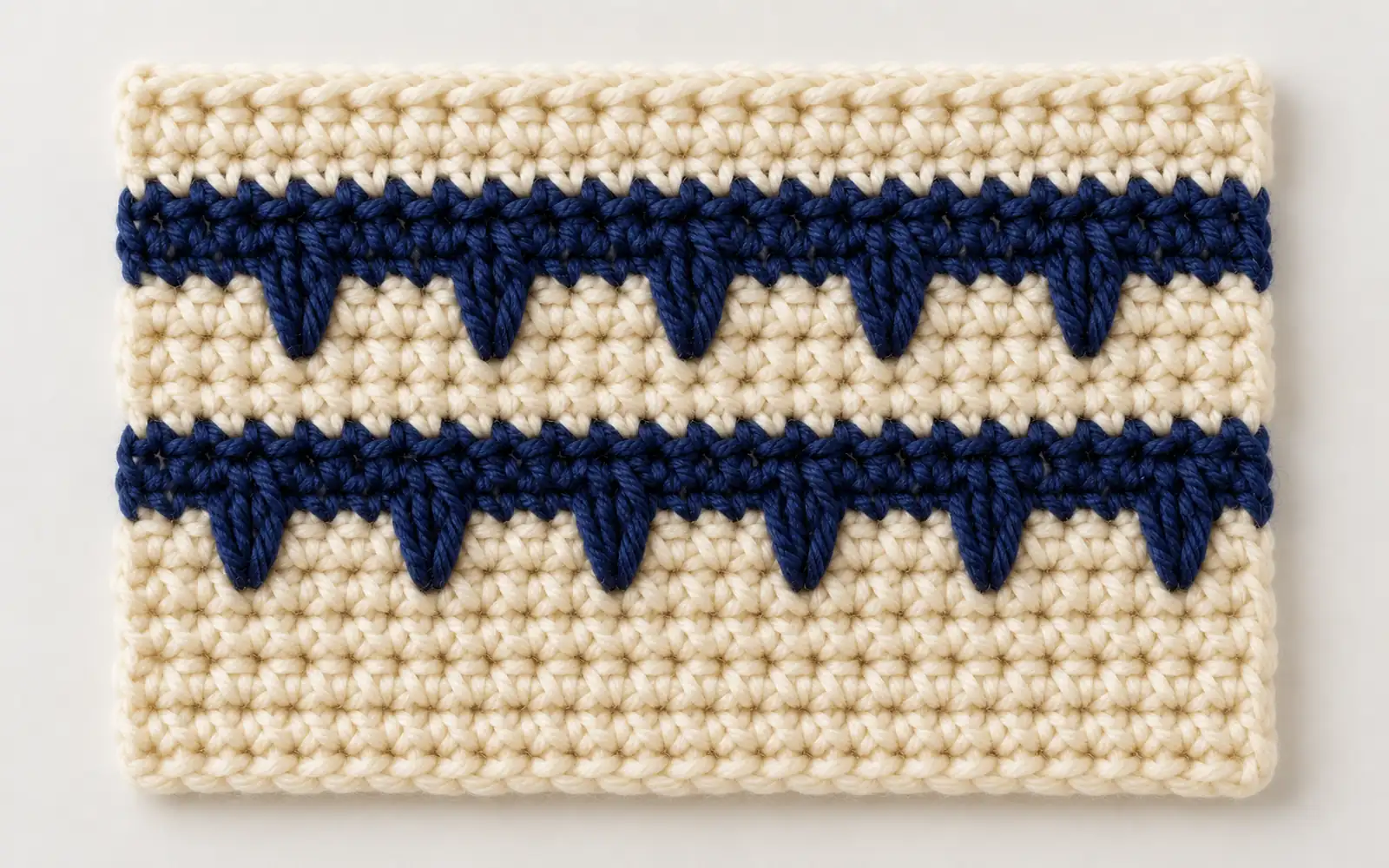
Spike stitch crochet swatch showing two rows of navy spikes over cream yarn, lying flat with straight edges
Table of Contents
  1. Before You Start: What a Spike Stitch Is
  2. How a Spike Stitch Is Made
  3. Finding the Spot: Counting Rows Below
  4. Your First Spike Swatch
  5. Keep Spikes Even: Loop Height, Tension and Spacing
  6. Spikes in a Contrast Color
  7. Fix Pulling, Uneven Spikes and a Changed Count
  8. Depth, Stitch Heights and Projects
  9. Key Takeaways
  10. Frequently Asked Questions

Quick answer: Spike stitch crochet is a single crochet worked into a lower row instead of the next stitch. Pull the loop up to the height of the row you are working, then yarn over and pull through both loops. The long strand covers the rows between and shows best in a contrast color.

You add a few spikes to a row and the fabric puckers around them, or the spikes come out in different lengths and look uneven. Each spike is only a single crochet, so it is hard to see what went wrong.

This page shows where the hook goes, how long to pull the loop and how patterns count rows below. It ends with a 25-stitch, 12-row swatch in two colors, a table of fixes for pulling and uneven spikes, and a guide to spike depth.

I draw each spike loop up to the height of the row and check it against the stitch beside it before I yarn over. A spike is long and easy to misjudge, so I do not leave its length to chance.

Before You Start: What a Spike Stitch Is

A spike stitch is a stitch worked into a lower row, so its long loop lies over the rows in between. It is a single crochet with the hook in a different place, so learn how to single crochet first. See crochet stitches and techniques for where it fits.

Hook, Yarn and Practice Setup

Use smooth worsted yarn in a light and a dark color and a 5.0 mm (H/8) hook to practice, so spikes and pulling are easy to see. A spike uses more yarn, so the fabric tends to be thicker. See worsted weight yarn and the crochet hook size chart. Photos are right-handed; left-handed crocheters mirror each step, starting the first row from the left.

Spike Stitch, Long Single Crochet and Other Names

A spike stitch is also called an elongated single crochet or a long single crochet. Abbreviations vary, such as spike st, SPsc or SP-2 for two rows below, so the pattern’s own key wins. A spike is not a post stitch. In UK patterns a single crochet is a double crochet. See crochet stitches to know and crochet abbreviations.

How a Spike Stitch Is Made

A spike is a single crochet with the hook in a lower row and the loop pulled up to the height of the row you are working. The other moves are the same as in how to single crochet, so learn that first.

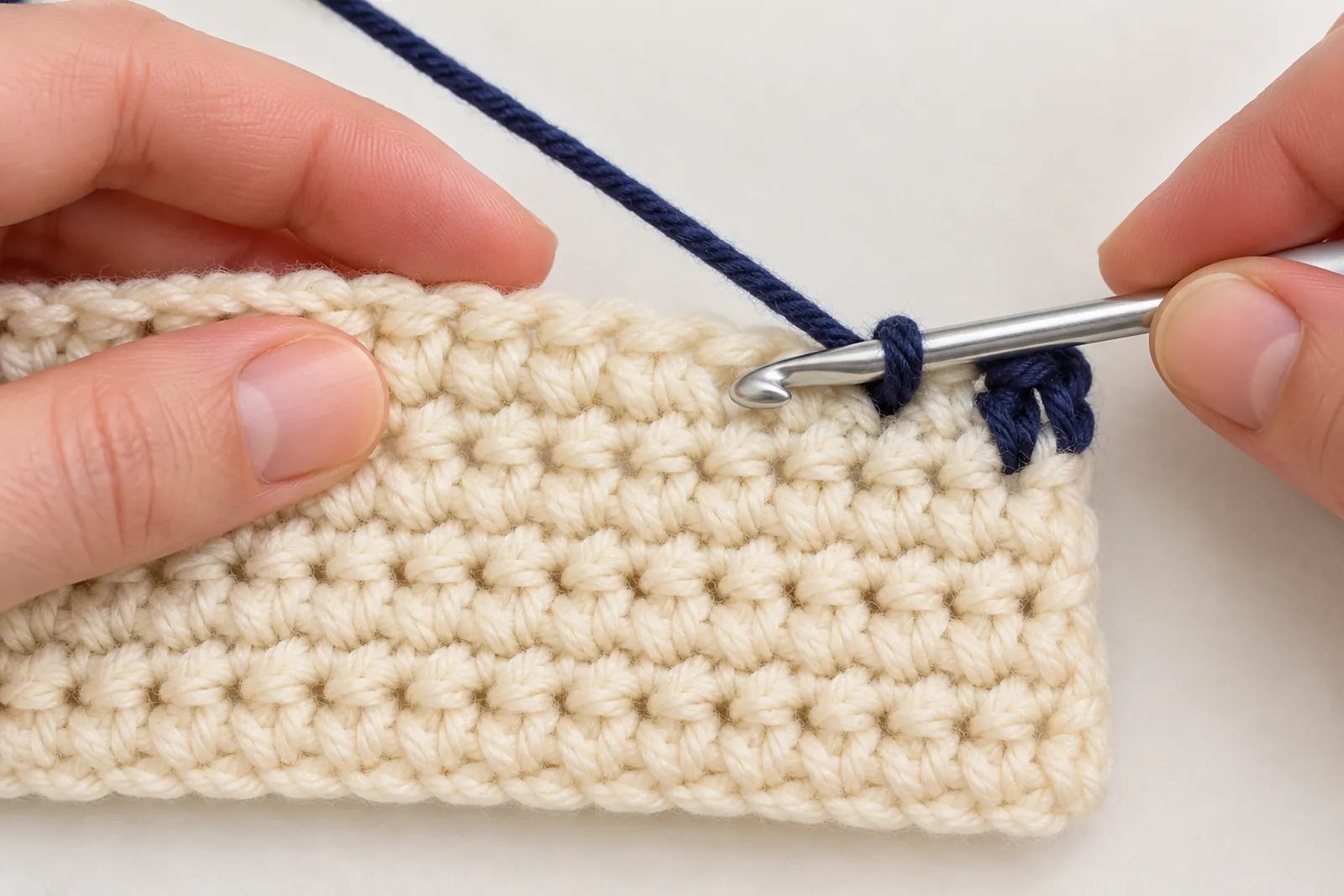
Insert the Hook in the Row Below

  1. Do not work into the next stitch; the spike will cover it.
  2. Insert the hook from front to back into the top of the stitch below the stitch you skipped.

Some patterns go into the space where that stitch was worked instead, so follow the pattern’s wording. Counting rows follows in the next section.

A crochet hook entering a stitch in the row below the skipped stitch to start a spike stitch in navy yarn over cream rows Skip the next stitch and put the hook in the stitch below it.
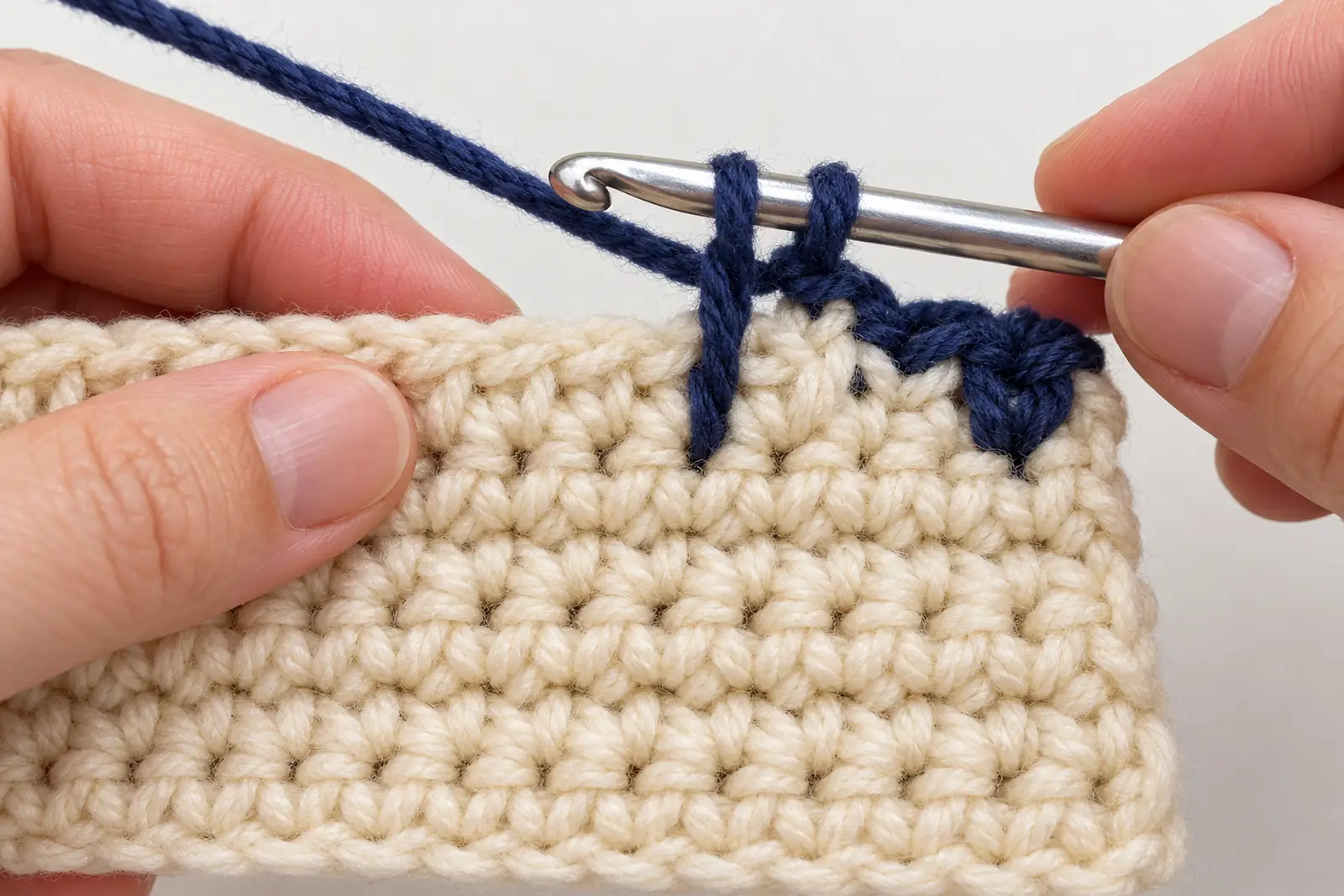
Draw Up the Loop and Finish the Stitch

  1. Yarn over and draw up a loop, then lengthen it until it is as tall as the row you are working; it now encloses the skipped stitch (2 loops on the hook).
  2. Yarn over and pull through both loops, as in a single crochet (1 loop on the hook).

The deeper the hook went, the longer the loop.

A crochet hook holding a long loop drawn up through a lower stitch to the same height as the stitch beside it in a spike stitch Draw the loop up until it is as tall as the stitches beside it.
Why You Skip the Stitch Behind the Spike

In rows, a spike replaces the stitch it covers, so the stitch count stays the same. Skip that stitch, work the spike, and count the row afterward. In the round, patterns differ: some do not skip in a flat circle, so the piece stays flat. The pattern’s stitch note decides.

Finding the Spot: Counting Rows Below

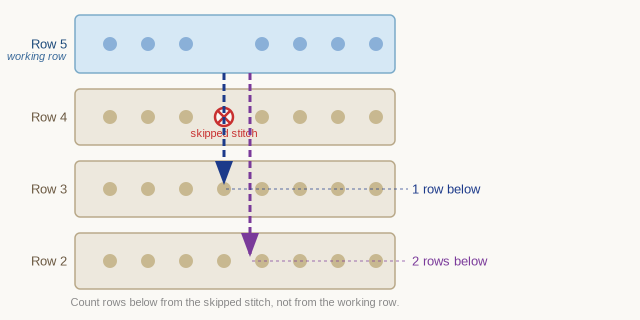
A spike stitch lands wrong when the hook goes into the wrong row or the wrong column. Two rules cover it: count rows from the stitch you skip, then check the column before you go in. One diagram shows the hook path.

How Patterns Count Rows Below

Count rows below from the stitch you skip, not from the row you are working. One row below is the stitch directly under the skipped stitch, in the row before the previous row; the spike covers one row. Two rows below covers two, and three covers three. Some tutorials count from the working row, which puts the hook in the previous row and gives a plain single crochet. Check the first spike against the pattern’s chart or photo: it should lie over as many rows as the number says.

Diagram showing stacked crochet rows with the hook path for a one-row spike and a two-row spike, both counted from the skipped stitch Count rows below from the skipped stitch, not from the working row.
Check the Column Before You Go In

Stitches lean, so the stitch directly below the skipped one may sit a little to the left or right. Deep spikes can drift to the right, so keep the same angle in every spike. I count down the column with the hook tip and go into the stitch directly under the one I skip, because a spike that lands one stitch off shows.

Your First Spike Swatch

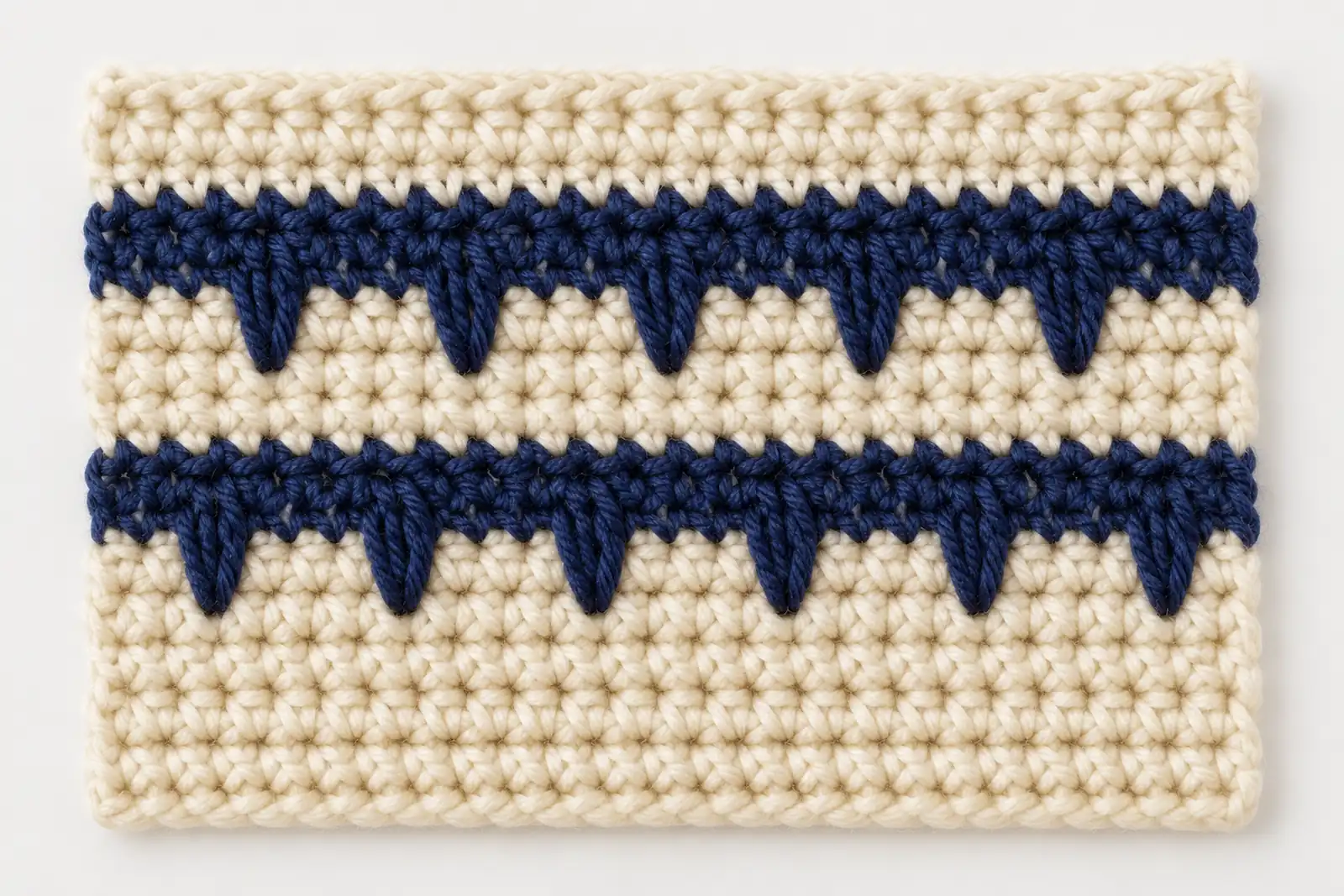
The practice swatch is 25 stitches wide and 12 rows tall. Cream rows under navy spikes make every spike easy to see and count, and it can be finished in one sitting. Abbreviations such as ch, sc and st are in crochet abbreviations.

Spike stitch crochet practice swatch: a finished 25-stitch, 12-row swatch with navy spikes over cream rows lying flat with straight edges A finished swatch: 25 stitches wide, 12 rows tall, navy spikes over cream rows.
Rows 1 to 4: Chain and Plain Rows

  1. With cream (A), chain (ch) 26.
  2. Row 1 (right side): single crochet (sc) in the second chain from the hook and in each chain across (25 stitches). Turn.
  3. Rows 2 to 4: ch 1, sc in each stitch (st) across (25 sts each). On the last st of row 4, stop with 2 loops on the hook and pull navy (B) through to change color (see how to change yarn color in crochet). Turn.

Row 5: The First Spike Row

  1. Row 5 (right side, B): ch 1 (does not count), sc in the first st (1 st).
  2. (Skip the next st, work a spike one row below it in the st of row 3, then sc in each of the next 3 sts) 6 times in all (25 sts).
  3. Turn. This row has 6 spikes and 19 sc; work each spike with steps 1 to 4.

Rows 6 to 12: Stripes and Staggered Spikes

  1. Row 6 (B): ch 1, sc in each st and spike top (25 sts). Change to A in the last st. Turn.
  2. Rows 7 and 8 (A): ch 1, sc across (25 sts each). Change to B in the last st of row 8. Turn.
  3. Row 9 (B): ch 1, sc in the first 3 sts, (skip 1, spike one row below, sc in the next 3) 5 times, sc in the last 2 sts (25 sts). Turn.
  4. Row 10 (B): ch 1, sc across (25 sts). Change to A in the last st. Turn.
  5. Rows 11 and 12 (A): ch 1, sc across (25 sts each). Fasten off and weave in ends.

Carry the unused color up the side.

Keep Spikes Even: Loop Height, Tension and Spacing

Spikes stay even when every loop is drawn up to the same height, the height of the row you are working. That one check matters most. The next three habits cover the loop, the strand and the count. For other tension mistakes, see common crochet mistakes.

Pull the Loop Up to Row Height

Draw each spike loop up to the height of the stitches beside it, then yarn over. A loop left short draws the covered rows together, and the fabric puckers. Compare the loop with the neighboring stitch on every spike, because the longer the spike, the easier it is to misjudge. Check it before you yarn over, not after.

Keep the Spike Loose Around the Rows

A spike strand should lie loosely over the rows it covers without squeezing them. Advice on tension differs: some designers keep the pulled-up loop slightly loose on the hook, and others keep it fairly taut while the strand sits loose around the rows below. The aim is the same, a strand that lies flat. After the stitch, smooth the strand flat with a fingertip.

Anchor Spikes With Plain Stitches and Count

Start every spike sequence with plain single crochets so the row stays anchored. The practice swatch puts three plain single crochets between spikes and at least one at each row end. Spikes can sit in a set repeat or at random. A spike replaces the stitch it covers, so every swatch row stays at 25 stitches; count after every row.

Spikes in a Contrast Color

A spike is one strand laid over other rows, so its color decides how much it shows. The same spike can read as a bold line or a soft texture, depending on the colors. For ideas on pairing colors, see contrasting colors in crochet.

Why Contrast Shows Spikes Best

A spike in a contrast color reads as a vertical line; in the same color it gives a subtle texture. A dark contrast over a light base also shows uneven loop heights, which is why the practice swatch is navy on cream. The choice is a matter of taste. For ways to lay out larger color areas, see the colorblock crochet guide.

Changing Color for Spike Rows

Work the spike row in the new color, and change color in the last stitch of the row before. Pull the new color through the last two loops of that stitch (see how to change yarn color in crochet). In this swatch each color rests for only two rows, so carry it up the side. For charted colorwork with yarn carried inside the stitches, see tapestry crochet.

Fix Pulling, Uneven Spikes and a Changed Count

Most spike stitch problems come from the loop height, the row or column, or the count. A swatch shows each of them early, before you commit to a large piece. For mistakes that apply to any stitch, see common crochet mistakes.

Fabric That Pulls or Puckers

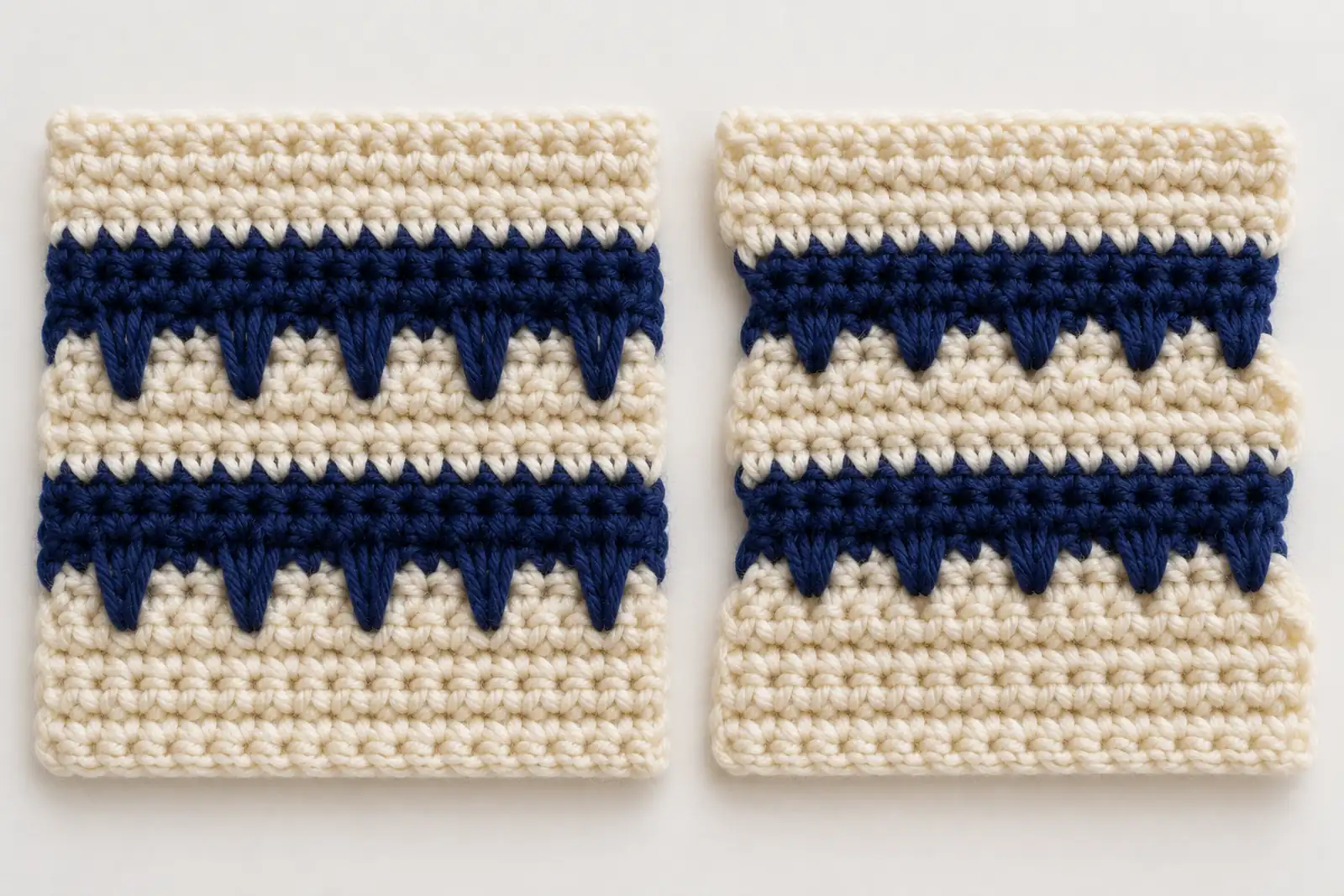
Spike stitch fabric pulls in when the loops are left shorter than the row, because each short spike draws the rows it covers together. Check the width: a puckered row is narrower than the plain rows around it. To fix it, undo back to the first short spike and rework it, drawing the loop up until it matches the stitches beside it.

Two spike stitch swatches side by side: the left one with long even spikes and flat rows and the right one with short spikes that pucker the rows Made on purpose: spikes drawn up to row height (left) and spikes left short (right).
Other Spike Stitch Problems

Problem Likely cause Fix
The spikes are different lengths The loop height changes from stitch to stitch Draw each loop up to the height of the stitch beside it
The spikes look crooked The stitches lean and the hook went into the wrong column Count down the column with the hook tip
The spikes cover the wrong number of rows Rows were counted from the working row Count from the skipped stitch
The spikes flop or catch The loops are taller than the row Draw them up only to row height, and use shorter spikes on items with heavy wear
The stitch count changes The stitch behind the spike was also worked, or a stitch was skipped without a spike Count after every row and compare with 25

Depth, Stitch Heights and Projects

The look of a spike changes with how many rows it covers and the height of the stitch. Once the one-row spike is even, small changes are easy to try, and the pattern’s stitch note decides the details. See crochet stitches and techniques and crochet stitches to know.

Spike Depth at a Glance

Depth Where the hook goes What it looks like
One row below The stitch under the skipped stitch A short spike that blends into the fabric
Two rows below Two rows down A visible vertical bar
Three rows below Three rows down A long decorative line that drifts more
Four rows below Four rows down The longest spike; check the loop height most carefully

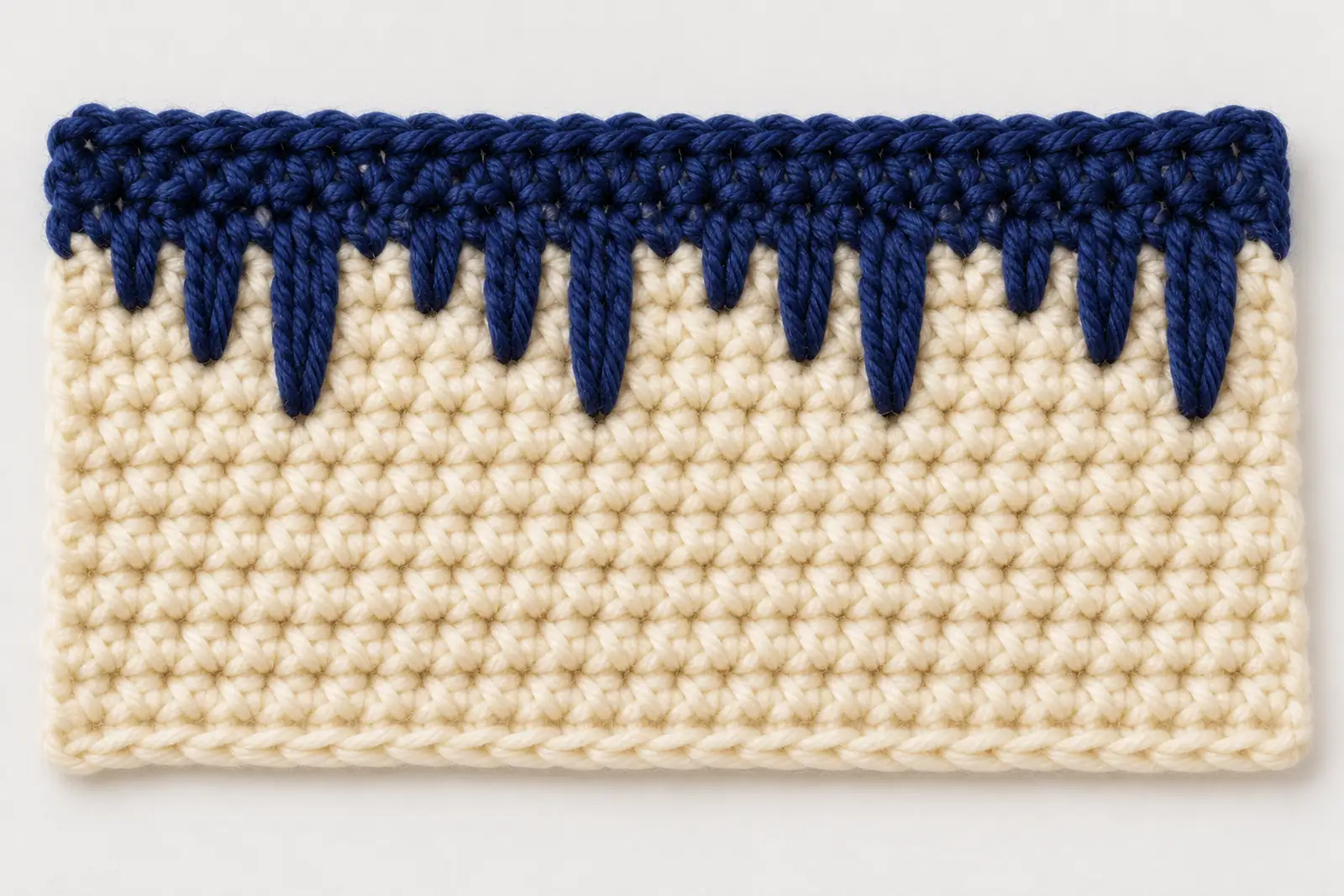
Spikes of rising and falling depth in one row can make triangles or points. See crochet stitches to know for more.

A crochet swatch with navy spikes worked one, two and three rows below over cream rows in repeating groups Spikes one, two and three rows below, left to right in each group.
Other Stitch Heights and Spikes in the Round

A spike can be worked at any stitch height, because the hook’s place defines it. Patterns may call a taller one a long double crochet; see crochet stitches to know. In the round, some patterns do not skip a stitch in a flat circle, to keep it from cupping; the pattern decides. Alternating spike rounds with plain rounds suits coasters.

Projects That Suit Spikes

Spike stitch fabric is thick and firm, so it suits striped blankets, bags, coasters and pillows. Pouches and other accessories work too. See the crochet baby blanket guide and how to crochet a bag, or browse free blanket patterns and free bag patterns. The Rainbow Afghan is a larger project to try.

Key Takeaways

  • A spike stitch is a single crochet worked into a lower row instead of the next stitch, so a long loop lies over the rows between.
  • Draw each loop up to the height of the row you are working, then yarn over and pull through both loops.
  • In rows, skip the stitch behind the spike so the stitch count stays the same, and count after every row.
  • Count rows below from the stitch you skip, and go into the stitch directly under it, because stitches lean.
  • Short loops pucker the fabric and uneven loops make uneven spikes; undo to the first one that is off and rework it.

Frequently Asked Questions

What is a spike stitch in crochet?

A spike stitch is a stitch, usually a single crochet, worked into a lower row instead of the next stitch. The loop is pulled up to the height of the row being worked, so the long strand lies over the rows in between. It is also called an elongated or long single crochet. The sections above on what a spike stitch is and how it is made show every step.

How long should a spike stitch be?

The loop should be as tall as the row you are working, and the stitch covers as many rows as the pattern says. One row below is the usual starting point, and some tutorials go down three or four rows. The deeper the hook goes, the longer the stitch, so check each loop against the stitch beside it. The counting and depth sections above give the details.

Why is my spike stitch pulling the fabric?

Usually the loop was not drawn up to the height of the row, so the short spike draws the rows it covers together. Undo back to the first short spike and rework it, pulling the loop up until it matches the stitches beside it. Keep the strand loose over the rows. The sections above on loop height and fixes cover this.

Do you skip a stitch when you crochet a spike stitch?

Yes, in rows. The spike takes the place of the stitch behind it, so you skip that stitch and the row keeps the same stitch count. In the round, some patterns do not skip, for example in a flat circle, so follow the pattern’s stitch note. Count the row afterward to check. The section above on the skipped stitch has the steps.

Is the spike stitch hard for beginners?

No, if you can single crochet. A spike is a single crochet with the hook in a different place and a longer loop. The usual trouble is the loop height and finding the right row, so practice on the 25-stitch swatch and count after every row. The swatch section above has every row. If single crochet is new, start with how to single crochet.

Portrait of Linda Davidsen

Written by

Linda Davidsen

Designer & founder

Linda has been crocheting for over 15 years and designs cozy, beginner-friendly patterns that anyone can finish in a weekend.

Keep reading

All posts