
🧶 Yarn Calculator

Try

Visit our Etsy Shops

Pick a shop to browse. Each one opens on Etsy in a new tab.

Stitches & Techniques

How to Double Crochet: Complete Step-by-Step Tutorial

Learn how to double crochet step by step: yarn over, insert, pull through twice, start a row, work the turning chain and keep edges even.

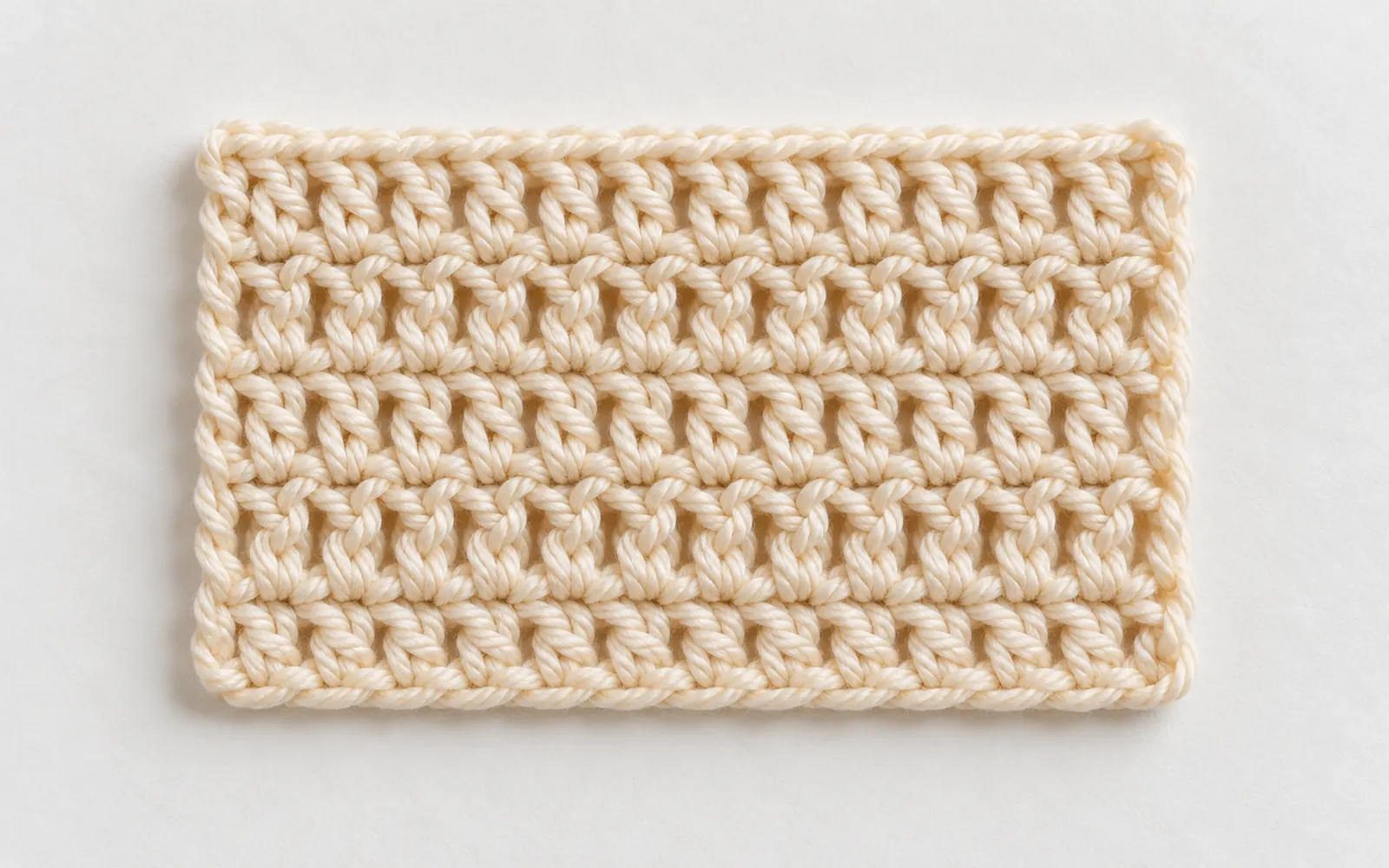
A finished double crochet practice swatch in cream worsted yarn lying flat, showing even edges and neatly worked rows of tall stitches
Table of Contents
  1. Before You Start: What Double Crochet Is
  2. How to Double Crochet: The Four Moves
  3. Start the First Row: The Foundation Chain
  4. The Turning Chain and the Last Stitch
  5. Count Every Row and Keep Edges Even
  6. Your First Swatch: 12 Stitches, 6 Rows
  7. Fix Common Double Crochet Problems
  8. Double Crochet in the Round and What to Learn Next
  9. Key Takeaways
  10. Frequently Asked Questions

Quick answer: How to double crochet comes down to four moves: yarn over, insert the hook and pull up a loop, then pull through two loops twice. Chain 3 at the start of each row counts as your first stitch, and the last stitch of the row goes into the top of that chain.

You yarn over, insert the hook, and somewhere in the middle of the pull-throughs you lose count of the loops on the hook. A few rows later the piece starts to shrink or swell at the edges, and you cannot see where it went wrong.

This page builds the stitch in four moves with a loop count at each one, then starts a row, works the turning chain and the last stitch, and ends with a 12-stitch swatch. A table of fixes covers narrowing edges and the usual problems.

I count my stitches at the end of every row, even when I feel sure. A missing stitch is easy to fix one row later and miserable to fix ten rows later.

Before You Start: What Double Crochet Is

Double crochet (dc) is a tall crochet stitch made with one yarn over before the hook goes in and two pull-throughs of two loops each. It is about three chains tall, and it is a common next stitch after single crochet. See crochet stitches and techniques for more.

Hook, Yarn and Practice Setup

Use smooth, light-colored worsted yarn and a 5.0 mm (H/8) hook to practice. See worsted weight yarn and the crochet hook size chart, and keep a stitch marker handy. A chain of 14 gives the 12-stitch swatch below. Photos on this page are right-handed; left-handed crocheters mirror each step, starting the first row from the left.

US and UK Names for This Stitch

A US double crochet is called a treble crochet (tr) in the UK, and a UK double crochet is a US single crochet. Check which set a pattern uses before you start. This page uses US terms throughout. See crochet abbreviations for the full list.

How to Double Crochet: The Four Moves

Yarn over, insert the hook, yarn over and pull up a loop, then yarn over and pull through two loops twice. The stitch builds on the moves in how to single crochet, with one extra yarn over. The first stitch of a row has its own steps further down.

Step 1: Yarn Over and Insert the Hook

Yarn over first, then insert the hook. Wrap the yarn over the hook from back to front, then put the hook, front to back, under both loops of the V at the top of the next stitch. In the foundation chain, go through the center of the chain unless the pattern says otherwise.

Step 2: Yarn Over and Pull Up a Loop

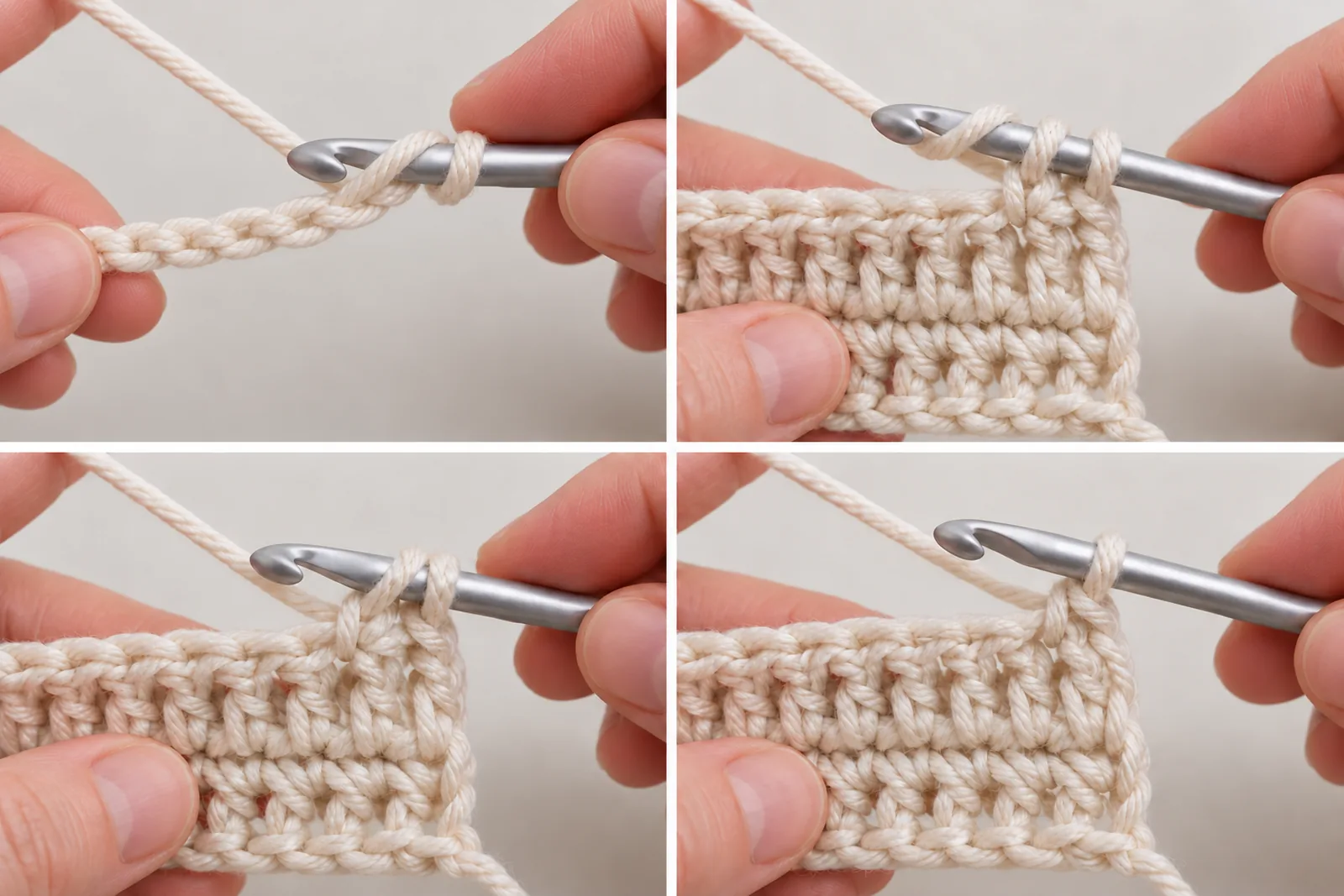
You should have 3 loops on the hook once you yarn over again and pull a loop back through the stitch. Check that number before you go on, because many beginners lose a stitch by pulling through everything at once.

Step 3: Pull Through Two Loops

Pull through the first two loops only. Yarn over and pull through the first two loops on the hook, and two loops remain. Do not pull through all three. That would make a half double crochet instead. Keep the second pull-through for the next move.

Step 4: Pull Through the Last Two Loops

Pull through the last two loops to finish the stitch. Yarn over and pull through the last two loops, and one loop remains. For the next stitch, yarn over and insert the hook into the next stitch; repeat across the row. See single crochet vs double crochet for why it is taller.

Loops on the Hook at Every Move

A double crochet has 3 loops on the hook after the loop is pulled up, then 2, then 1.

Move What you do Loops on the hook afterward
Start Working loop only 1
Yarn over Wrap the yarn over 2
Insert and pull up a loop Pull a loop through the stitch 3
Pull through two First two loops 2
Pull through two again Last two loops 1, stitch complete

If the count differs, undo the last move.

Four frames of one double crochet: yarn over and insert, three loops on the hook, two loops, then one loop One double crochet in four frames: yarn over and insert, three loops, two loops, one loop.
Start the First Row: The Foundation Chain

The first row of double crochet is worked into a foundation chain of your stitch count plus 2. It is the hardest part for many beginners, because there is little to hold. Two steps make it simple: chain the right number, then start in the fourth chain.

Chain Your Stitches Plus Two

Chain your stitch count plus 2 for a double crochet foundation row. The 3 chains nearest the hook will count as the first stitch, so you do not work into them. For a 12-stitch row, chain 14. If a pattern gives a chain count, chain that number, because it already includes the extra chains. Do not count the loop on the hook.

Work the First Stitch Into the Fourth Chain From the Hook

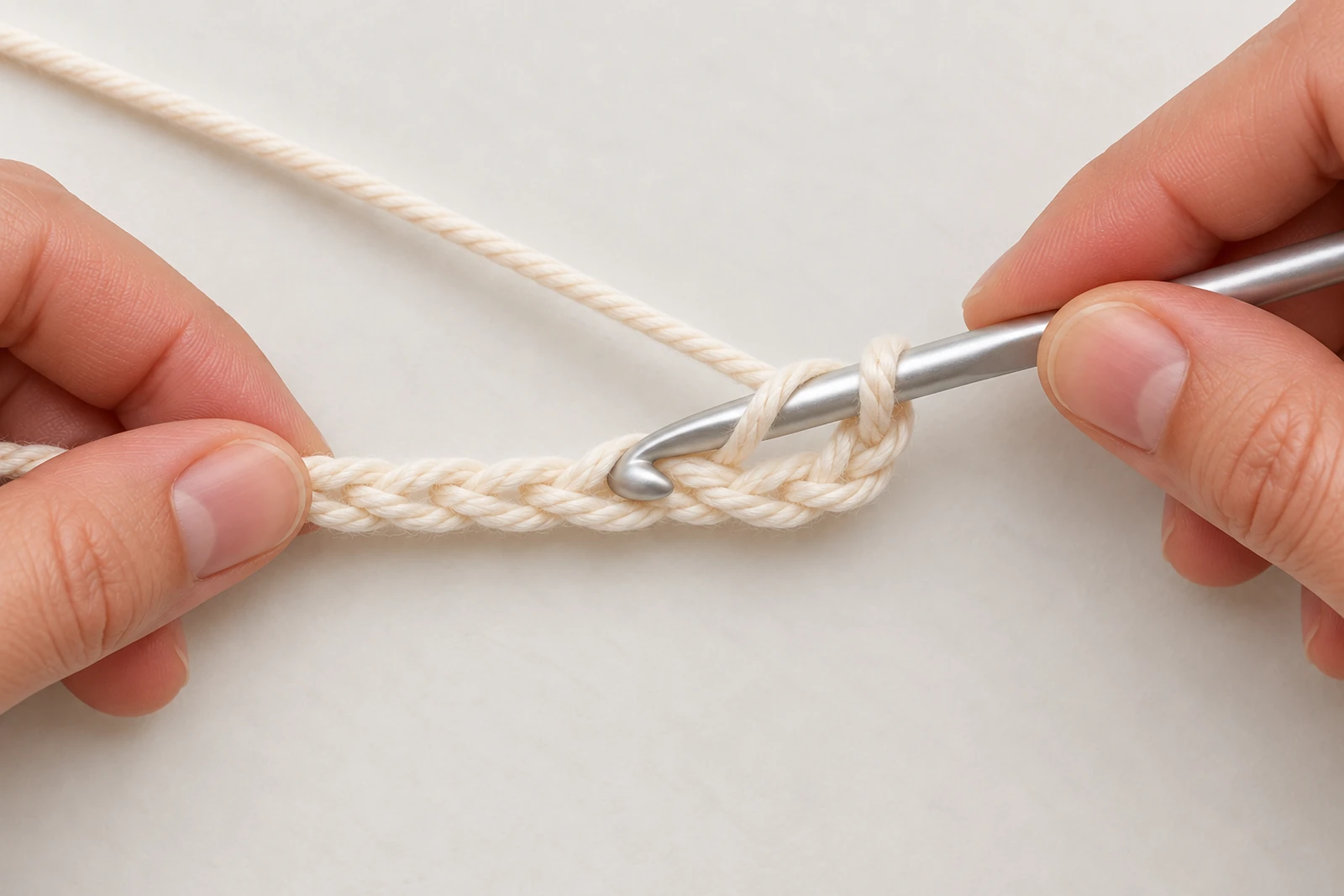
Insert the hook into the fourth chain from the hook: yarn over first, then go through the center of the chain, skipping the three nearest the hook. They stand in for the first stitch. Complete the stitch with the four moves, then work one double crochet into each remaining chain. A 12-stitch row ends row 1 with 11 double crochet plus the skipped chains counted as one stitch.

A crochet hook with yarn over it entering the fourth chain from the hook on a double crochet foundation chain, three chains skipped The first stitch goes into the fourth chain from the hook.
The Turning Chain and the Last Stitch

A turning chain of 3 raises the hook to the height of a double crochet at the start of each row. Three chains match the height of the stitch. Patterns word it in different ways, and how to read a crochet pattern shows how to follow them.

Chain 3 and Turn

Chain 3 at the end of the row, turn, and count the chains as the first stitch. Turn the same way at the end of every row; the direction matters less than keeping to it. Some patterns use chain 2 and do not count it (see the next section’s table); the pattern’s note decides. This page follows chain 3 as the first stitch.

Skip the First Stitch and Work Across the Row

Skip the first stitch of the row below, because the turning chain stands in for it. This is the stitch right at the base of the chain. Yarn over and insert the hook under both loops of the V of the second stitch, then work a double crochet in each stitch across. Do not work into the base of the chain, which adds a stitch.

Work the Last Stitch Into the Top of the Turning Chain

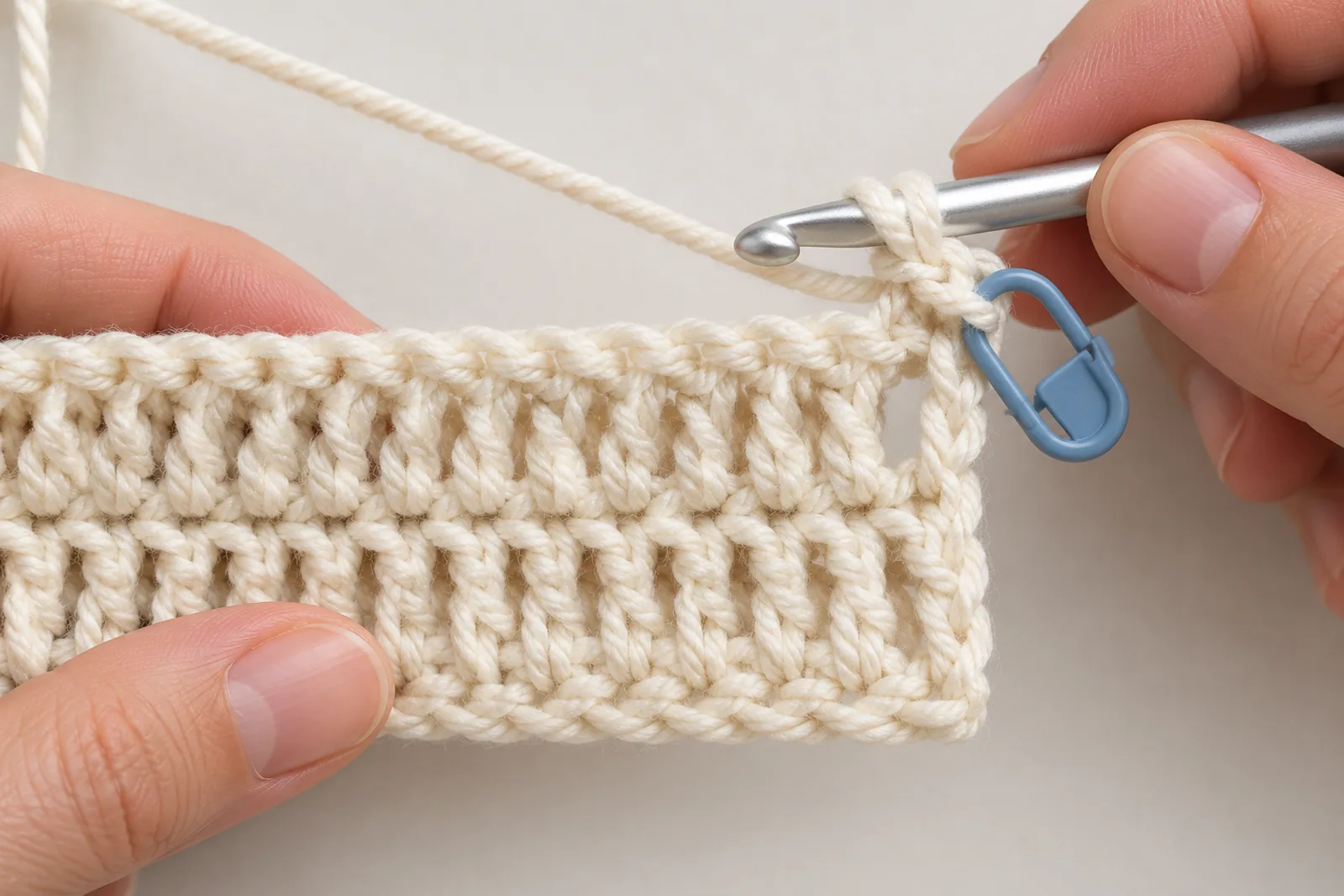
The last stitch of the row goes into the top of the turning chain: the third chain you made at the start of the row below, worked under its two loops. This stitch is easy to miss, and missing it is a common reason a piece narrows. I clip a stitch marker into the top of the turning chain as soon as I make it, and move it up every row. See crochet tools for beginners for markers.

A crochet hook entering the top of the turning chain at the end of a double crochet row, with a stitch marker clipped in the chain The last stitch goes into the top of the turning chain. The marker shows where it is.
Count Every Row and Keep Edges Even

Edges stay even when every row has the same number of stitches. A count at the end of every row catches a mistake while it is only one row deep and easy to undo. For other mistakes, see common crochet mistakes.

Count at the End of Every Row

Count the V on top of each stitch, and count the turning chain as one. A 12-stitch row has 11 Vs plus the turning chain, or 12 stitches in all. Count at the end of every row and compare it with your starting number. If it differs, check the first and last stitches, where mistakes usually hide.

Does the Turning Chain Count? What It Does to Your Edges

Whether the turning chain counts decides where the first and last stitches go.

Turning chain First stitch goes into Last stitch goes into The edge
Counts (chain 3, this page) Second stitch below Top of the turning chain Even edges
Counts, but its top is skipped Second stitch below Last stitch, skipping the chain top Narrows, one stitch lost each row
Does not count (some patterns, often chain 2) First stitch below Last stitch, skipping the chain top Even edges
Does not count, but its top is worked First stitch below Top of the turning chain Widens, one stitch gained each row

Read the pattern’s note and pick one rule for the whole piece; common crochet mistakes lists more fixes.

Your First Swatch: 12 Stitches, 6 Rows

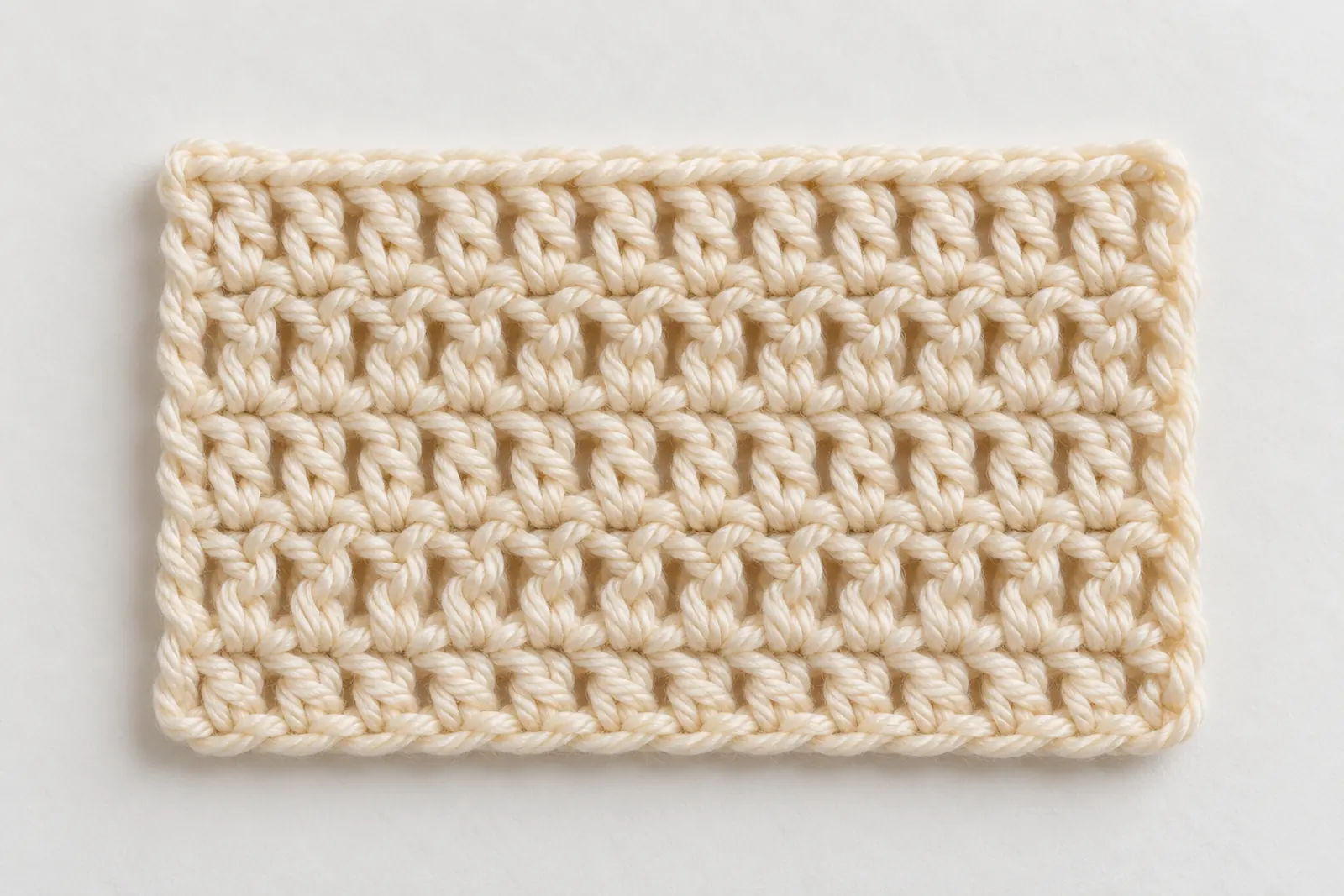
A swatch of 12 stitches and 6 rows in light worsted yarn is small enough to finish in one sitting and wide enough to practice the turning chain and the last stitch. Abbreviations such as ch and dc are in crochet abbreviations.

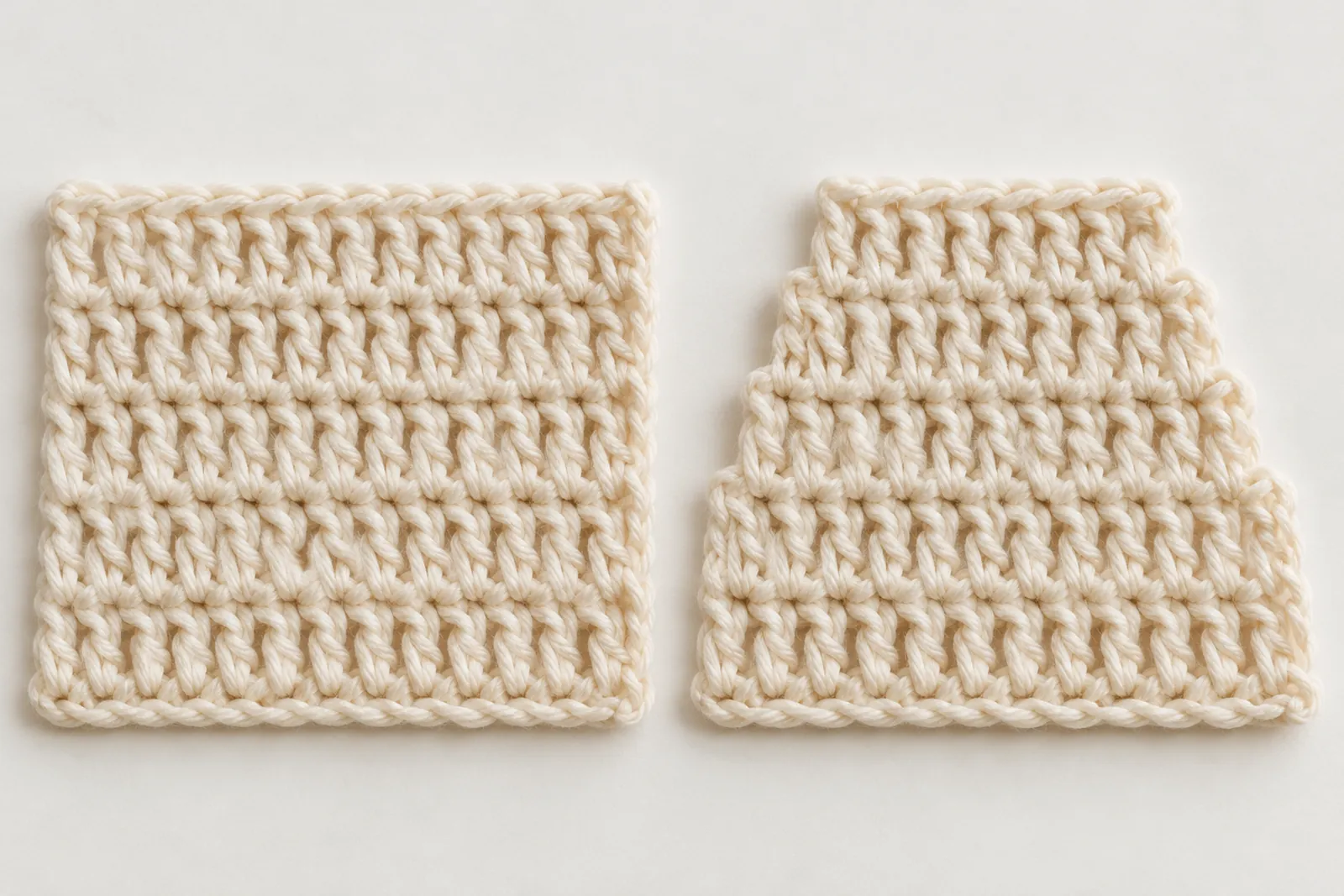
How to double crochet practice swatch: a finished 12-stitch, 6-row double crochet swatch lying flat with even edges A finished swatch: 12 stitches wide and 6 rows tall.
The Swatch Row by Row

  1. Chain 14.
  2. Row 1: dc in the fourth chain from the hook and in each chain across (11 dc, which with the skipped chains makes 12 stitches). Chain 3, turn.
  3. Row 2: skip the first stitch, dc in each of the next 10 stitches, then dc in the top of the 3 skipped chains (12 stitches). Chain 3, turn.
  4. Rows 3 to 6: repeat row 2, ending in the top of the turning chain (12 stitches each row).
  5. Fasten off: cut the yarn, leave a short tail and pull it through the loop. Weave in the end.

Fix Common Double Crochet Problems

Most double crochet problems come from the first or last stitch of a row, from tension, or from a missed move. A small swatch shows them early, before you commit to a large piece. For mistakes that apply to any project, see common crochet mistakes.

Edges Getting Narrower or Wider

A narrowing edge almost always means the last stitch was skipped, so the top of the turning chain was missed. A widening edge means an extra stitch: one worked into the base of the chain when the chain already counted, or into the top of a chain that did not count. Count back to find the row where the count changed, undo to there and redo it. Blocking helps only slightly with minor narrowing and cannot replace missing stitches.

Two double crochet swatches side by side: the left one with straight even edges and the right one narrowing toward the top Made on purpose: even edges (left) and an edge that narrows when the last stitch is skipped (right).
Other Common Problems

Problem Likely cause Fix
Stitches are too tight to get the hook in Tight tension, or yarn pulled hard on every wrap Relax your grip, try a hook one size larger and let the yarn run
Stitches are loose and the fabric has gaps Loose tension Go down one hook size
Rows uneven in height Uneven pull-throughs Pull each loop to the same height and keep a steady grip
Loose, loopy first stitch Turning chain too slack Pull the chain snug before you turn, or test chain 2 on a swatch if the pattern allows
You lose track of the loops Pulling through all three at once Stop at three loops, then pull through two and two

Double Crochet in the Round and What to Learn Next

In the round, double crochet uses the same four moves, with the chain 3 as the first stitch and no turning. Each round starts with chain 3 and closes with a slip stitch, so the right side always faces you.

Double Crochet in a Joined Round

In a joined round, chain 3 counts as the first double crochet. Make a ring, chain 3, and work double crochet into the ring’s center or into each stitch around. Close the round with a slip stitch into the top of the first chain 3. Start each new round with chain 3, and do not turn. See how to crochet in the round and how to crochet granny squares.

Where Double Crochet Goes Next

Once double crochet is even, shells, bobbles and granny squares are built from it, and crochet stitches to know lists the rest. Half double crochet (chain 2) and treble crochet (chain 4) are the nearest neighbors. Single crochet vs double crochet helps with choosing a stitch. The Island Time granny square blanket is a project to try.

Key Takeaways

  • A double crochet is a yarn over, then insert, then pull up a loop for 3 loops on the hook, then pull through two loops twice.
  • Chain your stitch count plus 2, and work the first stitch into the fourth chain from the hook.
  • Chain 3 at the start of a row counts as the first stitch, so skip the first stitch below and work the last stitch into the top of the chain.
  • Count the stitches at the end of every row, and clip a marker in the turning chain so the last stitch is never missed.
  • A narrowing edge usually means the last stitch was skipped; a widening edge usually means a stitch was worked into the base of the chain.

For the wider learning path, read crochet stitches and techniques.

Frequently Asked Questions

How many chains do you start with for double crochet?

Chain your stitch count plus 2. For 12 stitches, chain 14. Work the first double crochet into the fourth chain from the hook, and the three skipped chains count as the first stitch. If a pattern gives a chain count, use that number, because it already includes the extra chains. The foundation chain section above shows each step.

Does the turning chain count as a stitch in double crochet?

Usually yes. A chain 3 at the start of a row counts as the first double crochet, so you skip the first stitch below and work the last stitch into the top of the chain. Some patterns use chain 2 and do not count it, so read the pattern’s note and use one rule for the whole piece. The edge table above shows what each choice does.

Why is my double crochet getting narrower?

The last stitch of each row is usually being skipped. It belongs in the top of the turning chain, which is easy to miss. Count your stitches at the end of every row, clip a marker in the turning chain, and undo to the row where the count changed. A piece that gets wider has an extra stitch, often one worked into the base of the chain. The fixes section above covers both.

Is double crochet harder than single crochet?

A little, at first. It uses the same moves as how to single crochet plus one yarn over before the hook goes in and a second pull-through, so there are three loops to track instead of two. Many beginners report finding the rhythm within a few rows, and the stitch works up faster because each one is taller. See single crochet vs double crochet.

Where do you put the hook for a double crochet?

Under both loops of the V at the top of the stitch below, unless a pattern says front loop or back loop only. In the foundation chain, go through the center of the chain, and for the last stitch of a row go under the two loops of the top of the turning chain. Yarn over before you insert the hook. The four moves and the turning chain sections above show each place.

Portrait of Linda Davidsen

Written by

Linda Davidsen

Designer & founder

Linda has been crocheting for over 15 years and designs cozy, beginner-friendly patterns that anyone can finish in a weekend.

Keep reading

All posts