🧶 Yarn Calculator

Try

Visit our Etsy Shops

Pick a shop to browse. Each one opens on Etsy in a new tab.

Stitches & Techniques

Single Crochet vs Double Crochet: When to Use Each

Single crochet vs double crochet: how height, density and drape differ, which stitch suits toys, bags and blankets, and what changes if you swap.

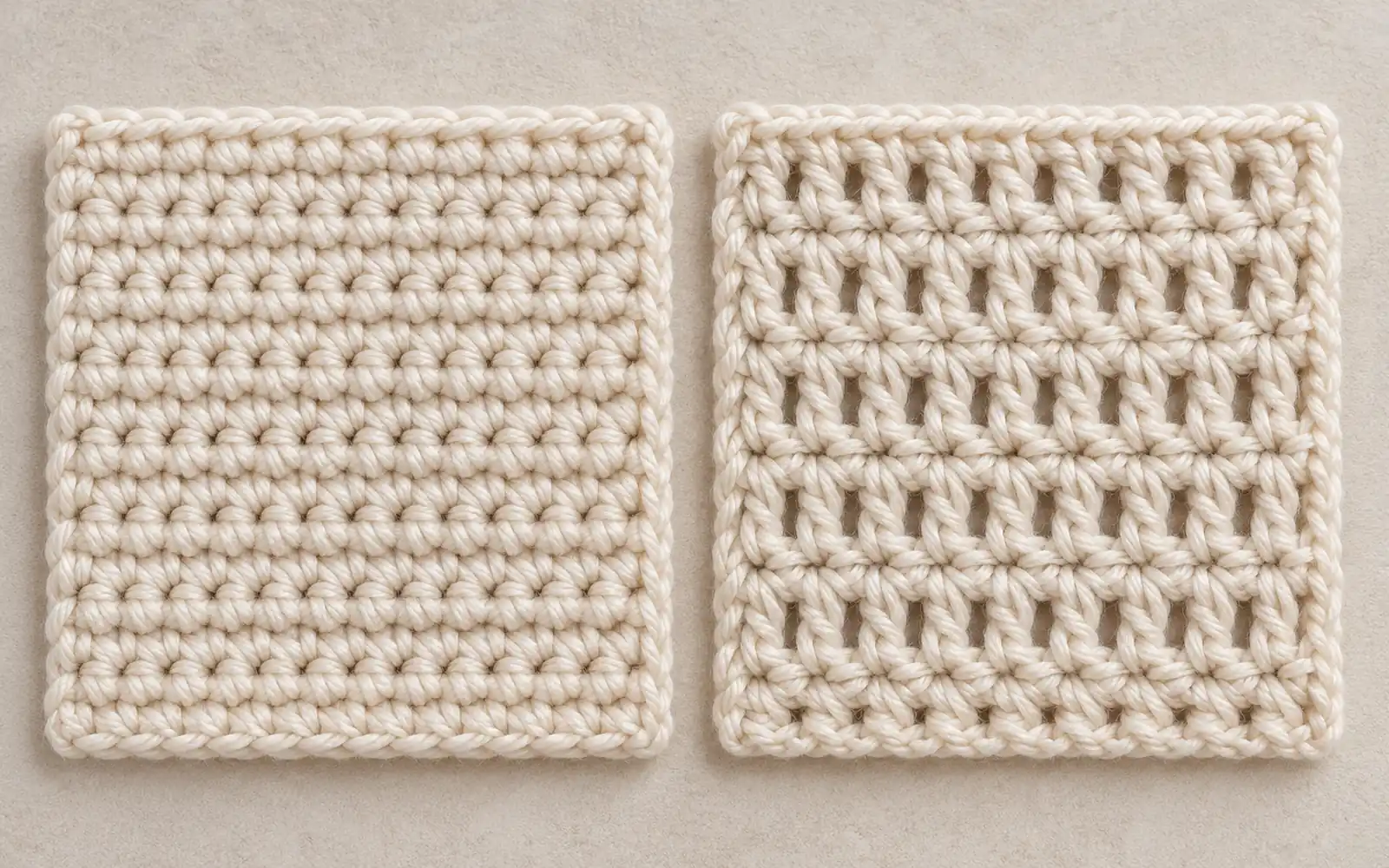
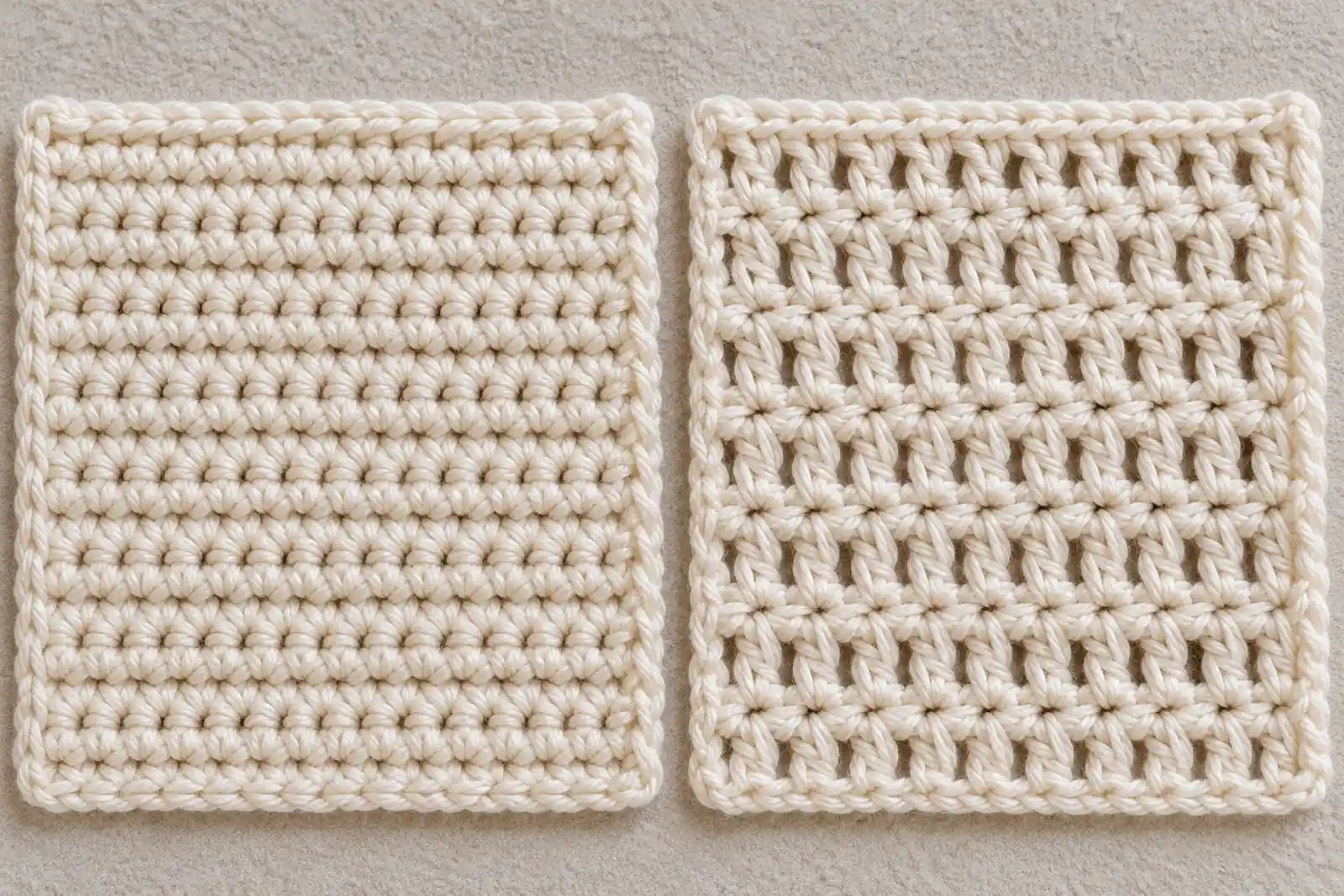
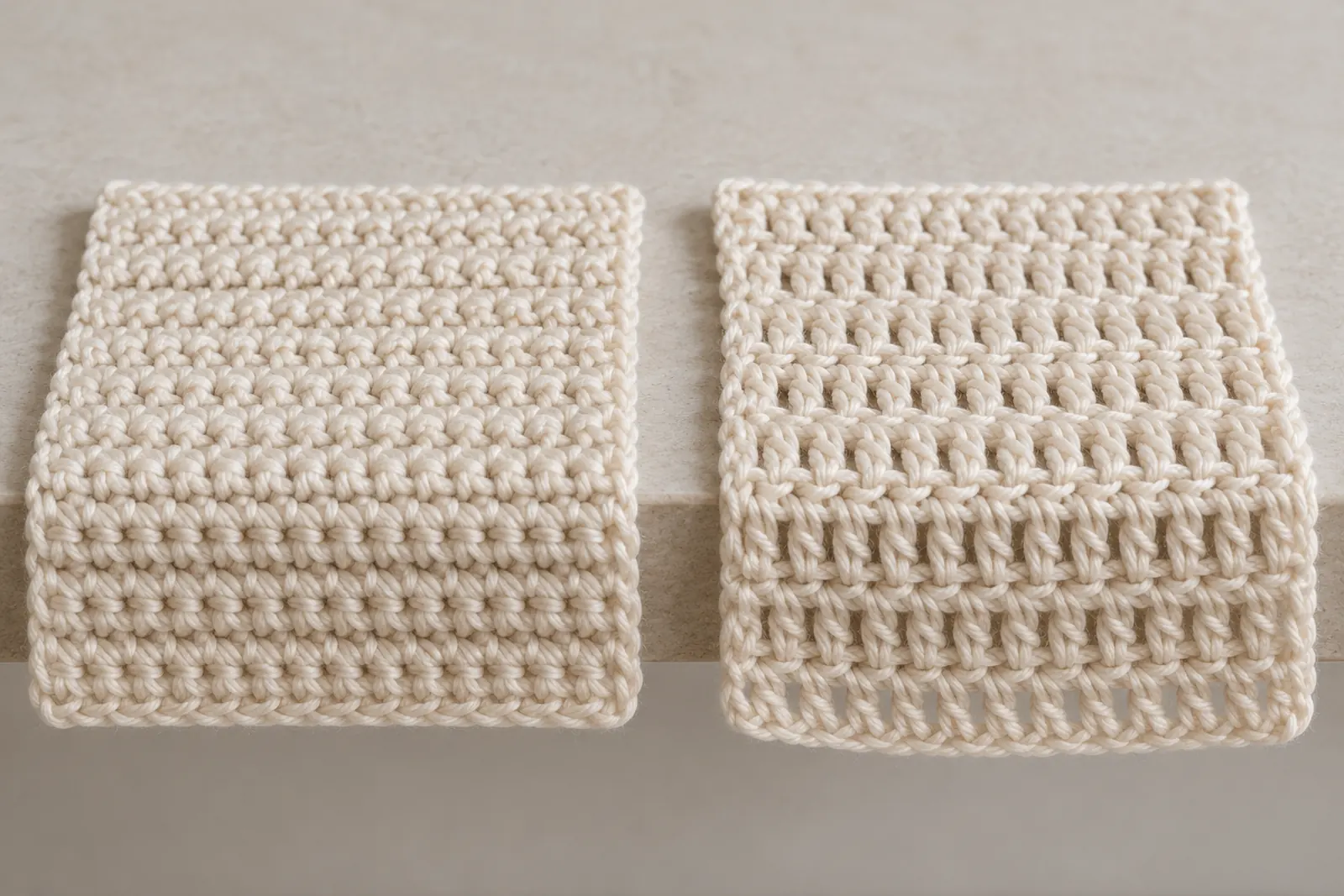
Two crochet swatches side by side, single crochet on the left and double crochet on the right, showing the difference in stitch height and fabric texture
Table of Contents
  1. The Two Stitches in One Minute
  2. Single Crochet vs Double Crochet Side by Side
  3. How the Fabric Differs: Density, Drape and Height
  4. Which Stitch for Which Project
  5. What Changes If You Swap One Stitch for the Other
  6. Key Takeaways
  7. Frequently Asked Questions

Quick answer: Single crochet vs double crochet comes down to height. Single crochet is short and makes a dense, firm fabric, so it suits toys, bags and edgings. Double crochet is taller, covers a length in fewer rows and drapes more, so it suits blankets, scarves and granny squares.

Your pattern says sc, or dc, and you are not sure why. Or you are choosing a stitch for a blanket, a bag or a toy and every tutorial seems to give a different answer. Both stitches use the same hook and the same yarn, yet the fabric they make is nothing alike.

This page puts the two stitches side by side: how they are made, how the fabric differs, and which one suits which project. It also shows what changes if you swap one for the other in a pattern, and how to test it on a small swatch first.

When I am unsure, I swatch both stitches in the yarn I plan to use. Five minutes with a hook tells me more about the fabric I want than any rule of thumb about which stitch is better.

The Two Stitches in One Minute

The difference starts with one extra move: double crochet adds a yarn over before the hook goes in. Everything else on this page follows from that. The crochet stitches and techniques guide shows where both stitches fit in the wider learning path.

Single Crochet: Short and Firm

Single crochet (sc) is a short, dense stitch made by inserting the hook, pulling up a loop, then pulling through both loops on the hook. There is no yarn over before the hook goes in, so two loops sit on the hook after the first loop is pulled up, and one pull finishes the stitch. The turning chain is 1 and usually does not count as a stitch, and the first stitch of a foundation row goes into the 2nd chain from the hook. The how to single crochet tutorial covers the steps.

Double Crochet: Taller and Looser

Double crochet (dc) is a tall stitch that starts with a yarn over before the hook goes in and finishes in two steps of two loops each. After the first loop is pulled up, three loops sit on the hook, and you pull through two loops, twice. The turning chain is 3 and usually counts as the first stitch, and the first stitch of a foundation row goes into the 4th chain from the hook. The how to double crochet tutorial has the steps.

Single Crochet vs Double Crochet Side by Side

Every row in the table below follows from one fact: double crochet is taller. The extra yarn over adds a step, the extra height changes the turning chain, and the taller stitch changes how the fabric looks and moves. Read the table across, one feature at a time.

The Comparison Table

Feature Single crochet Double crochet
Abbreviation sc dc
UK name double crochet treble
Height Shorter, about 1 chain tall Taller, about 3 chains tall
Yarn over before the hook goes in None One
Finishing the stitch Pull through both loops once Pull through two loops, twice
Loops on the hook after pulling up the first loop 2 3
Turning chain (US) 1, usually not counted 3, usually counted
First stitch into the foundation chain 2nd chain from the hook 4th chain from the hook
Fabric Dense and firm More open, drapes more
Rows needed to reach the same length More Fewer

Single crochet and double crochet compared.

Heights are approximate and shift with your hook, yarn and tension. The turning chain count matches the stitch height in chains, which is why double crochet needs 3 and single crochet only 1. Read the UK row with care, because UK patterns use different names for the same two stitches. The crochet abbreviations guide has the full US and UK name list.

How to Tell Them Apart in Finished Work

In a finished piece, a double crochet shows a tall vertical post under each V-shaped top loop, and the fabric has more small gaps between stitches. A single crochet stitch sits short and tight, with little or no gap. At the edge of a row, a double crochet turning chain stands taller than a single crochet one. If turning chains bulge out of the fabric, one guide suggests chaining one fewer, and one more if they pull the edge tight. The photo shows the two fabrics close up.

Single crochet vs double crochet swatches side by side up close, the short tight single crochet stitches on the left and the taller double crochet stitches with visible posts on the right

Single crochet (left) and double crochet (right), same yarn and hook.

How the Fabric Differs: Density, Drape and Height

Stitch height changes how much space the yarn covers and how the fabric moves, and that one cause sits behind density, drape and row counts. The two parts below take density and drape first, then rows and yarn. Both come back to height.

Density and Drape

Single crochet makes a firm, dense fabric that holds its shape, which suits structured items such as toys and bags. Double crochet makes a more open fabric that drapes and moves, which suits flowing items such as scarves and blankets. The photo shows two same-size swatches draped over a table edge. That is one pair of swatches, not a rule, because the hook, the yarn and your tension all change how different the two fabrics feel. Single crochet is not always stiff, either: some baby blanket patterns use it with chains and a large hook for a soft, lacy result.

Two same-size crochet swatches hanging over a table edge, the single crochet swatch on the left holding its shape and the double crochet swatch on the right falling in a softer curve

The same size swatches draped over a table edge: single crochet (left) and double crochet (right).

Rows, Height and Yarn

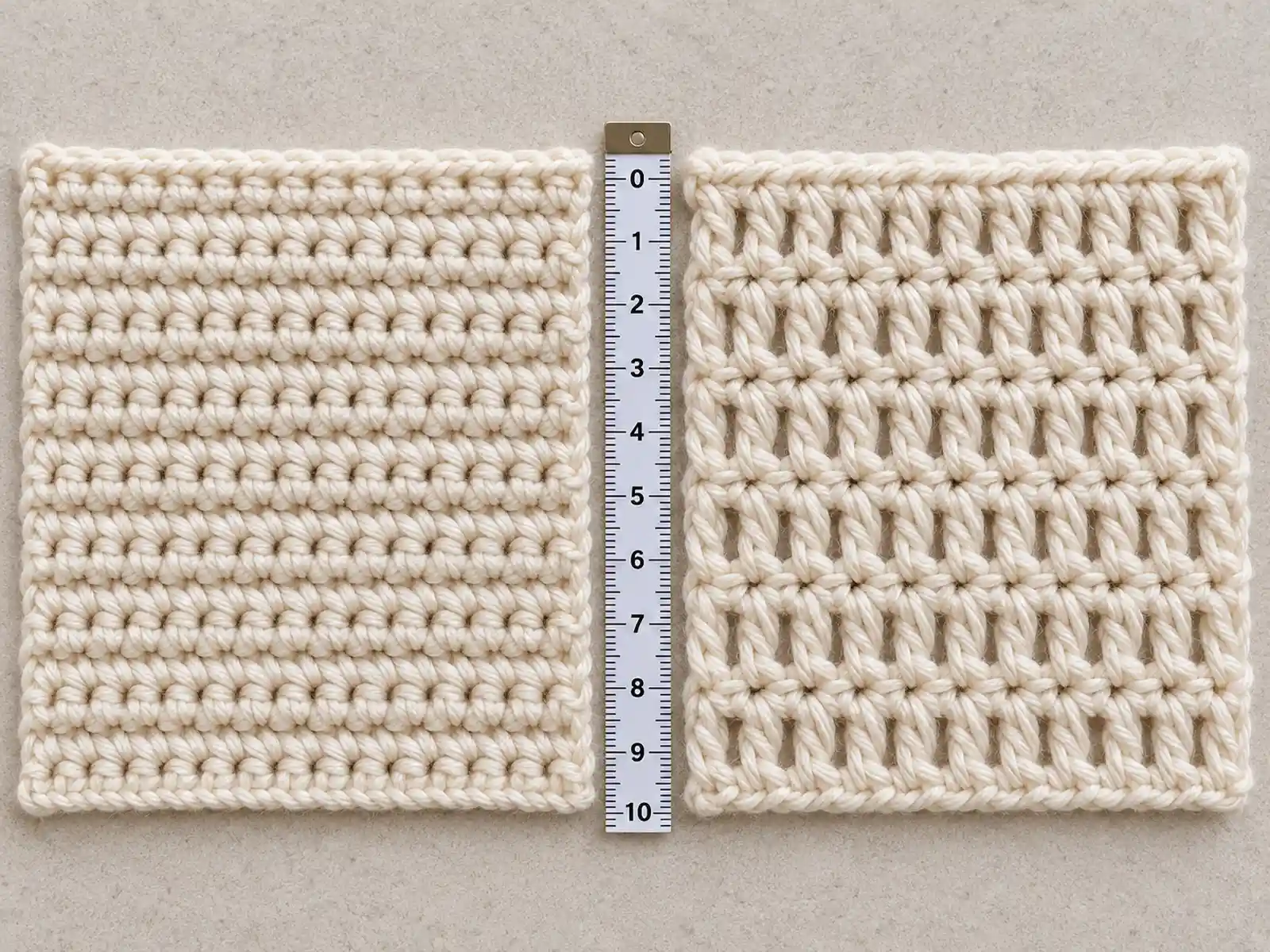
A taller stitch covers a length in fewer rows, which is why a double crochet blanket seems to grow faster. In the photo, both swatches are the same height, and the single crochet swatch needed more rows. In plain terms, a double crochet is about three chains tall and a single crochet about one. A taller stitch needs fewer rows to reach the same length; whether it uses more yarn depends on what you measure. Per stitch or per row, a double crochet uses more yarn. For the same area, one crocheter’s hands-on test found single crochet used more, while other pages only reason about it. Compare on your own swatch, as the swatch section below shows.

Two crochet swatches of the same 4 in height next to a measuring tape, the single crochet swatch on the left with more rows than the double crochet swatch on the right

Both swatches are about 4 in (10 cm) tall; the single crochet swatch took more rows.

Which Stitch for Which Project

Choose single crochet when the piece must hold its shape, and double crochet when it should move or when you want to cover a length quickly. The table gives the usual choices, and two shorter notes cover combining stitches and where half double crochet fits.

Choose by Project

Project Usual stitch Why
Amigurumi and toys Single crochet Dense fabric holds the stuffing in
Keychains and coasters Single crochet Firm, holds its shape
Bags and baskets Single crochet Sturdy, holds its shape
Dishcloths Single crochet Dense and hardwearing
Edgings and borders Single crochet Neat, firm edge
Hats and beanies Single or half double crochet The pattern says which
Blankets and throws Double or half double crochet Covers a length faster and drapes
Scarves, shawls and garments Double crochet Drapes
Granny squares Double crochet The classic square is made of double crochet clusters

Which stitch for which project.

The pattern always decides; these are the usual choices, so treat the table as a starting point, since your yarn and hook change the result. For toys, see how to make amigurumi and the free amigurumi patterns, such as the Minimal Frog Amigurumi. For blankets, see the crochet baby blanket guide and the free blanket patterns, such as the Textured Afghan Blanket.

When to Combine Them

A sturdy single crochet body with a double crochet border is one pairing. Alternating single and double crochet rows is another, and one beginner scarf pattern does it in every row for a thick, textured fabric. Surface crochet on a double crochet base is a third. Mixing stitches along an edge needs care, because the two heights mean a different number of stitches is picked up along a side, which is one reason the stitches cannot be swapped blindly. The crochet stitches to know list covers stitch patterns that mix them.

Where Half Double Crochet Fits

Half double crochet (hdc) is a stitch taller than single crochet and shorter than double crochet, made with one yarn over before the hook goes in. It finishes with one pull through all three loops, and the turning chain is 2, usually counted. It is roughly two chains tall, and its UK name is half treble. It is a common middle choice for hats and blankets. The crochet abbreviations guide lists the UK names, and the crochet stitches to know list covers more stitches.

What Changes If You Swap One Stitch for the Other

You can swap stitches in a flat rectangle if you recalculate, but not in shaped work. The two stitches differ in height, turning chain and gauge, so every count in the pattern shifts. This section shows what changes and how to test it first.

Why a Direct Swap Changes the Piece

Four things change together when you swap one stitch for the other:

  • The row height changes, so the piece grows at a different rate.
  • The number of rows needed for a given length changes.
  • The turning chain changes (1 instead of 3, or the reverse), and so does whether it counts.
  • The stitch gauge changes, so the width may change.

To reach a pattern’s gauge, change the hook size instead of working tighter or looser. In shaped work such as toys and hats, the increases and decreases are built on one stitch height, so a swap breaks the shape. A swap is safest in flat rectangles like scarves and blankets. How to read a crochet pattern explains where to find the gauge line.

Test It With a Swatch

Make a swatch about 6 in (15 cm) square in each stitch, with the yarn and hook you plan to use. Measure a section in the middle, away from the edges, which can distort, and count the stitches and rows in 4 in (10 cm). More stitches than the pattern gives over 4 in means a larger hook; fewer means a smaller hook. If the piece will be blocked, block the swatch first. Do this before you start the project, not after. Compare the two swatches before choosing, and weigh two same-size swatches on a kitchen scale if you want to compare yarn use.

Key Takeaways

  • Double crochet is taller than single crochet because it starts with a yarn over before the hook goes in and finishes in two steps instead of one.
  • Single crochet makes a dense, firm fabric that suits toys, bags, dishcloths and edgings; double crochet makes a more open, drapey fabric that suits blankets, scarves and granny squares.
  • A taller stitch needs fewer rows to reach the same length; whether it uses more yarn depends on what you measure, so test on a swatch.
  • The turning chain is 1 chain for single crochet (usually not counted) and 3 for double crochet (usually counted), and the pattern says which.
  • Do not swap one stitch for the other in a shaped pattern; in a flat rectangle, swatch both and recalculate the stitch and row counts first.

For the rest of the path, see crochet stitches and techniques.

Frequently Asked Questions

What is the difference between single crochet and double crochet?

Height. Double crochet is taller because it starts with a yarn over before the hook goes in and finishes in two steps of two loops, while single crochet has no yarn over and finishes with one pull through two loops. The turning chains differ too: 1 for single crochet and 3 for double crochet. The comparison table above lists ten differences side by side.

Is double crochet faster than single crochet?

Usually, for covering a length. A double crochet row is taller, so fewer rows reach the same length, although each stitch has more moves than a single crochet, so the time per stitch is slightly longer. Your own pace decides the rest, so time a few rows of each on a swatch. The section on rows, height and yarn above explains the row difference.

Which is easier for beginners, single or double crochet?

Single crochet, as a first stitch. It has no yarn over before the hook goes in, a 1-chain turning chain that does not count as a stitch, and a short row that is easy to count. Double crochet uses the same moves plus one yarn over, so it follows quickly. Start with how to single crochet, then move on to how to double crochet.

Does double crochet use more yarn than single crochet?

Not reliably, because sources measure different things: one counts yarn per row, another per area, another per project. For a piece of the same size, swatch both stitches at least 4 in (10 cm) square and weigh each on a kitchen scale. The figures quoted online come without sources, so your own weighing is the better test. The swatch section above shows how to make a fair comparison.

Can I substitute double crochet for single crochet in a pattern?

Only in flat pieces, and only after recalculating. The row height, the number of rows, the turning chain and the width all change. Do not swap in shaped work such as toys and hats, because the increases and decreases depend on stitch height. Swatch both stitches first. How to read a crochet pattern explains the gauge line, and the swap section above has the details.

What are single and double crochet called in UK patterns?

US single crochet (sc) is called double crochet (dc) in UK patterns, and US double crochet is called treble (tr). UK patterns have no “single crochet”. The pattern usually states which system it uses, so check before you start. This swap causes the most mix-ups, so it is worth checking even for simple patterns. The crochet abbreviations guide has the full US and UK list.

Portrait of Linda Davidsen

Written by

Linda Davidsen

Designer & founder

Linda has been crocheting for over 15 years and designs cozy, beginner-friendly patterns that anyone can finish in a weekend.

Keep reading

All posts