🧶 Yarn Calculator

Try

Visit our Etsy Shops

Pick a shop to browse. Each one opens on Etsy in a new tab.

Crochet Projects

Crochet Toys & Games: Safe Materials and Pattern Guide

Crochet toys and games guide: stacking toys, rattles and memory games, choosing by age, yarn, stuffing, washing, small parts and country rules.

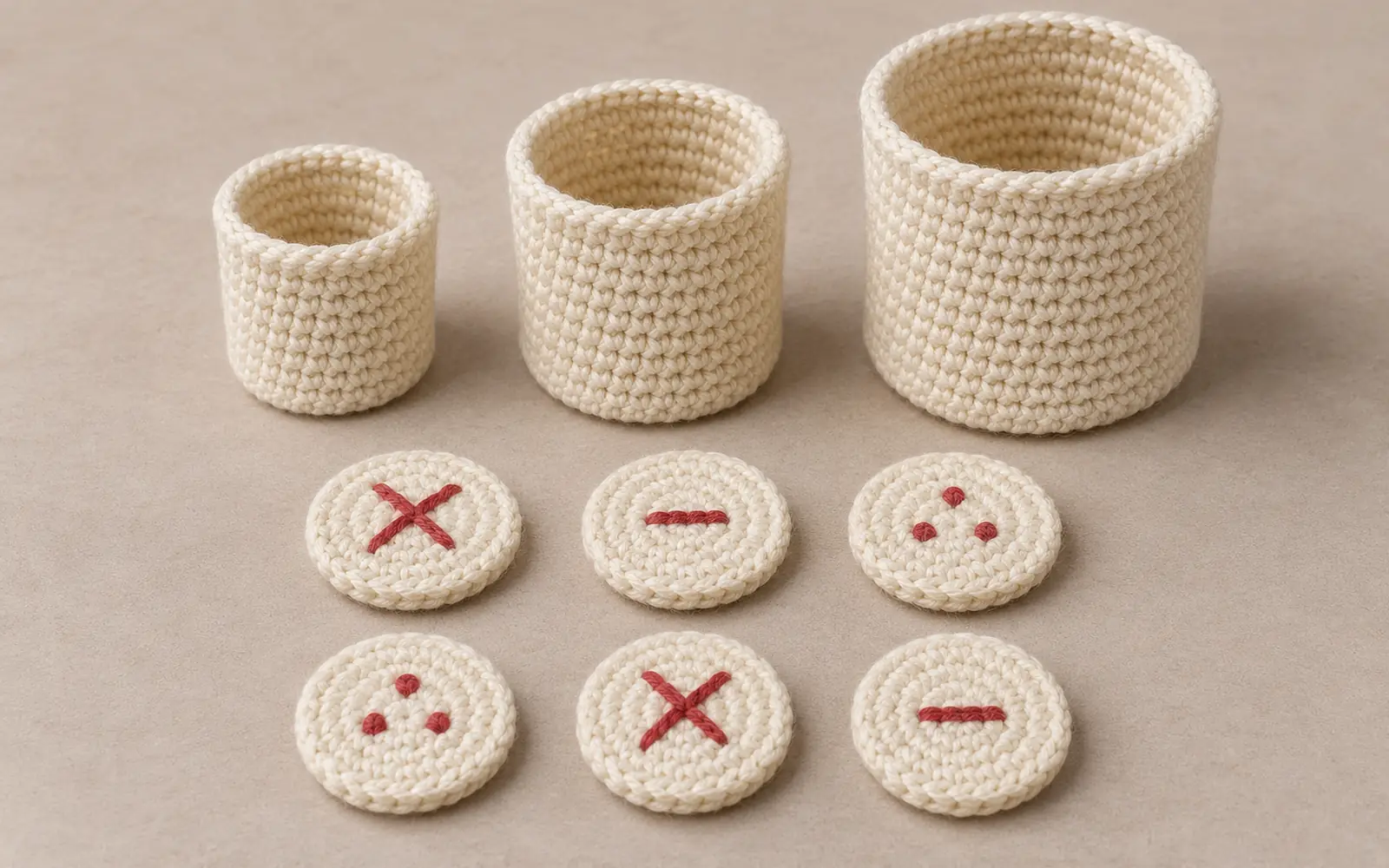
Three cream crochet cups in small, medium and large sizes above six flat crochet discs marked with red crosses, lines and dots, on a taupe surface
Table of Contents
  1. Kinds of Crochet Toys and Games
  2. Choose by Age and Check the Rules
  3. Read the Pattern Before You Start
  4. Materials: Yarn, Stuffing and Washing
  5. Small Parts, Eyes, Strings and Ribbons
  6. Common Problems and Fixes
  7. Key Takeaways
  8. Frequently Asked Questions

Quick answer: This crochet toys and games guide comes down to four checks: choose the toy by the child’s age, use smooth washable yarn and fiberfill, keep small parts, eyes and strings off or secure, and check your own country’s rules. No toy is safe by default.

You want to make a toy for a child, and the questions are different from any other project. Which pieces are suitable, which yarn, which stuffing, and what the pattern does not say about age. A toy gets handled, chewed and washed, so the choices matter.

This guide covers the kinds of crochet toys and games, how to choose by age, materials and washing, small parts, eyes and strings, and a problem table. An age table, patterns to try and a note on checking your country’s rules are included.

I decide who the toy is for before I choose the pattern, because the child’s age decides the eyes, the parts and the yarn. Everything else follows from that one answer, so I settle it first.

Kinds of Crochet Toys and Games

Crochet toys go beyond stuffed animals to stacking toys, rattles, memory games and tic tac toe sets. This page covers all of them in turn. See crochet project guides for choosing a project, and the toy and game patterns for more.

Stacking Toys, Rattles and Soft Toys

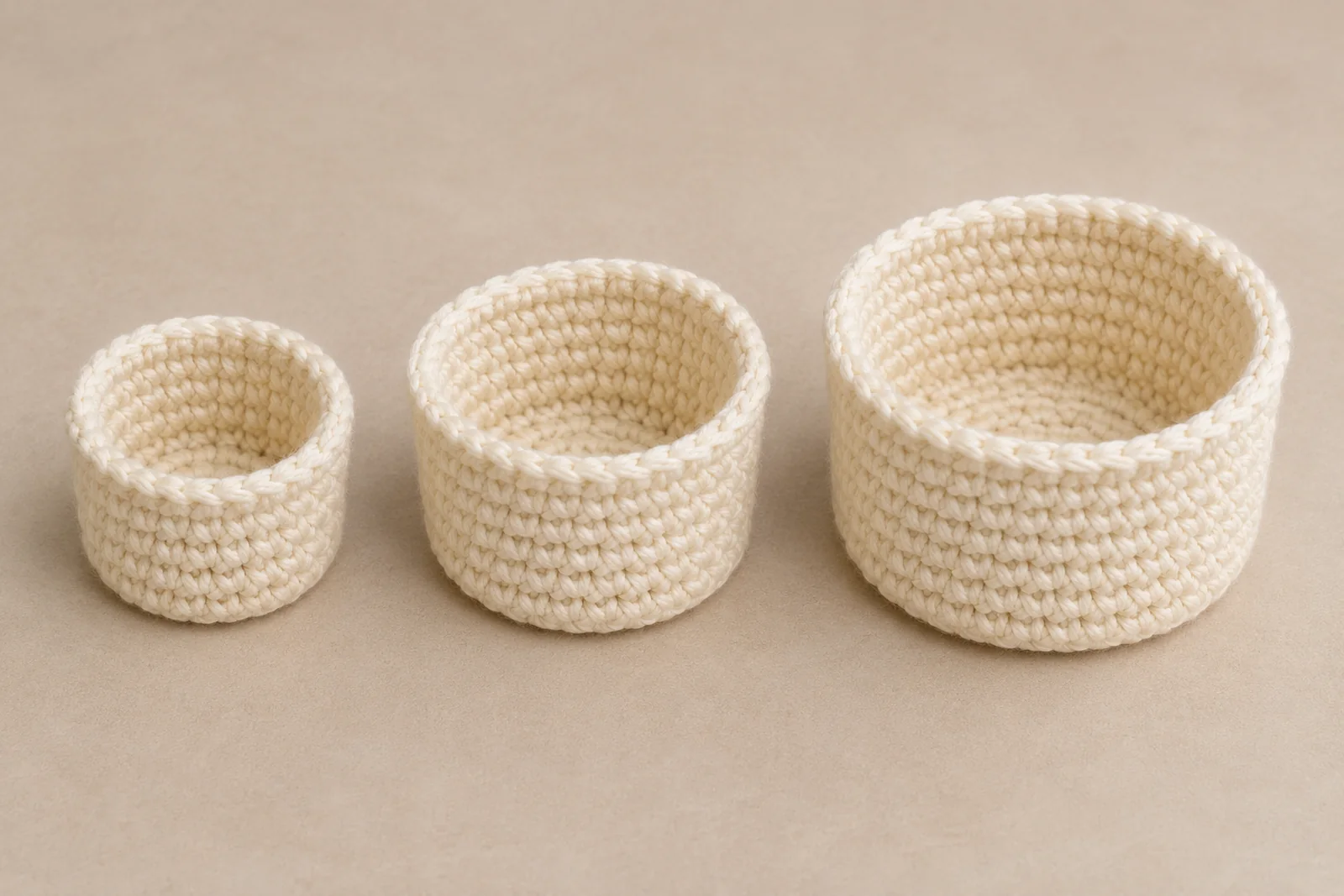
A crochet stacking toy is a set of graded pieces, such as cups, rings or animals, that stack or nest, and a crochet rattle adds a sound insert. A soft toy is the familiar stuffed animal; see how to make amigurumi for building one. Stacking toys and soft toys use the same tight stitches, and sizes should be consistent so the pieces fit. Any insert, such as a bell, is a small part inside the toy, so the pattern’s own notes come first. Try the Farm Animals Stacking Toy, Fruit Stacking Toy, Bunny Unicorn Giraffe Baby Rattle or Baby Dino Toy (Blue). The photo below shows three cups in graded sizes.

Three cream crochet cups in small, medium and large sizes standing side by side in size order with their open tops visible A stacking set: three cups in graded sizes.
Memory Games and Tic Tac Toe

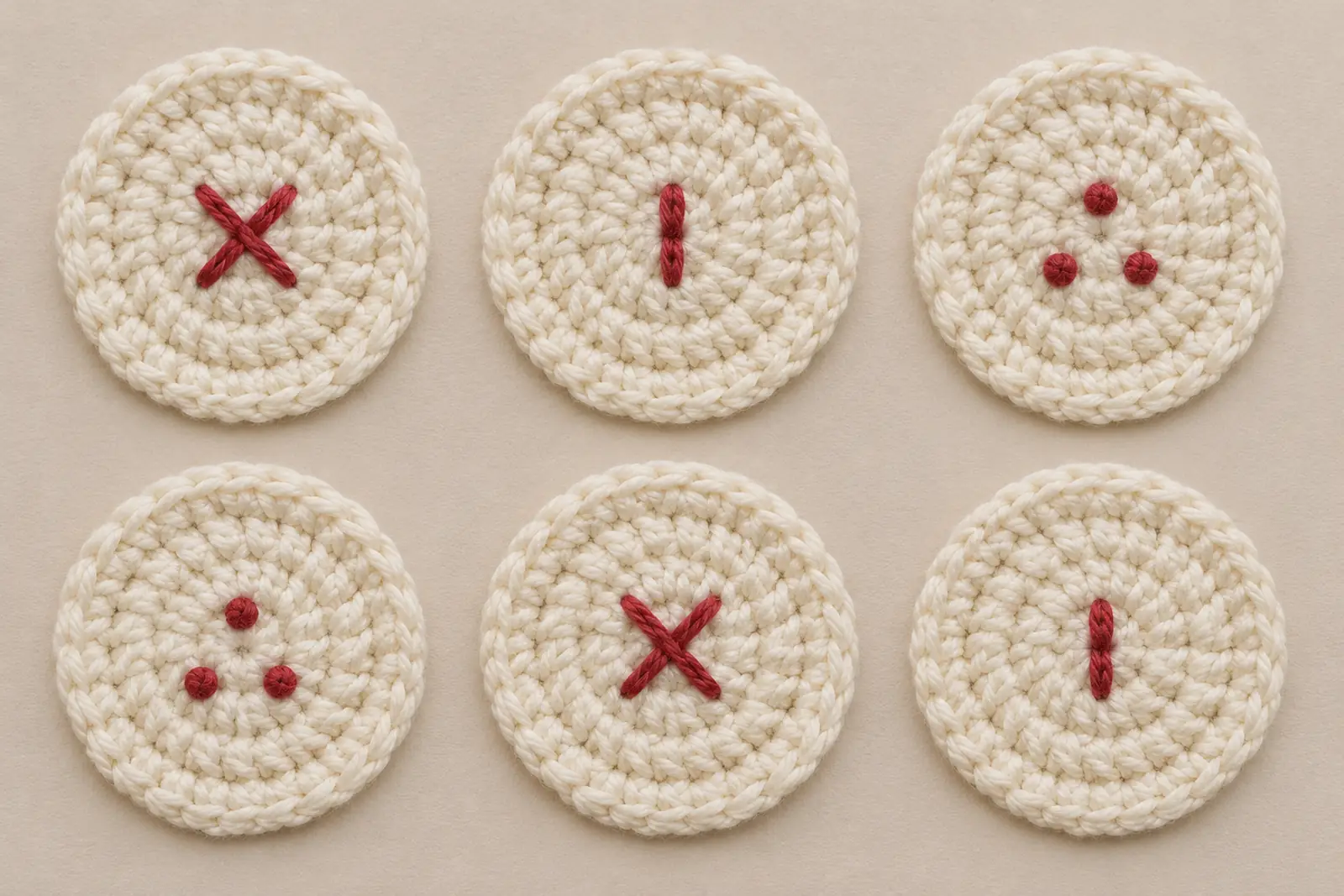
A crochet memory game is pairs of matching flat pieces, each pair marked differently, and a crochet tic tac toe set is a board of nine squares with two sets of markers. Both repeat one simple shape in different colors or marks. Game pieces are small and many, so they are small parts, and a set suits older children better than the youngest; see the age notes below. Sets are often sold as educational toys, and this page makes no claim about what a child learns. Try the Hot Cocoa Memory Game, Turtle Memory Game or Sunflower Tic Tac Toe. The photo below shows six discs in three pairs.

Crochet toys and games guide memory set of six cream flat discs in two rows of three, forming three matching pairs marked with a cross, a line and three dots Three matching pairs of flat discs, laid out as a memory game.
Simple, Montessori-Style Toys

Montessori-style describes a simple toy with one clear purpose and no batteries, usually in natural materials, and it is a description, not a certificate. One overview says natural materials such as wood and cotton are preferred and that the surroundings matter more than any toy. Crochet suits the plain end of that idea: a stacking cup, a soft ball or a simple fabric sensory piece. This page does not call any pattern Montessori and makes no claim about learning.

Choose by Age and Check the Rules

The child’s age sets the eyes, the parts and the stuffing, and guides give age notes that differ in detail, so check your own country’s rules. None of the guides replaces those rules, and this page calls no toy safe.

What Guides Say by Age

Guides give age notes for crochet toys, and they differ in detail.

Age What guides say Where guides differ
Under 1 Soft toys with features worked into the fabric, such as embroidery, and less stuffing Some guides add certified safety eyes, and a learner book says embroider or use regulation eyes
Under 3 No small parts that can come off; fiberfill only; weave in and trim every end; embroidered or certified eyes One guide says avoid safety eyes because stitches can loosen
Under 5 Polypropylene stuffing beads are a choking hazard Only one guide gives this age
Under 8 Keep wire and other sharp objects out of the stuffing Another guide says avoid wire accessories for toddlers

The table is not a standard. For a lovey with a toy head, see the crochet baby blanket guide; for eyes, see amigurumi safety eyes.

Check Your Country’s Rules

Rules for children’s toys differ by country, and a handmade crochet toy has not been tested to a toy standard unless it has been. One US overview says the children’s product law covers ages 0 to 12, does not exempt handmade items and may require lab testing and a Children’s Product Certificate, with a small-batch route for some makers. One EU overview says toys for under 14s fall under the EN 71 standards, with CE marking, and the EU is replacing its toy rules, so check the current text. If you sell, check the rules where you live. For a baby, ask the child’s carer and doctor. This is not legal advice.

Read the Pattern Before You Start

A crochet toy pattern lists the yarn, the notions and the finished size, and usually not the age, so read it with the child in mind. A pattern is not a safety statement, so the child’s age is the check you add.

What the Pattern Lists

Before you crochet a toy, check the pattern’s notions for eyes, buttons, beads, bells and ribbon, and check the finished size. Check the yarn weight and hook too: some guides say exact gauge is not essential for a toy, but the fabric still has to be tight. Many patterns give no age. Left-handed makers work the same pieces mirrored; only the direction differs. Tight stitches with a small hook tire the hand, so rest between pieces.

Changing a Pattern for a Younger Child

To change a crochet toy pattern for a younger child, embroider the features, drop beads and ribbons, sew rather than glue and weave in every end. A learner book says beginners should take care modifying patterns, so change one thing at a time and make a test piece; see the project guides. For eyes, see the safety eyes guide. Making these changes does not make a toy safe, and the child’s age still decides.

Materials: Yarn, Stuffing and Washing

A crochet toy is handled and washed more than most projects, so the yarn, the stuffing and the care line matter. Each is covered below, with what guides say and where they differ, and the yarn comparisons live in other guides.

Yarn and Stitches

Guides say to crochet a toy in smooth, washable yarn with tight stitches and a hook one or two sizes smaller than the label suggests, so the stuffing cannot show. They say to avoid shedding yarns such as fun fur and angora and novelty yarns with loose sequins or beads. A learner book calls acrylic ideal for toys, and one page suggests plain cotton, so this page names no best fiber; see best yarn for amigurumi, cotton vs acrylic yarn and best yarn for baby crochet. Hand-dyed yarn may bleed in the wash. The amigurumi invisible decrease helps keep stitches tight, and how to read a yarn label covers care.

Stuffing

Guides recommend washable polyester fiberfill for a crochet toy and say to avoid beads and pellets, which are a choking hazard and may not wash. Check the label on natural fillers, since not all can be washed. Use less stuffing for an infant’s toy and do not overstuff, because that distorts the shape. One maker says filling should hold nothing smaller than about 1¼ in (3 cm), and sources vary. Sew with strong thread and tight stitches so the filling cannot escape. See the amigurumi guide for the stuffing method.

Washing and Drying

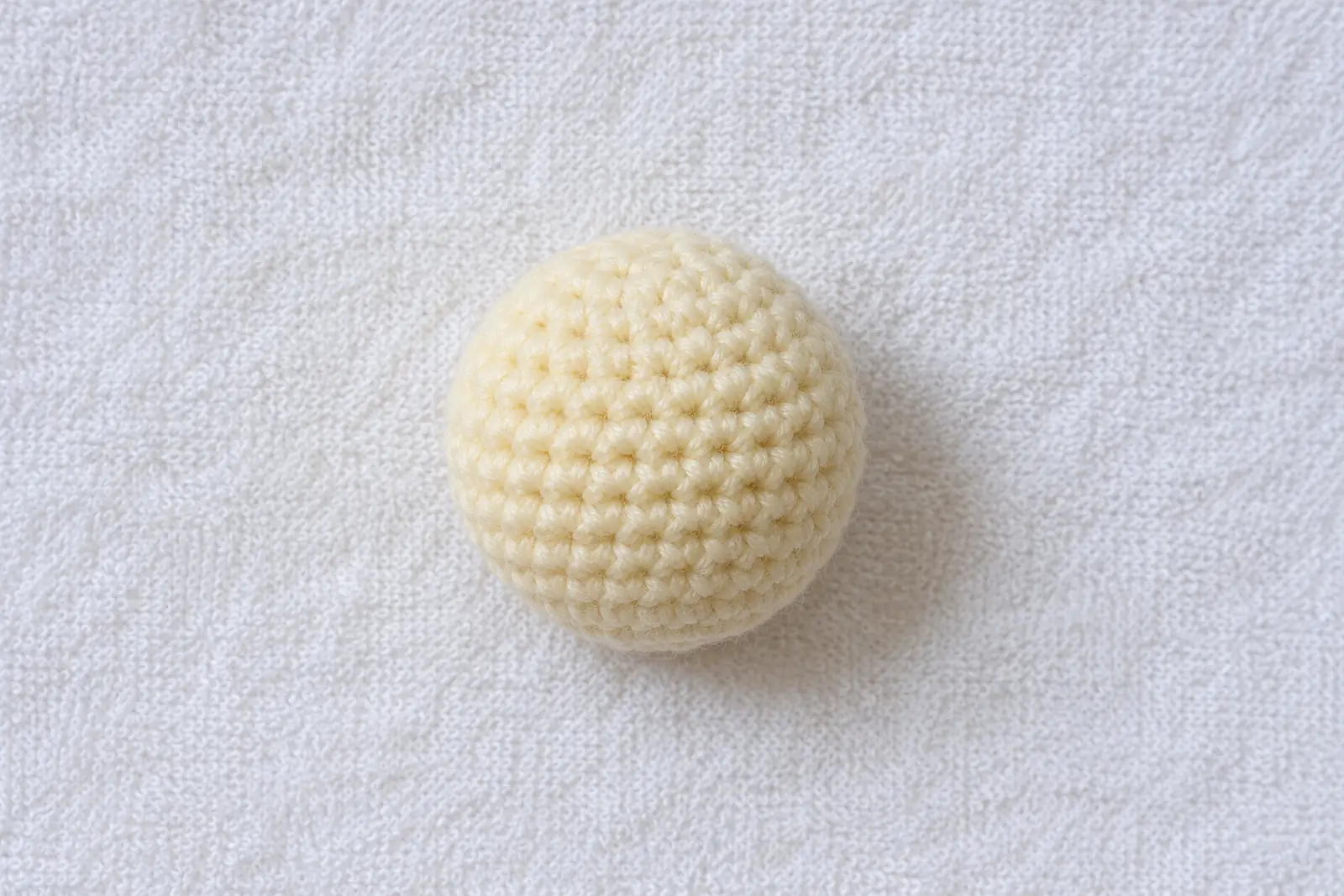
Wash a crochet toy by the yarn label, gently in cool water, and dry it flat and completely before it is used or stored. Some guides prefer hand washing and others allow a mesh bag on a cold gentle cycle, with mild detergent and no bleach or softener; the label guide covers symbols. Reshape the toy and dry it flat on a towel; hanging a wet toy can stretch seams and stuffing. I wash by the yarn label, use a gentle method, and dry the toy flat and completely before it is used again. The photo below shows a washed toy drying.

A small damp cream stuffed crochet ball, reshaped and lying on a plain white towel to dry A washed toy reshaped and left to dry flat.
Small Parts, Eyes, Strings and Ribbons

Guides focus on what can come off a crochet toy, so check what is attached, how it is attached and how long it is. The checks below cover small parts, eyes, and strings, ribbons and wire; none of them makes a toy safe.

Small Parts and Attachments

For children under three, guides say to avoid parts that could come off, sew attachments on instead of gluing them and weave in and trim every end. Many guides use about 1¼ in (3 cm) as the size of a small part, though sources vary. Go over each seam more than once, and avoid sharp metal or glass embellishments. I sew every part on securely, go over the seam a second time, then tug on it to check it holds. One guide says a larger toy is less likely to be swallowed. See the amigurumi guide for pinning and sewing parts.

Eyes, Briefly

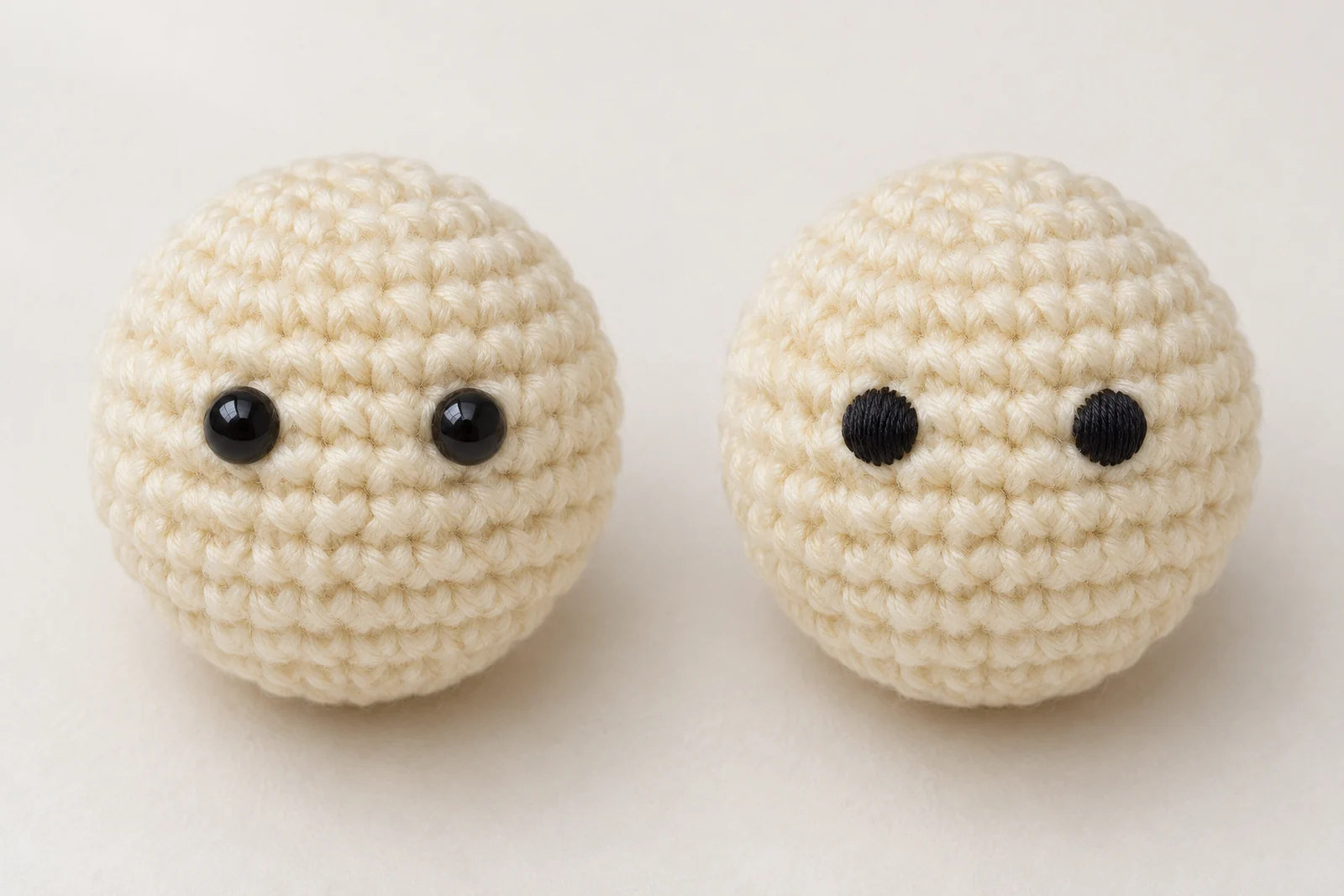
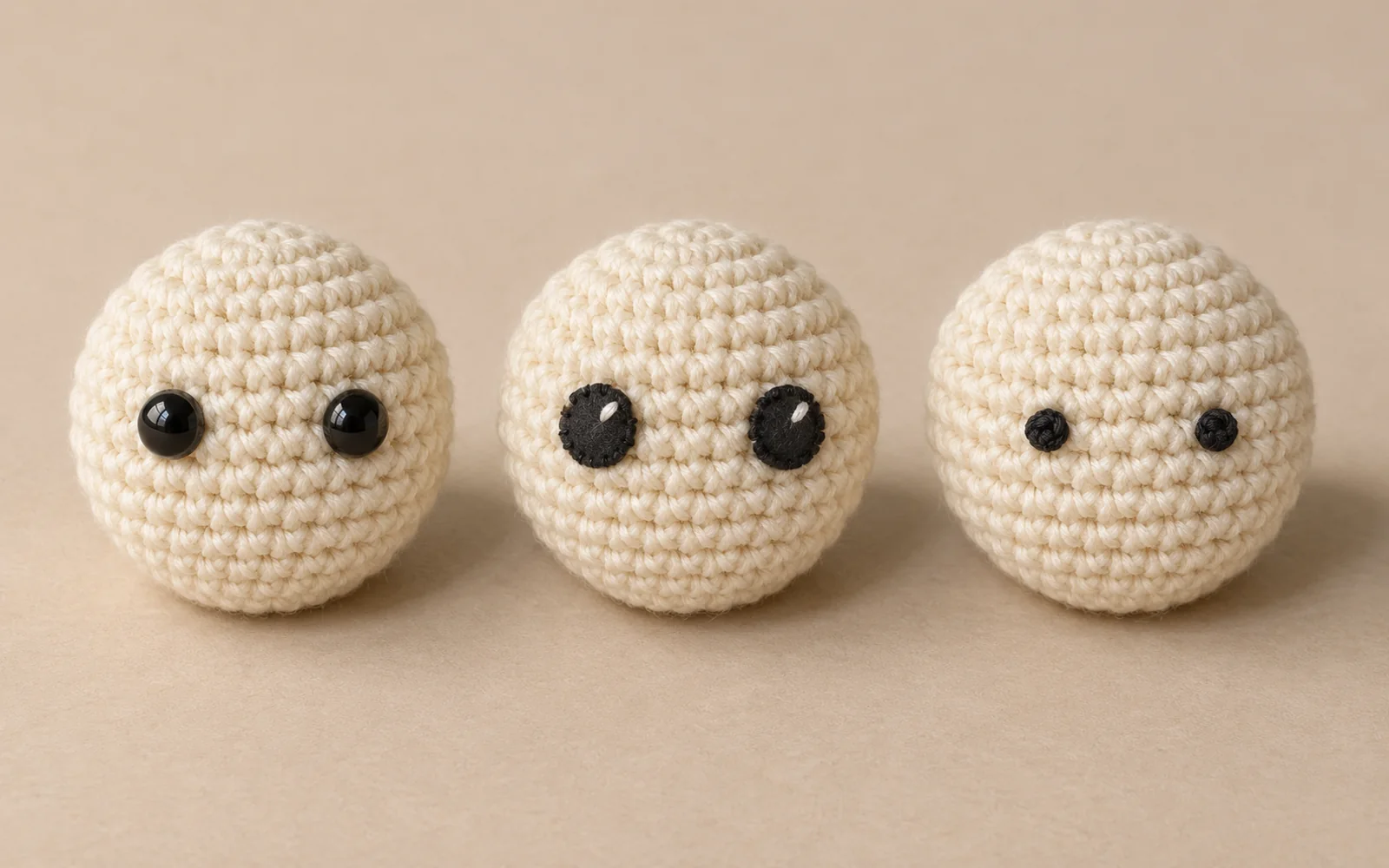
For a baby or very young child, guides say to embroider the eyes and never use buttons, and guides differ on safety eyes for toddlers. One guide says to avoid them because stitches can loosen, and one maker calls “safety eyes” a marketing term. Rules differ by country, so check your own; this is maker guidance, not a safety standard. See the safety eyes guide for types, sizes and placement. The photo below shows both kinds on the same shape, made on purpose.

Two small cream stuffed crochet balls side by side, the left one with black plastic eyes and the right one with embroidered eyes in the same place Made on purpose: plastic safety eyes (left) and embroidered eyes (right) on the same small shape.
Strings, Ribbons and Wire

One maker says to keep strings and ribbons on a baby’s crochet toy shorter than about 12 inches or leave them off, and guides differ on wire. Another guide says to avoid dangling strings and ribbons and to keep mobiles out of a young child’s reach. On wire, one guide says keep it out of toys for under 8 and another says to avoid it for toddlers. Rules differ by country; check yours.

Common Problems and Fixes

Most crochet toy problems come from loose stitches, loose parts or care, and each has a quick fix. The table gives the likely cause and the fix for six common ones, and each one follows advice from the sections above.

Problem, Cause and Fix

Stuffing that shows through, a part that wobbles and a toy that loses its shape in the wash are the most common crochet toy problems.

Problem Likely cause Fix
Stuffing shows through Loose stitches Use a smaller hook and tighter tension
A part wobbles or comes loose Sewn on once Sew it twice and tug to check
The toy loses its shape in the wash Overstuffed, or hung to dry Stuff lightly and dry it flat
Stacking pieces lean Uneven stuffing or uneven sizes Stuff each piece to the same firmness and check the stack
The yarn sheds or pills A fuzzy yarn Choose a smooth yarn and avoid fun fur and angora
Dark color bleeds A hand-dyed or dark yarn Wash a swatch first and choose a washable yarn

Key Takeaways

  • Choose a crochet toy by the child’s age first, because the age sets the eyes, the parts and the yarn.
  • For children under three, guides say to avoid small parts that can come off, use fiberfill only, embroider or crochet the features and weave in every end.
  • Use smooth washable yarn with tight stitches, avoid beads and pellets in the stuffing, and wash by the yarn label and dry the toy flat.
  • Sew every part on securely and check strings and ribbons, which one maker keeps under about 12 inches.
  • Rules differ by country and handmade toys are not tested unless they are, so check yours; this page calls no toy safe.

Frequently Asked Questions

Are crochet toys safe for babies?

Not by default: a handmade crochet toy has not been tested to a toy standard unless it has been, and this page does not call any toy safe. Guides say: for under 1, features worked into the fabric; for under 3, no small parts that can come off, fiberfill only and every end woven in and trimmed. Guides differ on eyes, and rules differ by country, so check yours. The Choose by Age and Check the Rules section above has the age table.

What yarn should I use for crochet toys?

Use a smooth, washable yarn worked tightly with a hook one or two sizes smaller than the label suggests. A learner book calls acrylic ideal for toys, one page suggests plain cotton, and guides say to avoid fun fur, angora and novelty yarns with loose sequins or beads. Check the label for care. The Materials: Yarn, Stuffing and Washing section above has more, and the amigurumi yarn guide compares yarns.

What stuffing should I use in a crochet toy?

Use washable polyester fiberfill and avoid beads and pellets, which guides call a choking hazard. Use less for an infant’s toy, do not overstuff, and keep filling above about 1¼ inches (3 cm); sources vary on the size. Natural fillers may not wash, so check the label. The Materials: Yarn, Stuffing and Washing section above has more.

Can I sell crochet toys I make?

Possibly, but check first: one US overview says handmade children’s products are not exempt from the main children’s product law and may need testing and a Children’s Product Certificate, with a small-batch route for some makers. One EU overview says toys are covered by the EN 71 standards with CE marking. This is not legal advice, so check the rules where you live. The Choose by Age and Check the Rules section above has more.

How do I wash a crochet toy?

Follow the yarn label: hand wash gently in cool water, or use a mesh bag on a cold gentle cycle if the toy is washable. Skip bleach and softener, avoid tumble drying, reshape the toy and dry it flat and completely. Hanging a wet toy can stretch the seams. The yarn label guide explains the symbols.

Portrait of Linda Davidsen

Written by

Linda Davidsen

Designer & founder

Linda has been crocheting for over 15 years and designs cozy, beginner-friendly patterns that anyone can finish in a weekend.

Keep reading

All posts