đź§¶ Yarn Calculator

Try

Visit our Etsy Shops

Pick a shop to browse. Each one opens on Etsy in a new tab.

Seasonal Crochet

Free Christmas Crochet Patterns: Ornaments, Trees & Santas

Free Christmas crochet patterns sorted by size and time: ornaments, trees, garlands, Santas, stockings, blankets and hats, plus how to hang them.

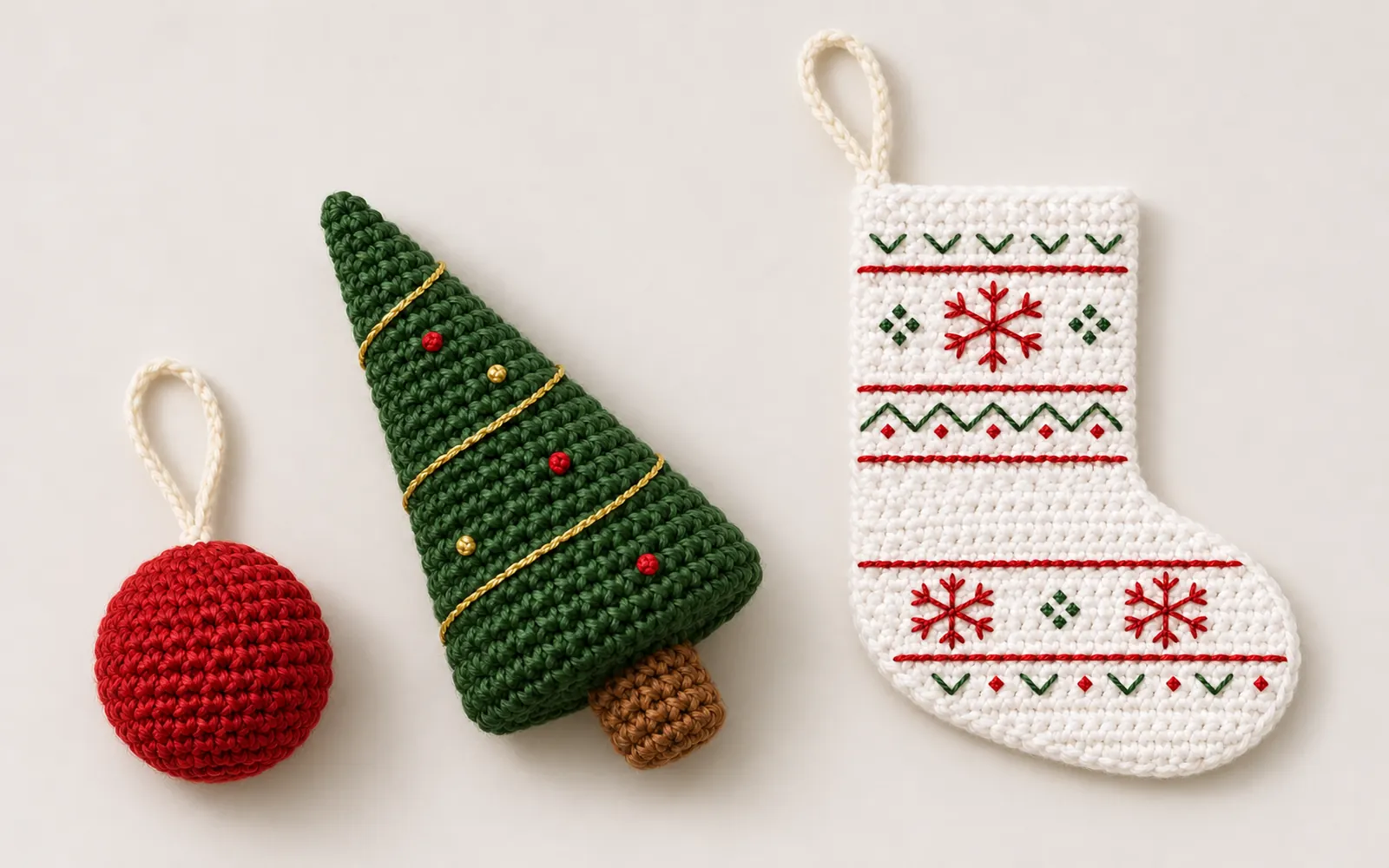
A red crochet ball ornament, a green crochet Christmas tree and a cream crochet stocking with red and green colorwork
Table of Contents
  1. Sort Christmas Crochet by Size and Time
  2. Ornaments and How to Hang Them
  3. Trees, Garlands and Lights
  4. Santa, Mrs. Claus and Other Figures
  5. Stockings, Blankets and Wearables
  6. Red, Green and Cream
  7. Key Takeaways
  8. Frequently Asked Questions

Quick answer: Free Christmas crochet patterns fall into three sizes: small ones like ornaments and trees, mid-size ones like Santa figures and stockings, and large ones like blankets and sweaters. Choose the size first, then the pattern, and plan how each ornament will hang.

Search for free Christmas crochet patterns and you get a hundred ornaments, a dozen Santas and three blankets in one scroll. Which ones can you actually finish, and where does each one end up: on the tree, on the mantel or on the couch?

This guide sorts Christmas crochet patterns by type and size: ornaments, trees, garlands, Santa figures, stockings, blankets and wearables. It also covers how to hang an ornament, how to choose red, green and cream, and what to check on small parts. Patterns to try sit beside each group.

Before I pick a Christmas pattern, I decide whether it is a small piece for the tree or a big piece for the couch. The size tells me what I can finish.

Sort Christmas Crochet by Size and Time

Christmas crochet runs from an ornament that takes an evening to a blanket that takes weeks, so sorting by size is the quickest way to a list you can finish. For the whole year in order, see the seasonal crochet patterns guide.

Seven Groups, Three Sizes

Christmas crochet patterns fall into seven groups and three sizes, from ornaments that take under an hour to an evening up to blankets and sweaters that take several weeks.

Group Size Rough time
Ornaments Small: palm-sized or smaller Under an hour to an evening
Small trees Small to mid: ornament to desk size An evening
Garlands and lights Long, built from small pieces An evening to a weekend, by length
Santa and Mrs. Claus figures Mid: hand-sized to forearm-sized An evening to a weekend
Stockings Mid: from mini to full size An evening for a mini, a weekend for a full size
Hats and baby pants Wearable: sized to a head or a baby A weekend
Blankets and sweaters Large Several weeks

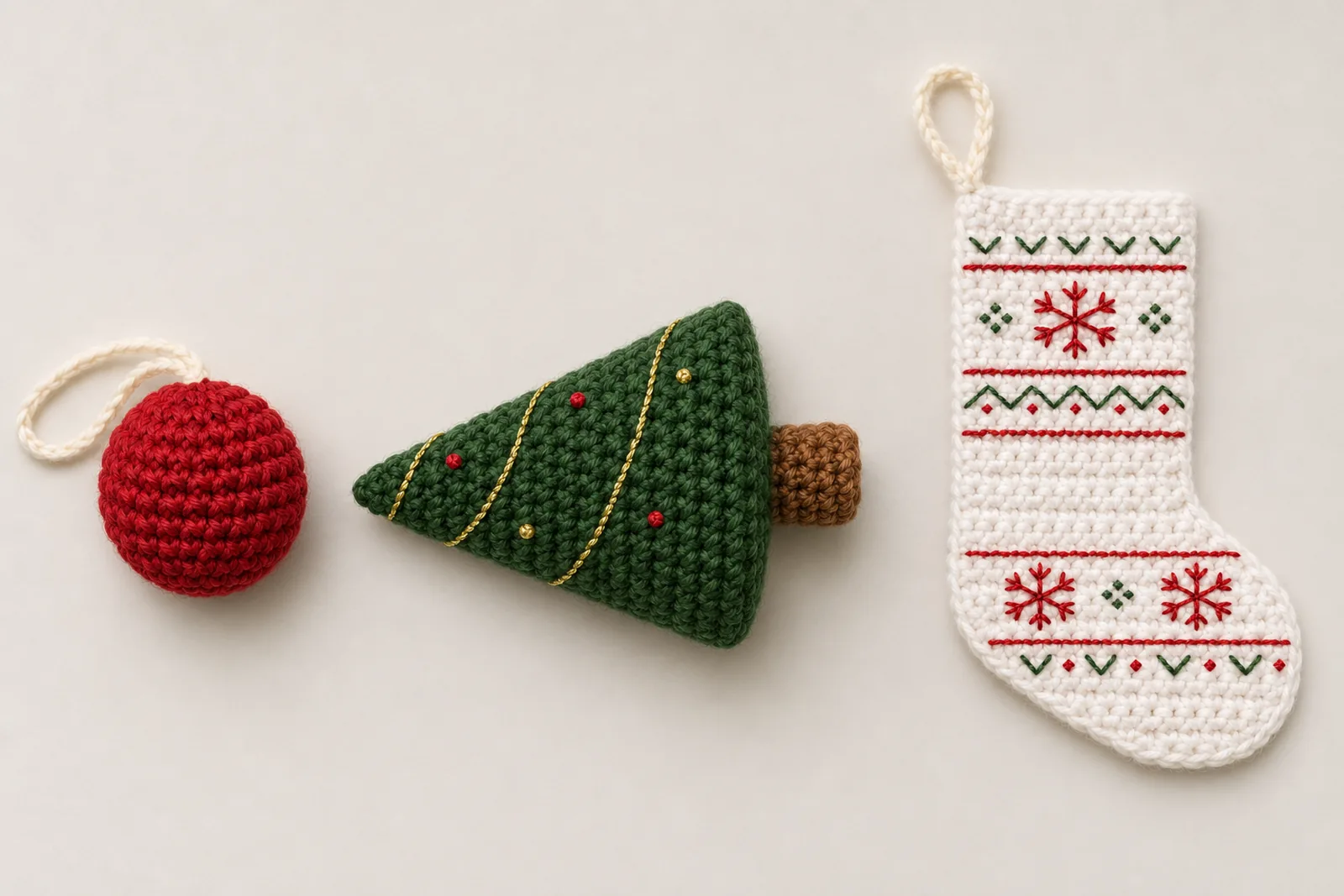
Three cream crochet Christmas shapes from small to large for free Christmas crochet patterns: a ball, a tree and a stocking Three sizes of Christmas crochet: a small ball, a mid-size tree and a flat stocking.
The three classes are small, mid-size and large. Times are rough ranges, web estimates conflict, and a pattern’s own finished size beats this table.

Choose by Size First

To choose a Christmas crochet pattern, decide where the piece will go first, because the place sets the size and the size sets how much you can finish. Mix classes: a few small pieces finish fast and give the tree something to show, while one large piece holds the longest. A pattern a size larger than your time allows can wait for next year. See crochet holiday planning for when to start and crochet Christmas gifts for gifts by person, and browse the holiday and seasonal patterns hub for the current list.

Ornaments and How to Hang Them

A crochet ornament is not finished until it has a way to hang, so plan the hanger when you pick the ornament. This section covers the ornaments to make, then the three common hangers and one way to stiffen flat pieces.

Ornaments to Make

Crochet Christmas ornaments are the smallest Christmas makes, and a stuffed one should be firm enough to hold its shape. Roundups list mittens, skates, balls, reindeer, candy canes, snowmen and stars. One roundup treats a tree small enough to hang as an ornament and a huggable Santa as a toy, so decide which a piece is before you add eyes or small parts. Flat stars and snowflakes are the lightest ornaments and stuffed figures the heaviest, so check the branch. Try the Miniature Christmas Ornaments.

Hangers, Loops and Stiffening

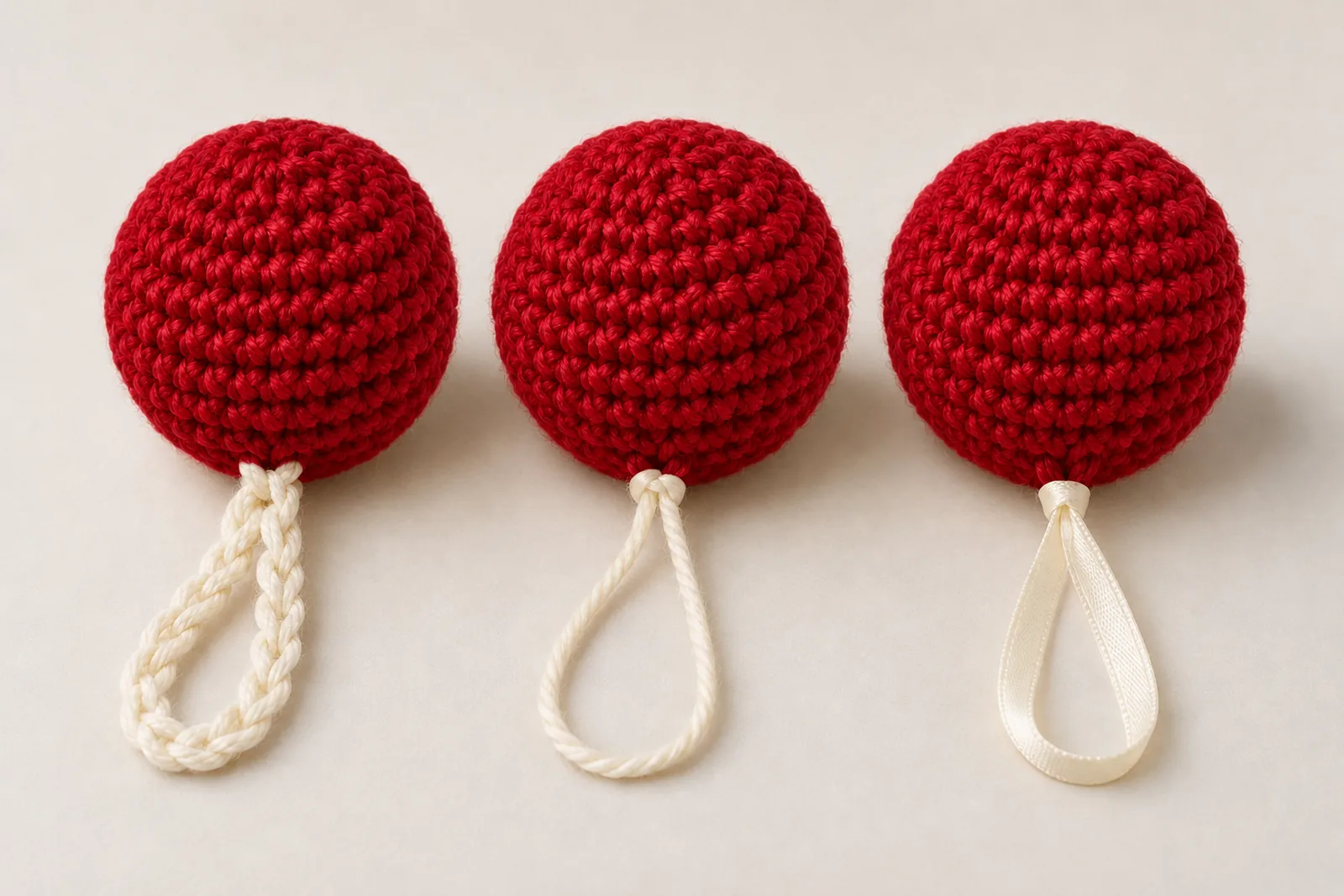
A crochet ornament hangs from a chain loop worked in the same yarn, a sewn yarn loop or a thin ribbon. One tutorial closes the last round, then chains 10 and joins the chain across the top. A sewn loop is fastened with a few stitches, and ribbon is threaded through the top stitches and tied; weave in the ends well. I crochet a chain loop in the same yarn at the top of an ornament instead of adding ribbon, so there is nothing to come untied. One health site advises placing ornaments at the top of the tree, out of children’s reach, and attaching them firmly, and not using ones that are falling apart. One page says thin flat pieces such as cotton snowflakes can be stiffened with a solution and pinned to dry for 24 to 48 hours.

Three identical small cream crochet balls, each with a different hanger: a chain loop, a sewn yarn loop and a ribbon Three hangers on the same ball: a chain loop, a sewn loop and a ribbon.
Trees, Garlands and Lights

Trees and garlands turn a room into a Christmas room, and both come in small and large versions. Ornament hangers are covered above, so this section is about the pieces themselves. Check each finished size before you start, because the same shape can be an ornament or a table piece.

Christmas Trees

A crochet Christmas tree can be small enough to hang on a branch or big enough to stand on a table, so check the finished size before you start. A mini and a table tree are different projects. A standing tree needs firm stuffing so it holds its shape. Plain green or a color or texture change both work, but keep beads and other decorations off any piece a young child may reach; see the small parts section below. Try the Christmas Tree Amigurumi.

Garlands and Lights

A crochet Christmas garland is made from separate small pieces joined along a chain or cord, so you can make as many as the length needs. A learner book works one garland as flowers threaded on a chain of the length you want and another as fish and starfish worked separately and joined. Measure the mantel, window or stair first and make the length before you decide how many pieces. Light shapes are small and repeat the same piece, so they suit a batch. Plan a loop or tie at each end for hanging. Try the Christmas Lights Garland.

Santa, Mrs. Claus and Other Figures

Santa and Mrs. Claus figures are the mid-size Christmas makes, and they are the group that needs the most care with eyes and small parts. The how to make amigurumi guide covers how to build one. This section sorts the patterns first and then covers the eyes.

Santa, Mrs. Claus and Character Patterns

Santa amigurumi is the best-known Christmas figure, and it ranges from a key ring to a toy you can hug, so check the finished size first. Roundups list Santa, Mrs. Claus, Father Christmas, elves and snowmen. A Santa small enough for a key ring is a keychain, and the crochet keychain tutorial shows the steps; the crochet stocking stuffers guide has more small figures. Try the Mrs Claus Amigurumi, the Santa Keychain or the Christmas Minion, a character-inspired Christmas pattern. Check each pattern page for its finished size, since figures vary a lot.

Eyes and Small Parts on Christmas Figures

For a baby or very young child, guides say to embroider the eyes or use eyes that meet your country’s rules, and never to use buttons. Under one year, guides prefer yarn eyes, and guides differ on plastic eyes for toddlers. For children under 3, guides say to avoid small parts that could come off; some use about 1¼ in (3 cm) as the size, though sources vary. A pom-pom, bell, bead or button on a Santa counts as a small part. Rules differ by country; this page calls no toy or part safe. See amigurumi safety eyes and the crochet toys and games guide.

Stockings, Blankets and Wearables

Stockings, blankets and wearables are the Christmas makes that get used, so they need more attention to size and care than a decoration. The sections below take them in turn: stockings, blankets and throws, then hats, baby pants and sweaters.

Stockings

A crochet Christmas stocking can be a few inches tall or full size, so check the finished size on the pattern page and make the loop as strong as the body. One free pattern gives two sizes, about 2.5 in (6 cm) and 5 in (13 cm) tall, and works a chain into the top for hanging; those are that pattern’s numbers, not a rule. One page says a row of small stockings can serve as an advent calendar. The stuffers guide covers what to put in a stocking.

Blankets and Throws

A Christmas crochet blanket is the longest holiday project, so swatch first, check the gauge, and attach care information if it is a gift. More stitches than the pattern’s gauge means a tight fabric, so go up a hook size. Wash and dry as the yarn label says, and test red next to white first; see the red section below. A blanket sits at the large end of the table above, so start it first. The gifts guide covers gifts by person. Try the Santa Blanket.

Hats, Baby Pants and Sweaters

Christmas crochet wearables need a swatch and the right size for the wearer, so make the swatch before the hat, baby pants or sweater. The how to crochet a hat guide covers fit. For baby pants, see best yarn for baby crochet, and check the finished size, since baby sizes run small. A sweater is a larger project that takes several weeks, so match the gauge first. Try the Christmas Tree Hat, the Christmas Baby Pants or the Christmas Sweater. Attach care information if a wearable is a gift.

Red, Green and Cream

The usual Christmas palette is red, green and white or cream, and red next to white is the one pairing that needs a test. The first section below chooses the colors, and the second tests the red. A swatch costs less than a ruined gift.

Choosing the Colors

A Christmas palette of red, green and cream often works best with cream as the main color and red and green in small amounts, though no source sets a rule. Cream keeps small pieces light, and a muted green or a deep red can read richer than a bright one. One neutral across a set ties ornaments of different shapes together. Keep dye lots together for a large piece, and check the yarn label for the lot number.

Test Red Before You Use It

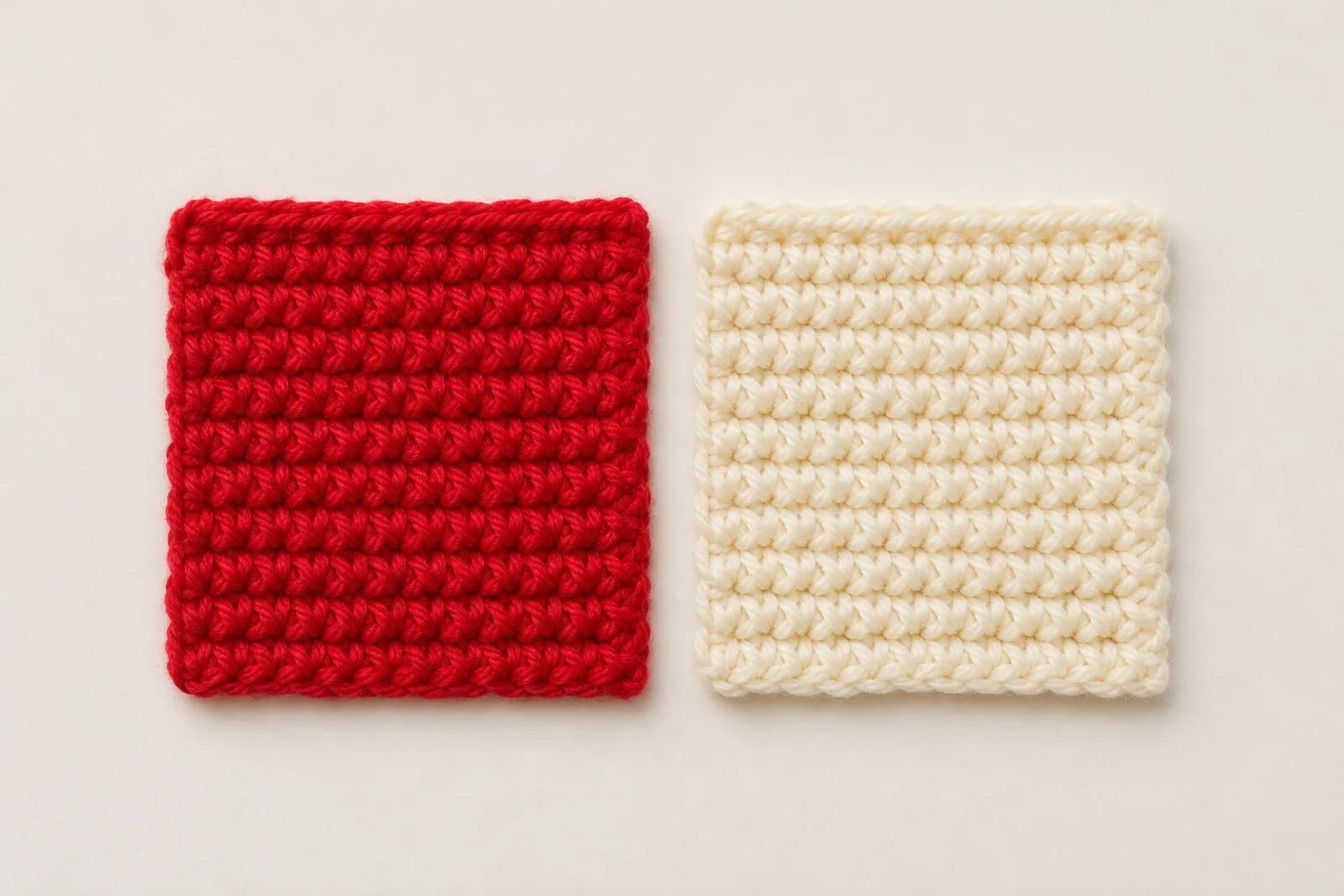
Test red yarn before it touches white or cream: one guide ranks bold dark colors such as red, blue and black as the highest bleed risk. Soak a swatch in lukewarm water for at least 20 minutes, then look at the water and the white; the same guide rates acrylic lower risk than cotton, and a pass is not a promise. Before I use a red yarn next to a white or cream one, I wet a small swatch and look at the water and the white. The best yarn for granny squares guide has the full test, and care information goes with a gift.

A small red crochet swatch beside a small cream crochet swatch of the same size A red swatch beside a cream swatch, ready for a wet test before the red touches the white.
Key Takeaways

  • Free Christmas crochet patterns sort into three sizes: small (ornaments, trees), mid-size (Santa figures, stockings, hats) and large (blankets, sweaters).
  • Decide whether a piece is for the tree, the mantel or the couch first, because the place sets the size and the size sets how much you can finish.
  • Give every ornament a hanger, such as a chain loop in the same yarn; one health site advises hanging it at the top of the tree, out of children’s reach.
  • Test red yarn on a wet swatch before it touches white or cream, because one guide ranks bold red, blue and black as the highest bleed risk.
  • For a baby or very young child, guides say to embroider the eyes or use eyes that meet your country’s rules and never use buttons; this page calls no eye safe.

Frequently Asked Questions

Where can I find free Christmas crochet patterns on this site?

The holiday and seasonals pattern hub lists the site’s Christmas patterns, and the blanket, keychain, wearable and sweater categories each add one more. The hub has a tree, a lights garland, ornaments, Mrs. Claus and a character-inspired pattern, and the categories add a Santa blanket and keychain, a tree hat, baby pants and a sweater. Check the holiday patterns hub for the current list. See the sections on size and on figures above.

What are the quickest Christmas crochet projects?

Ornaments, mini trees and mini stockings are the quickest Christmas crochet projects, from under an hour to an evening. Garlands and figures take an evening to a weekend, hats and baby pants about a weekend, and blankets and sweaters several weeks. Times are rough ranges that vary with the yarn, hook and pace. The Sort Christmas Crochet by Size and Time section above has the table.

How do you hang a crochet ornament?

Hang a crochet ornament from a chain loop worked in the same yarn, a sewn yarn loop or a thin ribbon through the top stitches. One health site advises placing ornaments at the top of the tree, out of children’s reach, and attaching them firmly. Weave in the ends of any loop well. The Ornaments and How to Hang Them section above has more.

Will red yarn bleed onto white in a Christmas project?

It can: one guide ranks bold dark colors such as red as the highest bleed risk, so soak a swatch in lukewarm water for at least 20 minutes before you use it next to white. Look at the water and the white. A swatch that passes is not a promise, and the same guide rates acrylic lower risk than cotton. The Red, Green and Cream section above has more.

What should I check before making a Christmas toy for a baby?

For a Christmas toy for a baby, guides say to embroider the eyes or use eyes that meet your country’s rules, and never to use buttons. They also say to avoid small parts that can come off for children under 3, and guides differ on plastic eyes for toddlers. Rules differ by country, so check yours; this page calls no toy safe. The Eyes and Small Parts on Christmas Figures section above has more.

Portrait of Linda Davidsen

Written by

Linda Davidsen

Designer & founder

Linda has been crocheting for over 15 years and designs cozy, beginner-friendly patterns that anyone can finish in a weekend.

Keep reading

All posts