🧶 Yarn Calculator

Try

Visit our Etsy Shops

Pick a shop to browse. Each one opens on Etsy in a new tab.

Beginner

Amigurumi Ball

Crochet a firm amigurumi ball in any size, from 1 inch around to 8 inches around and beyond, with one simple pattern. Free pattern with printable PDF.

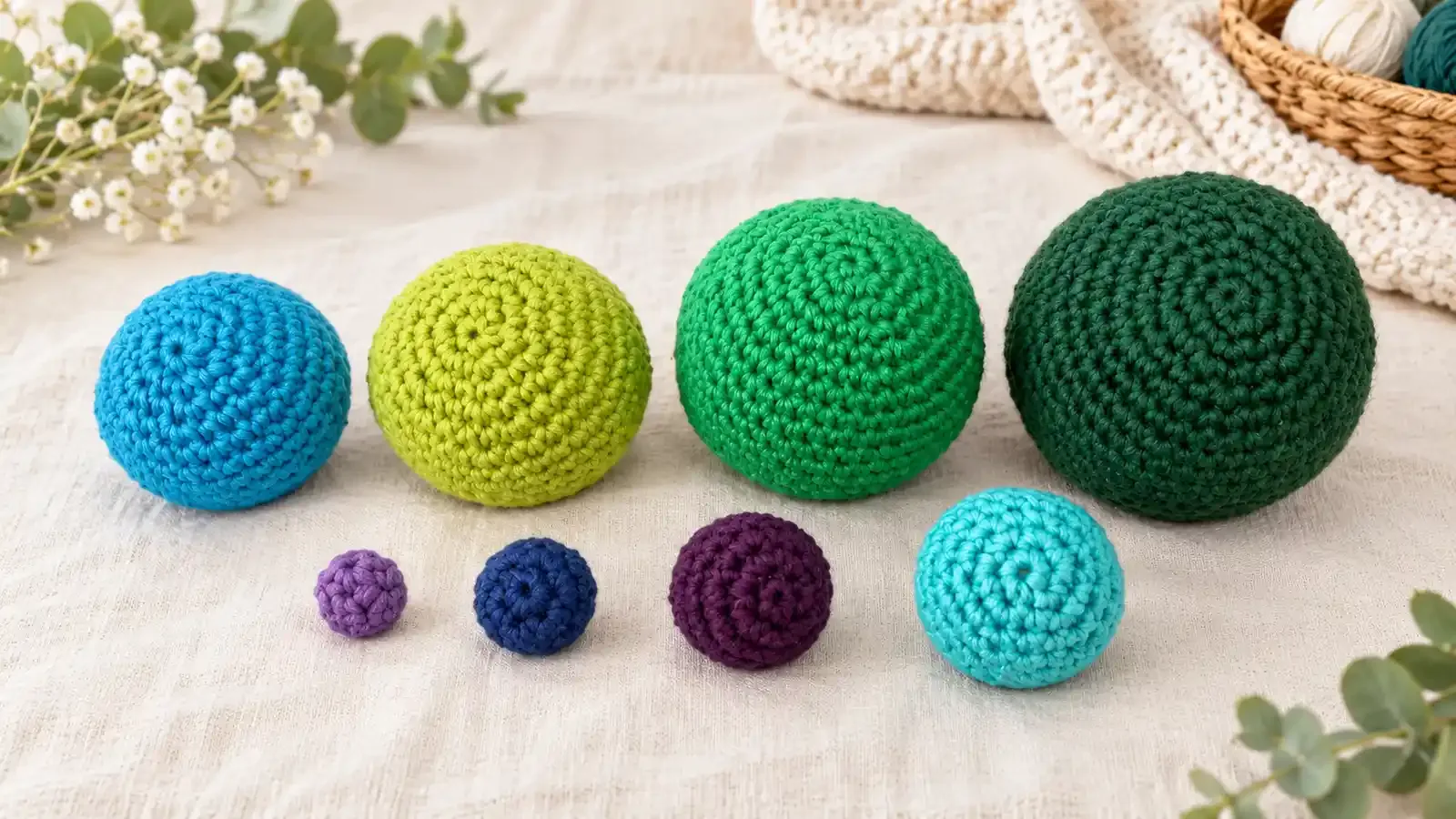
Eight crochet balls in graduated sizes on a cream linen cloth, four larger balls in blue, lime, green and dark green above four smaller ones in purple, navy, plum and aqua, with eucalyptus, small white flowers and a basket of yarn around them
Skill level
Beginner
Time
30 minutes – 2 hours
Yarn weight
Firm cotton, DK weight (PaintBox DK cotton for the samples)
Hook size
3.5 mm

Amigurumi Ball is a free crochet pattern for Beginner crocheters, and one pattern makes a smooth, firm ball in almost any size, from a tiny one inch bead to an eight inch play ball and beyond. The balls in the photos grow from about 2.5 cm to 20 cm around, and every one of them follows the same simple idea, so once you have made one you can make any size you like. It is a handy skill for toys, baubles, beads and doll heads.

Each ball is built from a circle section at the top, the same number of plain middle rows, and a matching circle section at the bottom. You work in spirals from a magic ring with only increases and decreases, and there is no stepping up at the end of a round. The maths behind the shape is explained in the pattern, but you do not need to follow it to make a ball, and the first eight sizes are written out in full so you can simply start crocheting.

The pattern is written in UK terms, where dc is the US single crochet, and the size of your ball depends on your yarn and hook, so you measure a small sample first as the pattern shows. Choose a firm cotton for the neatest sphere; the best yarn for amigurumi guide and the crochet hook size chart will help you pick. For safe materials when making play balls, read the guide to crochet toys and games, or browse more Toys & Games crochet patterns.

Using a different yarn? Estimate how many skeins with our free yarn substitution calculator.

Why You'll Love This Pattern

  • One pattern makes ball after ball in different sizes, from about 1 inch around up to 8 inches around and beyond, so you never need a second pattern.
  • The rounds are simple spirals worked with only increases and decreases, so there is no joining, no stepping up and very little to remember once you get going.
  • It is a good way to use up leftover yarn, as long as the yarn is a firm one that gives you a dense, even fabric.
  • A chart and a few simple sums show how much yarn a ball needs and how big a ball your own yarn will make, which takes the guesswork out of planning.
  • The same ball can become a toy, a bauble, a bead or the head of a doll, so one skill gives you plenty of different projects to make.
  • Every row lists its stitch count, so you can check your work as you go and finish with a smooth, round shape.

Get Creative With It!

Make a Soft Ball for Little Ones

Work a larger ball in firm cotton for a toddler or young child, close the last round tightly and stitch it up well so little fingers cannot get at the stuffing.

Turn Them Into Christmas Baubles

Use shading yarns, change colour every row, or put a colour pattern in the plain middle section, which is a good place for one, to make festive baubles.

Stack Three Sizes for a Snowman

Make two or three balls in different sizes and add a few felt or crochet extras to turn them into a cheerful snowman for a shelf or table.

Use Small Balls as Beads

Small balls in pretty or sparkly yarns make a graduated necklace, or cover wood or plastic beads with crochet instead of stuffing them.

Use a Ball as a Head or Body

Balls make good heads for dolls or animals, and a ball with extra middle rows becomes an oval body for a toy.

Add Them to a Toy Collection

Make a few balls in matching colours to go with the Fruit Stacking Toy or the Baby Dino Toy (Blue) for a handmade playroom set.

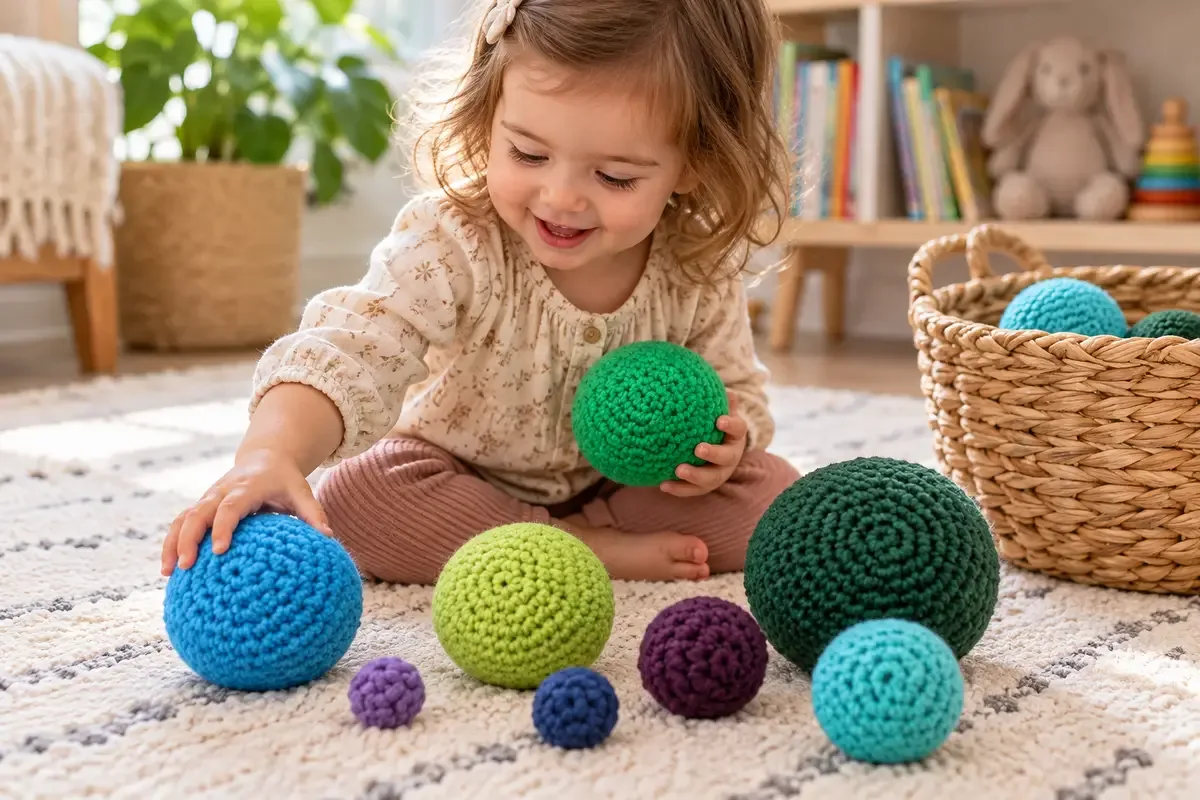
Smiling toddler sitting on a cream rug, touching a blue crochet ball and holding a green one, with lime, dark green, aqua, purple, navy and plum balls laid out on the rug beside a wicker basket

Perfect For

  • Scrap yarn lovers who want a quick, satisfying project that turns leftover firm yarn into smooth round balls
  • Soft play balls for toddlers to roll, carry and toss gently around the playroom, made in firm cotton
  • Handmade Christmas baubles in shading yarns or colourful stripes to hang on the tree or give as gifts
  • Snowman makers who want to stack two or three crochet balls in different sizes for a seasonal display
  • Crochet beads and necklaces made from tiny balls in sparkly or colourful yarns, or crocheted over wood beads
  • Doll and toy makers who need a neat round head or an oval body for their next amigurumi
  • Amigurumi beginners and cotton yarn fans who want to practise spirals, increases and decreases on a simple shape

The Pattern

Verified by the CrochetsPatterns.com team

Your progress0 of 36 steps · 0%

Tap each step as you finish it. Your progress is saved on this device.

What You'll Need:

0/6

Abbreviations Used:

  • dc – double crochet, (what the US calls sc)
  • dec – decrease, work two stitches together, dc two together (US, sc two together). Either pull one loop through each of the next two stitches so you have three loops on the hook and then finish them off together, or do an invisible decrease.

Notes & Tips Before You Start:

0/2

Method

  • Read this next part if you are interested in how this pattern works. If you don’t care and just want to make a ball, go on to ‘Top Section’.
  • You do not need to understand this bit of maths to make the balls.
  • The basis of this pattern is that a crochet dc stitch (US, sc, but I’m saying dc here) is more-or-less square, that is it is the same width as it is high – so you could make a square with five stitches and five rows, or any number of stitches and the same number of rows.
  • To make a ball, you need a circle (more or less) at the top and bottom, which will be pulled into a curved shape by the flat repeated rows around the middle – I know, it sounds wrong, but the way crochet stitches move against each other on the rows, it does work. To make the circle section, you can use the standard six-stitches in a magic ring and increase six evenly all around each row until you have the circumference you need for your ball (the circumference is the measurement all the way around the widest part of the ball – for example, the distance around the Equator is the circumference of the Earth). If you increase in the same place every time, you get a hexagon – it will still make a sphere, but it’s not quite as neat as if you offset the increases, so for the rows with even numbers of stitches between increases I offset the place by half – you’ll see how that goes when you read through the pattern. You then get more-or-less a circle.
  • In any case, the number of stitches is 6 times the number of rows you have done, since you start with six and increase six each time.
  • So, you have a circle with a number of stitches in the last row, which is its circumference. Call that X. You will need there to be the same total number of rows around the ball, so that it has the same distance around it from every direction. Since half of the rows will be on one side, and half on the other, you need half as many rows in total as the number of stitches in the last row of the circle section.
  • There will be another circle section at the top, decreasing in the same way as the increases. So, you have a number of rows you’ve done to get to the end of the circle section, and there will be the same number at the top. Call that Y.
  • Here’s the maths.
  • There are X stitches in the last row. It took Y rows to get here. Z is the number of rows we will need between the circle sections to make the ball the right height.
  • X = 6Y (because of the increases)
  • 2Y + Z = half of X = 3Y
  • Z = 3Y – 2Y = Y
  • So however many rows we have in our base circle section, we need that many rows without shaping, just one stitch in each stitch, to make the finished ball the same height as it is wide!

Top Section Note

0/1

Top Section: Rows 1-8

0/8

Middle Section

0/1

Bottom Section Note

0/1

Bottom Section: Rows 8-1

0/8

Stuffing

0/1

The Other 7 Smallest Sizes

0/1

Larger Sizes

0/7

Choosing the Size of Your Ball

  • To work out how to make a ball the size you want, you need to know the size of the stitch you get from your yarn with the hook you are using. I do this by making a little sample of crochet about 15 stitches wide and ten rows high (because I feel the first few rows may be distorted by the chain at the beginning). Measure the width of six of the stitches in the middle (ish) of the last row. This is your Unit Measurement. One stitch is a sixth of this, but the measurement you just took is the one you need because all the ball circumferences are a multiple of six stitches.
  • Note: if you want to work out how much yarn you need for your ball, or how large a ball you can make with the yarn you have, you will also want to weigh this sample or measure the amount of yarn it took (when you undo it to reuse the yarn). It has 150 stitches.
  • You can make the circumference of your ball any multiple of your unit size (or you can change that size, see later).
  • Each size of ball has a circumference of the Unit Measurement multiplied by the number of rows in the top circle section.
  • I get a Unit Measurement very close to 2.5 (two and a half) cm, near enough one inch, with PaintBox DK cotton and a 3.5mm hook. So if I wanted a ball with a 6 inch (15cm) circumference, I would need a six-row circle ball with this yarn.
  • However, if I wanted a ball with a 5.5 (five and a half) inch, 14cm, circumference, I couldn’t do it with that yarn and hook – I would have to try perhaps a smaller hook to get 2.33 (two and a third) cm, about nine tenths of an inch, for a six row, or a different yarn, perhaps a thicker one, to get 2.8 cm, one-and a tenth inches and do a five-row ball.
  • The balls here are all six-row and are made with Catania (a sport weight) and a 2.5mm hook, the PaintBox DK and PaintBox cotton Aran with a 4mm hook. The Unit Measurement for Catania is about 2cm, 8/10 of an inch, and for the Aran is about 3cm, one and a fifth (1.2) inches, so the three balls have circumferences of roughly 12cm, 15cm, 18cm (4.8ins, 6ins, 7.2ins) in that order.

How Much Yarn / How Big a Ball From My Yarn

  • You may want to know how much yarn you need for a ball, or how big a ball you can make from whatever amount of yarn you have left from a previous project. To do this, you need to know either the weight or the length of yarn needed for (say) 100 stitches in your yarn. So make a trial piece 10 stitches by 10 rows (or similar), and either weigh it or undo it and measure how much yarn it took. If you’ve done the 15 x 10 piece above to try out the size of the stitches, take two-thirds of your result for that (because that was 150 stitches).
  • Now, each ball has 6 stitches in the first row, 2x6 in the second row, 3x6 in the third etc. up to Nx6, then has N rows of N x 6 stitches where N is the number of rows which defines the size of the ball, so that is NxNx6 stitches. Plus of course the same size circle section at the base.
  • So we need to add up all the stitches in the top section, multiply by two (so we have the bottom section as well) and add the number in the middle. I’ve done this for you on a chart for the first 12 sizes – if you are doing a bigger ball, you’ll need to do the maths to add on to this. I do it by adding six to the number in the row, then adding that to the last circle size, then doing the rest of the sum. Don’t forget to multiply the circle stitches by two as well as adding in the middle section.
  • Now, if you want to know how much yarn you need, find the number of stitches, round up to the next hundred and divide by your weight or length measurement (see the first paragraph of this section) – that’s roughly your answer. I’d have a bit more to allow for error in the original result.
  • Alternatively, if you want to know how big a ball you can make, divide the amount of yarn you HAVE by your weight or measurement, and you know roughly how many stitches you can make, so choose a ball size where the total is less than that number. Again, allow for errors in measurement, so choose one smaller if it’s a close fit.

Number of Stitches in a Ball

  • Number of rows in circle section | Number of stitches in one circle section (A) | Number of stitches in middle section (B) | Total number of stitches (2A+B)
  • 1 | 6 | 6 | 18
  • 2 | 18 | 24 | 60
  • 3 | 36 | 54 | 126
  • 4 | 60 | 96 | 216
  • 5 | 90 | 150 | 330
  • 6 | 126 | 216 | 468
  • 7 | 168 | 294 | 630
  • 8 | 216 | 384 | 816
  • 9 | 270 | 486 | 1026
  • 10 | 330 | 600 | 1260
  • 11 | 396 | 726 | 1518
  • 12 | 486 | 864 | 1836

Get This Pattern as a Free PDF

Ad-free, printable, and ready for your project bag. We'll also send you one new free pattern every week.

    No spam. Unsubscribe anytime.

    Amigurumi Ball: FAQ

    How long does it take to crochet an amigurumi ball?

    The PDF gives no time, so this is an estimate. A tiny ball can be done in well under an hour. The biggest of the eight full sizes has 816 stitches in total (from the PDF's chart), so it may take a couple of hours. Larger balls take longer.

    What yarn and hook do I need for the crochet Amigurumi Ball?

    The PDF recommends a firm yarn, such as a cotton, if you want a fairly accurate sphere. Use a hook to match the yarn, and one size less than the yarn usually asks for gives a firmer fabric. The samples use PaintBox DK cotton with a 3.5mm hook instead of a 4mm. You also need a large-eye needle (or a smaller hook) to finish the ends, and stuffing.

    What sizes can I make with this pattern?

    The first eight sizes are given in full. With PaintBox DK cotton and a 3.5mm hook they measure about 2.5, 5, 7.5, 10, 12.5, 15, 17.5 and 20 cm around (1, 2, 3, 4, 5, 6, 7 and 8 inches). Larger sizes follow the same rule. Your own yarn and hook change the final size, so measure a sample first, as the PDF explains in Choosing the Size of your Ball.

    Is this pattern in US or UK crochet terms?

    It is written in UK terms. The PDF uses dc for double crochet, which is what the US calls single crochet. The decrease (dec) means working two stitches together, as a dc two together (US, sc two together).

    How do I make the ball smaller or bigger?

    For smaller balls, take the first rows you want from the eight-row ball, then the same number of middle rows, then the last same number of rows from the bottom section. For larger balls, keep increasing six stitches evenly on each top row, with one more stitch between the increases each time, and work as many plain middle rows as you have rows in the top circle.

    How much yarn will I need for a ball?

    The PDF works it out from a trial piece of about 10 stitches by 10 rows. Weigh it or measure the yarn it took, then use the chart of total stitches (2A+B) for your ball size. Round the stitch total up to the next hundred and divide by your weight or length measurement. Allow a bit extra for error.

    Can I sell items made from this free crochet pattern?

    Yes. This is a free pattern for personal and commercial handmade use. You are welcome to sell the finished balls you crochet from it; credit is appreciated but not required.

    Keep stitching

    All patterns
    Beginner 8–12 hours

    Cupid Angel

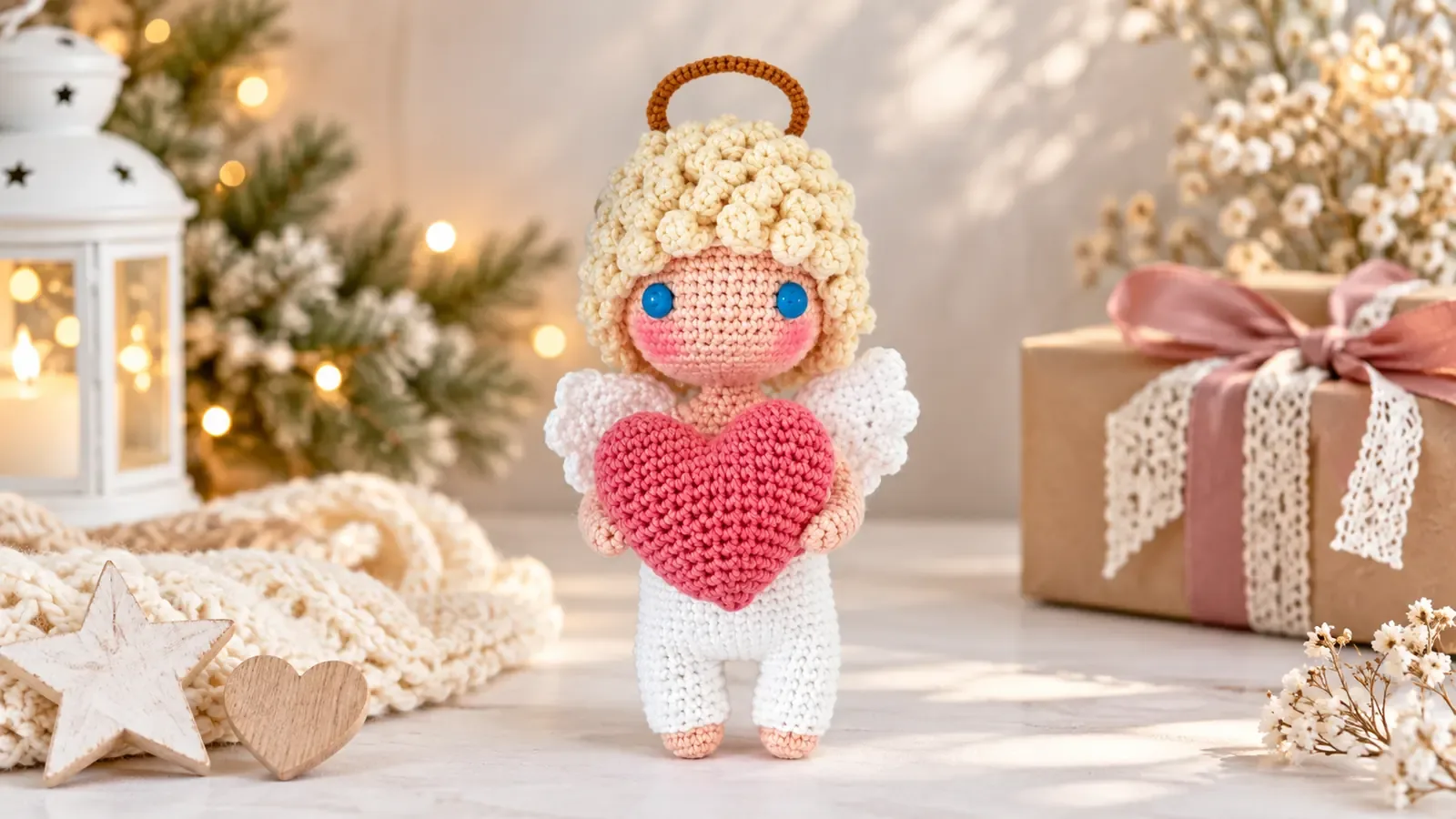
    Free Cupid Angel amigurumi crochet pattern: a 16 cm Valentine's Cupid with curly hair, wings, halo and heart, 1.5 mm hook. Free printable PDF.

    View Pattern
    Beginner 30–90 minutes per egg

    Easter Egg

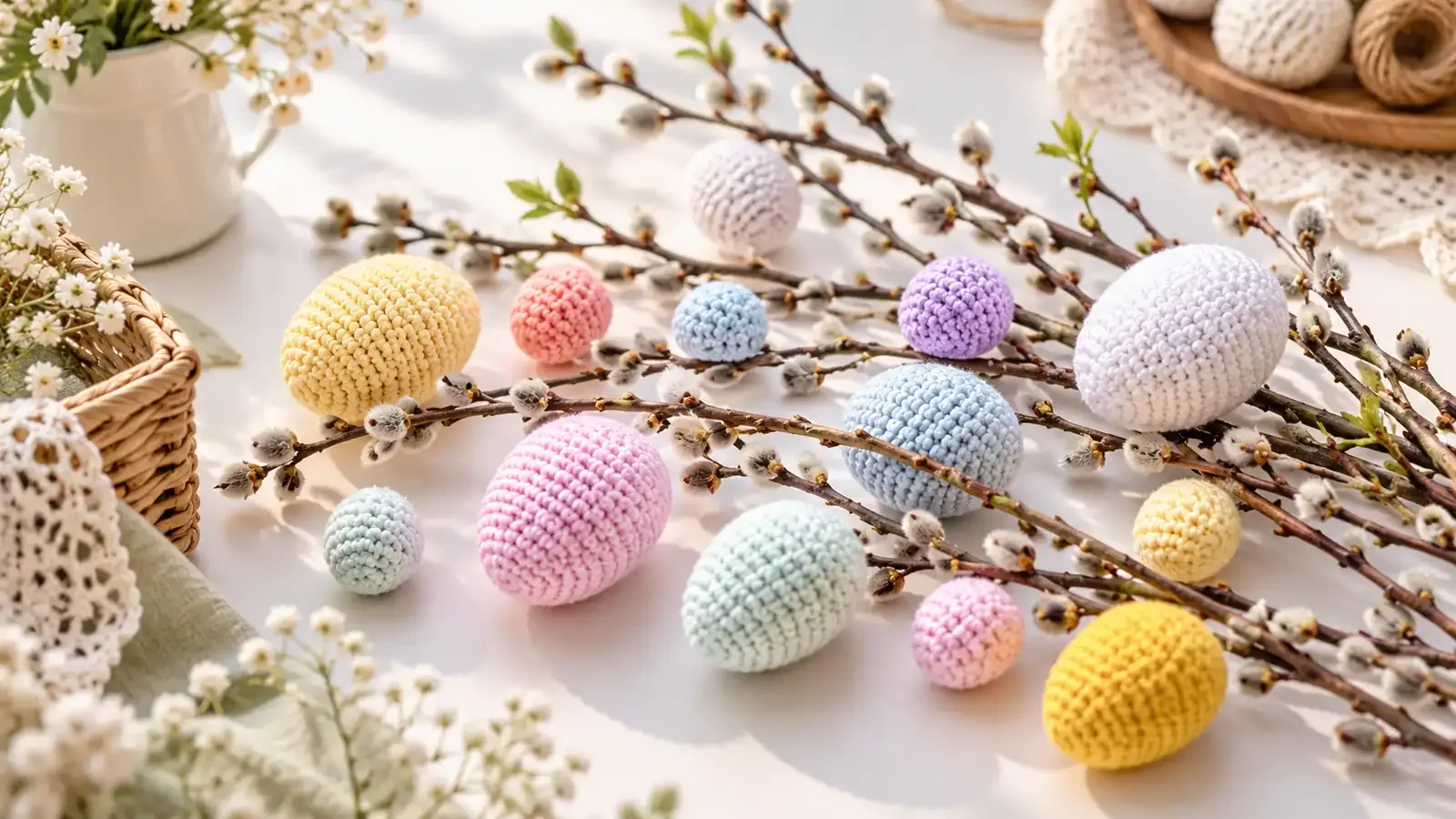
    Free Easter Egg crochet pattern: stuffed amigurumi eggs in small, medium and big sizes, about 2-6 cm, cotton yarn, 2.5 mm hook. Free printable PDF.

    View Pattern
    Portrait of Linda Davidsen

    Written by

    Linda Davidsen

    Designer & founder

    Linda has been crocheting for over 15 years and designs cozy, beginner-friendly patterns that anyone can finish in a weekend.

    This pattern is free for personal use. You're welcome to sell items you make from it; please credit CrochetsPatterns.com. See our IP rights page.