
🧶 Yarn Calculator

Try

Visit our Etsy Shops

Pick a shop to browse. Each one opens on Etsy in a new tab.

Color & Design

Color Wheel for Crochet: How to Build a Yarn Palette

Color wheel for crochet: primary, secondary and tertiary colors, neighbors and opposites, warm and cool, building a palette and swatching it.

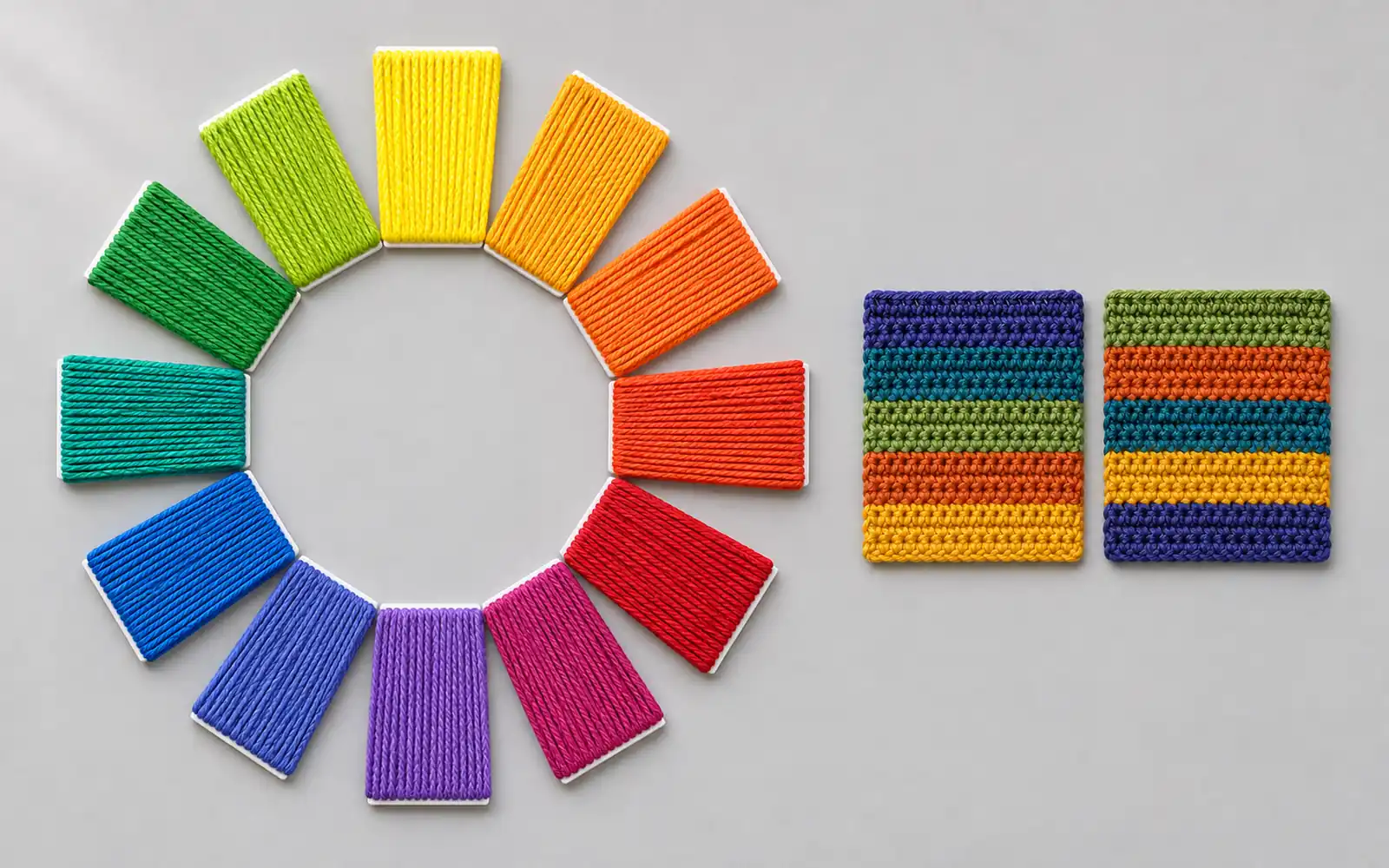
Twelve yarn wraps arranged as a color wheel beside two striped crochet swatches
Table of Contents
  1. How the Color Wheel Works
  2. How to Read the Wheel
  3. What the Wheel Leaves Out
  4. Build a Palette From a Base Color
  5. Swatch Your Palette Before You Buy
  6. A Color Wheel Blanket
  7. Key Takeaways
  8. Frequently Asked Questions

Quick answer: A color wheel for crochet is a map of how colors relate: primary, secondary and tertiary colors in a circle, with neighbors that blend and opposites that contrast. Pick a base color, add from the wheel, then swatch the palette, because the wheel shows hue but not value.

You open a color wheel chart and it shows twelve colors in a circle, but your yarn shelf has dozens. It is not clear how a flat circle helps you pick a skein. The wheel is a map, and a map only helps once you know what it shows and what it leaves out.

This guide explains the color wheel for crochet: primary, secondary and tertiary colors, neighbors and opposites, and warm and cool halves. It then shows how to build a palette from a base color, swatch it before you buy, and plan a color wheel blanket.

I pick my base color first, then I look at what sits beside it and across from it on the wheel. Those two directions give me a short list of colors to try next.

How the Color Wheel Works

A color wheel puts colors in a circle so you can see at a glance which ones sit close together and which sit far apart. The crochet color theory guide covers the color words. Two parts follow: the colors on the wheel, then which wheel.

Primary, Secondary and Tertiary Colors

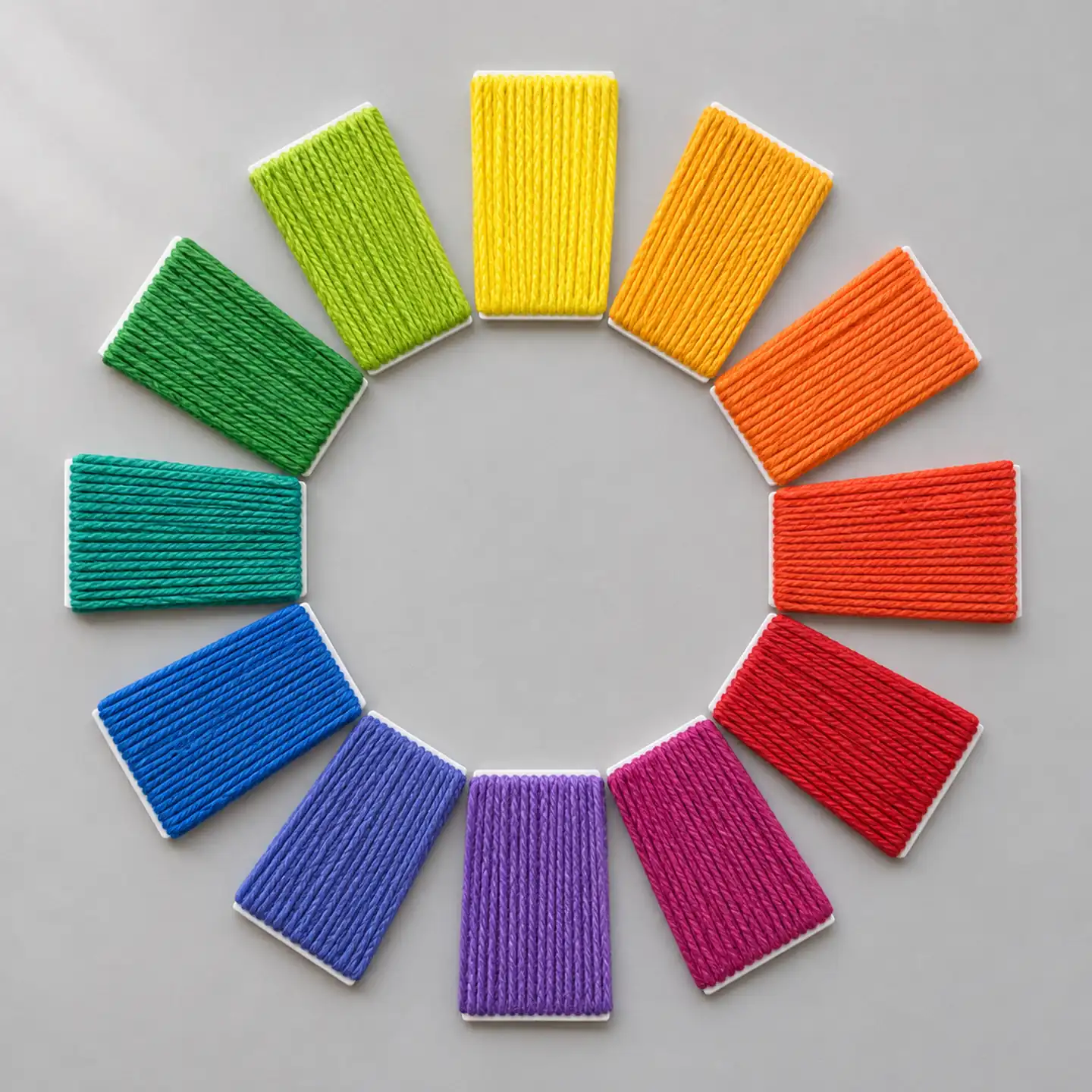
The color wheel has three primary colors (red, yellow and blue), three secondaries (orange, green and purple) and six tertiaries between them, twelve in all. A learner book says two adjacent colors combine into a secondary, and a tertiary occurs when a secondary is mixed with the nearest primary. One page draws the twelve segments with the primaries in a triangle and the secondaries in a hexagon. Yarn is not mixed like paint, so the wheel is a map of colors you can choose, not a recipe. The photo shows twelve yarn wraps in wheel order.

Twelve yarn-wrapped cards in a ring in color wheel order, a simple color wheel for crochet projects Twelve yarn wraps in wheel order: three primaries, three secondaries and six tertiaries.
Which Wheel? Red-Yellow-Blue and Rainbow Order

Crochet pages use the red-yellow-blue wheel, while screens use red, green and blue, so a wheel in an app can place opposites differently from a printed one. One reference page calls the red-yellow-blue wheel the traditional painters’ wheel, and says the first wheels were built on the seven rainbow colors: red, orange, yellow, green, blue, indigo and violet. A children’s yarn project uses a six-part wheel of the primaries and secondaries. This page uses twelve parts, and the pairs it names come from the red-yellow-blue wheel. Check which wheel a chart uses before you trust its pairs.

How to Read the Wheel

Two moves on the wheel do most of the work: a step to the side gives a color that blends, and a move straight across gives one that contrasts. The how to choose yarn colors guide names the schemes. Two parts follow: neighbors and opposites, then warm and cool.

Neighbors and Opposites

Neighbors sit next to each other on the wheel and blend, while opposites sit straight across, such as yellow and violet, and make each other stand out. A learner book gives red and green as another opposite pair, and blue sits across from orange. For neighbors, one page uses green, teal and blue, and the same book says colors next to each other combine well as long as their values differ. It adds that a project based on greens stays out of the red section but can mix in yellows and blues. An opposite pair is also called complementary.

Warm and Cool Halves

The wheel splits into a warm half of reds, oranges and yellows and a cool half of blues and greens, but every color has a warmer and a cooler version. One page lists purples as cool, while a learner book lists purple among the warm shades and violet among the cool ones, so purple can lean either way and this page does not settle it. That book gives a warm azure blue and a cold icy blue as examples, so the halves are a guide, not a wall. It adds that cool colors are generally darker in tone, and that a warm mixture needs a higher proportion of cool colors to balance it.

What the Wheel Leaves Out

The wheel shows hue only, so two colors that are perfect partners on the wheel can still look flat together. The contrasting colors in crochet guide covers the value check. Two parts follow: value and saturation, then neutrals, black and white.

Value and Saturation

The color wheel shows hue only, so two opposite colors can have the same value and look flat together even though the wheel says they contrast. Value is how light or dark a color is, and saturation is how pure it is. One page says the wheel does not show fine differences between shades and should be paired with other tools. A learner book draws each wheel segment as a hue, a shade, a tone and a tint, a reminder that every wheel color comes in lighter, darker and grayer versions. One knitting page says same-value colors side by side can vibrate. The contrast guide covers the check.

Neutrals, Black and White

Black, white, gray and tan are not on the color wheel, so a neutral is a separate choice you add to a palette. A learner book says black and white are not classified as colors; it calls black harder to see, hiding texture, and says white shows every stitch but shows dirt sooner. One page treats neutrals such as black, white, gray and tan separately from the wheel. See neutral crochet colors for palettes built on them. A neutral is a soft or plain color that sits beside the wheel colors instead of on the wheel.

Build a Palette From a Base Color

A base color gives the wheel a starting point: add neighbors for a soft palette or one opposite for punch. The choosing colors guide names the schemes in full. Two parts follow: picking the base and moving around the wheel, then giving each color a role.

Pick the Base and Move Around the Wheel

Build a palette outward from one base color: its neighbors sit one step to each side, and its opposite sits straight across. One page says to choose a favorite color first and build around it so the palette does not get chaotic, and its example swaps one neighbor for the opposite to add punch. Think about where the piece will live and who will use it, the same page adds. Step once to each side for a soft palette, or straight across when you want punch. The diagram shows a base color, its two neighbors and its opposite.

Y YO O RO R RV V BV B BG G YG Base (blue) Neighbor (blue-violet) Neighbor (blue-green) Opposite (orange) Thick outline: base · Medium outline: neighbor Dashed outline: opposite · Thin line: base to opposite
A base color, its two neighbors and its opposite.

Give the Colors Roles

Give each wheel color a role, with the base leading and the brighter opposite as the accent, so the accent does not overpower the project; one amigurumi page gives that advice, and the amigurumi color guide covers it. Another page says to decide whether one color should dominate or whether the colors should blend or contrast, then choose a layout such as stripes, blocks or a pattern. The yarn-peg page adds a warm color or two to balance a cooler palette, or leaves them out. A learner book says cool colors need a higher proportion to balance warm.

Swatch Your Palette Before You Buy

The wheel gives you a short list of colors, but only a swatch tells you whether the list works in your stitch. A swatch costs a little yarn, and a clash costs a whole project. Two parts follow: planning squares and yarn pegs, then testing the order.

Planning Squares and Yarn Pegs

Make small planning squares or wrap yarn on pegs and move them around the wheel to see how colors interact before you commit to a whole project. I crochet one small swatch for each color pair before I buy the rest of the yarn. One page moves small crocheted planning squares around a wheel, and a learner book says to crochet a few sample squares. One page’s peg method wraps each yarn on a wooden clothes peg, picks 15 colors as five sets of three and jumbles the pegs to spot clashes. A children’s project glues yarn scraps onto a six-part paper wheel.

Test the Order

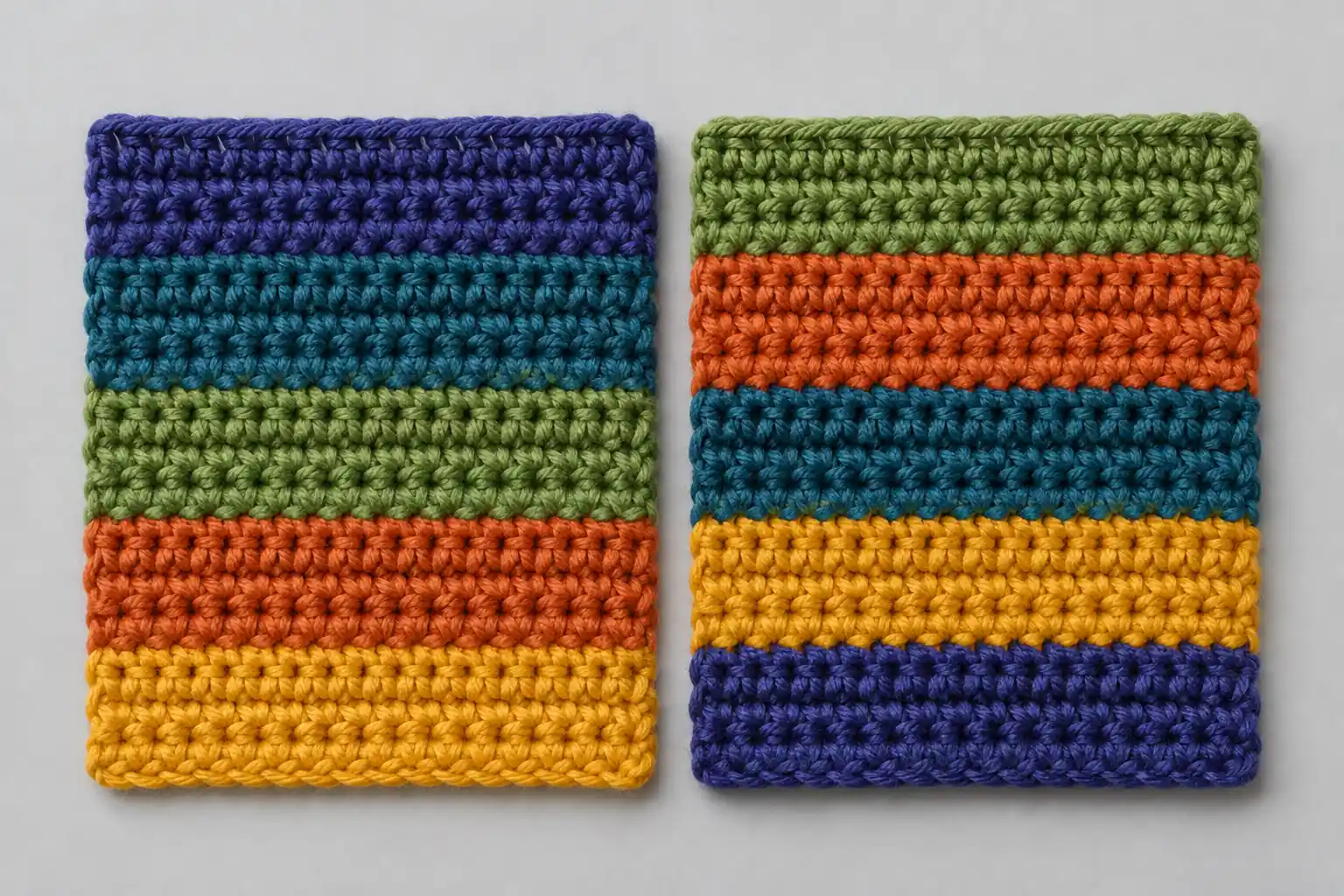
Test the order of your colors by jumbling them, because a plain rainbow order can look flatter than a stripe with lively contrasts and smooth runs. The yarn-peg page arranges the pegs as a random stripe, avoids a plain rainbow order and photographs each arrangement to revisit later. Rainbow order is red, orange, yellow, green, blue, indigo and violet in a row. Swatch the two orders you like best, since a stripe reads differently in stitches than on a peg. The photo shows the same five colors in wheel order beside a jumbled order.

Two striped crochet swatches in the same five colors, one in wheel order and one in a jumbled order The same five colors in wheel order and in a jumbled order.

A Color Wheel Blanket

A color wheel blanket turns the wheel into a project: each part of the blanket takes a color, in wheel order or in a mixed order. It can use leftover yarn as well as new skeins. Two parts follow: planning the sections, then patterns to start from.

Plan the Sections

Plan a color wheel blanket in six or twelve sections, one per wheel color, and put them in wheel order for a smooth blend or in a mixed order for a lively one. One pattern page joins motifs of about 5 in (13 cm) each in a semi-random color sequence for a rainbow effect, and says you can pick your own palette or use leftover yarn. Make sample squares first, and buy all the yarn for a project at once, because different dye lots can differ slightly in shade. See how to crochet granny squares for motifs.

Patterns to Start From

Any blanket pattern can take a color wheel palette, because patterns label the yarns A, B and C and you choose which wheel color each letter becomes. One guide names the colors A, B, C and D and gives a color sequence, and a learner book’s throw pattern says to use its tones as shown or any three shades that coordinate with your own scheme. Pick the wheel colors first, then give each one a letter. Browse blankets and throws for more.

Try the Rainbow Afghan, the Boho Rainbow Baby Blanket or the Granny Square Blanket.

Key Takeaways

  • The red-yellow-blue wheel has three primaries, three secondaries and six tertiaries, twelve colors in all, and screens use a different red, green and blue wheel.
  • Neighbors on the wheel blend and opposites contrast, such as yellow and violet, and each opposite makes the other stand out.
  • The wheel shows hue only, so opposite colors can still look flat together if their values match.
  • Start from a base color: its neighbors sit one step to each side and its opposite sits straight across.
  • Swatch the color pairs you are considering, and test the order by jumbling it.

Frequently Asked Questions

How do I use a color wheel to pick yarn colors?

To use a color wheel to pick yarn colors, start from one base color, look one step to each side for neighbors that blend or straight across for an opposite that contrasts, then swatch the pairs you like. The wheel shows hue only, so check the values too. The Build a Palette From a Base Color and Swatch Your Palette Before You Buy sections above have more.

What are primary, secondary and tertiary colors in crochet?

The primary colors are red, yellow and blue, the secondaries are orange, green and purple, and the six tertiaries sit between them. Each secondary is made by mixing two primaries, and each tertiary by mixing a secondary with the nearest primary. Yarn comes ready-colored, so the wheel is a map, not a recipe. The How the Color Wheel Works section above has more.

Do I need to buy a color wheel to choose yarn colors?

No, you do not need to buy a color wheel, because planning squares or yarn pegs let you move real colors around and test them. A children’s project glues yarn scraps onto a six-part paper wheel. The wheel shows no value or neutrals, so a swatch matters more. The Swatch Your Palette Before You Buy section above has more.

What colors are opposite on the color wheel?

On the red-yellow-blue wheel, red is opposite green, yellow is opposite violet and blue is opposite orange, and each pair makes both colors stand out. One page uses purple and yellow as an example. Wheels on screens use red, green and blue and can place opposites differently. The How the Color Wheel Works and How to Read the Wheel sections above have more.

Why do two opposite colors still look wrong together?

Two opposite colors can still look wrong together because the wheel shows hue only, and they may have the same value or be equally bright, so they look flat or vibrate. Shift one color lighter or darker, add a neutral or change the amounts, then swatch the fix. See the contrast guide. The What the Wheel Leaves Out section above has more.

Portrait of Linda Davidsen

Written by

Linda Davidsen

Designer & founder

Linda has been crocheting for over 15 years and designs cozy, beginner-friendly patterns that anyone can finish in a weekend.

Keep reading

All posts